Lewis Electron-Dot Structure Generator
Free online Lewis Electron-Dot Structure generator: get a fully labeled figure in about 90 seconds. The AI plans the must-have label list first, then renders a clean textbook-style diagram — every label editable afterwards, ready for papers, assignments and slides.
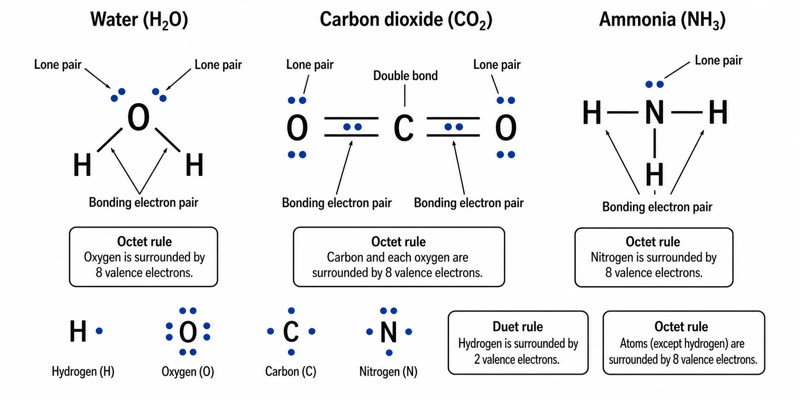
Labels included in this diagram
- Water (H2O)
- Carbon dioxide (CO2)
- Ammonia (NH3)
- Hydrogen (H)
- Oxygen (O)
- Carbon (C)
- Nitrogen (N)
- Bonding electron pair
- Lone pair
- Double bond
- Octet rule
- Duet rule
✓ Accurate labels ✓ Edit text after generation ✓ PNG for papers, posters & slides
 OUTPUT · 16:9 · PNG
What this diagram shows
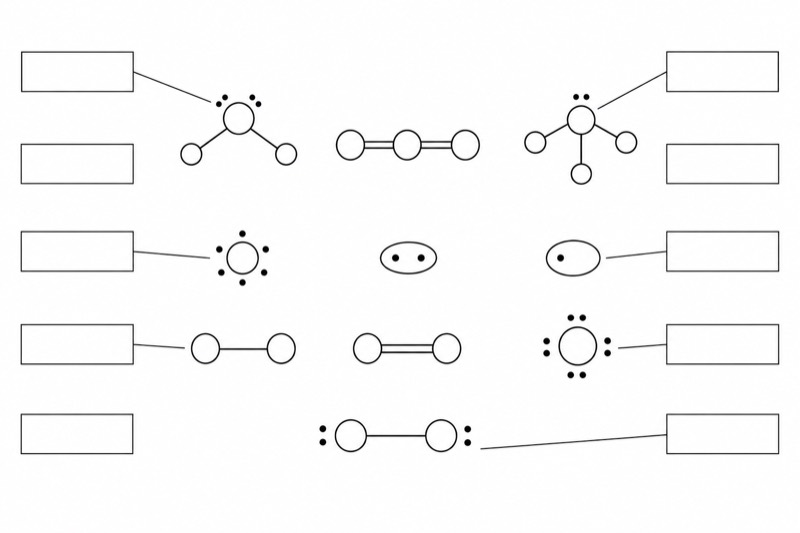
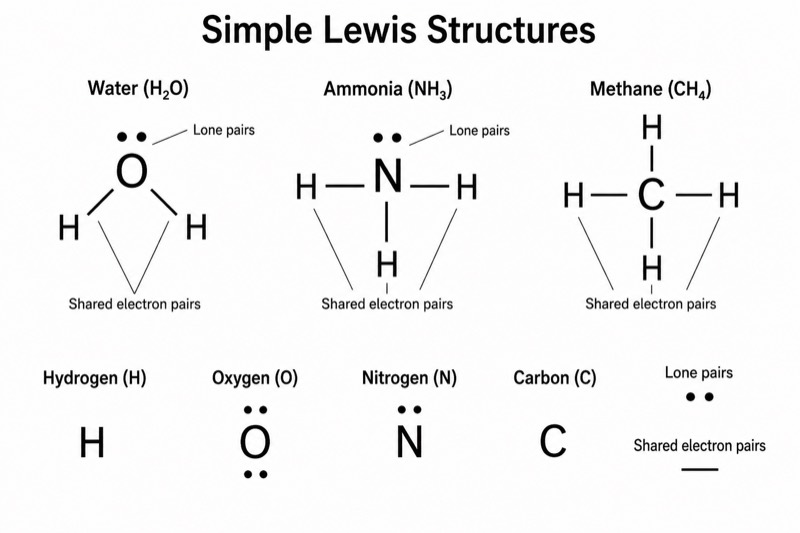
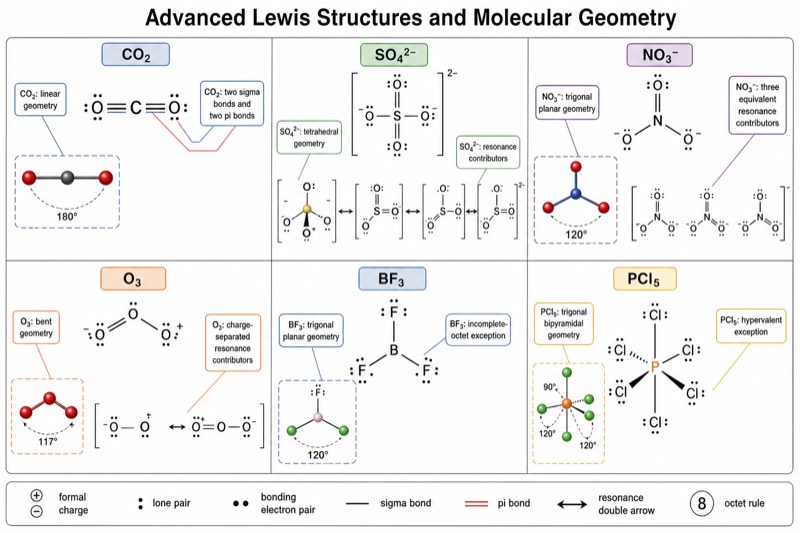
A Lewis electron structure represents valence electrons as dots and shared electron pairs as lines or paired dots. In H2O, oxygen forms two single bonds with hydrogen and retains two lone pairs. In CO2, carbon forms two double bonds, one to each oxygen; every oxygen has two lone pairs. In NH3, nitrogen forms three single bonds with hydrogen and has one lone pair. These structures show how atoms share electrons to obtain stable valence-shell configurations. Oxygen, carbon, and nitrogen generally follow the octet rule, while hydrogen follows the duet rule because its first electron shell holds only two electrons.
The drawing process begins by counting the total number of valence electrons and choosing a central atom, usually the least electronegative non-hydrogen atom. Connect surrounding atoms to the center with single bonds, then distribute the remaining electrons as lone pairs to complete terminal-atom octets. Place any leftover electrons on the central atom. If the central atom lacks an octet, convert neighboring lone pairs into multiple bonds, as required in CO2. The final structure must conserve the original electron total and should minimize formal charges. Comparing H2O, NH3, and CO2 shows how bonding pairs and lone pairs vary while electron-counting principles remain consistent.
What a correct diagram must include
- Correct element symbols: write H, C, N, and O accurately, because each symbol identifies the atom and determines its number of valence electrons.
- Complete valence-electron count: add the valence electrons from every atom before drawing so that no electrons are lost or added.
- Appropriate central atom: place O at the center of H2O, C at the center of CO2, and N at the center of NH3; hydrogen is never central.
- Bonding electron pairs: show each shared pair as a line or two dots; H2O and NH3 contain single bonds, whereas CO2 contains two double bonds.
- Lone pairs: include two lone pairs on oxygen in H2O, two on each oxygen in CO2, and one on nitrogen in NH3.
- Octet and duet completion: confirm eight electrons around C, N, and O, but only two electrons around each H atom.
- Formal-charge check: calculate formal charges when needed and prefer the structure with the smallest charge separation; all three standard structures shown here have zero formal charge on every atom.
Common mistakes
- Giving hydrogen an octet or placing it as the central atom; hydrogen forms only one bond and follows the duet rule.
- Omitting lone pairs, especially the two pairs on oxygen in H2O or the single pair on nitrogen in NH3, which changes electron count and predicted molecular shape.
- Drawing CO2 with only two single C–O bonds without showing the resulting formal charges; the preferred neutral structure is O=C=O.
- Counting a bond line as one electron instead of one shared electron pair; each single bond represents two electrons, and each double bond represents four.
Teaching tips
Use the diagram after introducing valence electrons and before teaching VSEPR theory. Ask students to count the available electrons, identify the central atom, and justify every bond and lone pair before revealing each completed structure. Then compare the electron domains around O in H2O, C in CO2, and N in NH3. Questions such as “Why does CO2 require double bonds?” and “Why does hydrogen not follow the octet rule?” connect the diagram to common assessment tasks involving electron counting, formal charge, bond order, molecular geometry, and polarity.
FAQ about this diagram
Why does CO2 have double bonds instead of single bonds?
Two single C–O bonds leave carbon without a complete octet and produce formal charges. Converting one lone pair from each oxygen into a bonding pair gives O=C=O, completes all octets, and makes every formal charge zero.
What is the difference between a bonding pair and a lone pair?
A bonding pair is shared between two atoms and is represented by a bond line or two dots between their symbols. A lone pair belongs primarily to one atom and is drawn as two dots beside that atom.
Do Lewis structures show the actual molecular shape?
Not directly; they primarily show electron connectivity, bond multiplicity, and lone pairs. The electron domains in a Lewis structure can then be interpreted with VSEPR theory to predict linear CO2, bent H2O, and trigonal-pyramidal NH3.