Molecular Structure of Benzene Generator
Free online Molecular Structure of Benzene generator: get a fully labeled figure in about 90 seconds. The AI plans the must-have label list first, then renders a clean textbook-style diagram — every label editable afterwards, ready for papers, assignments and slides.
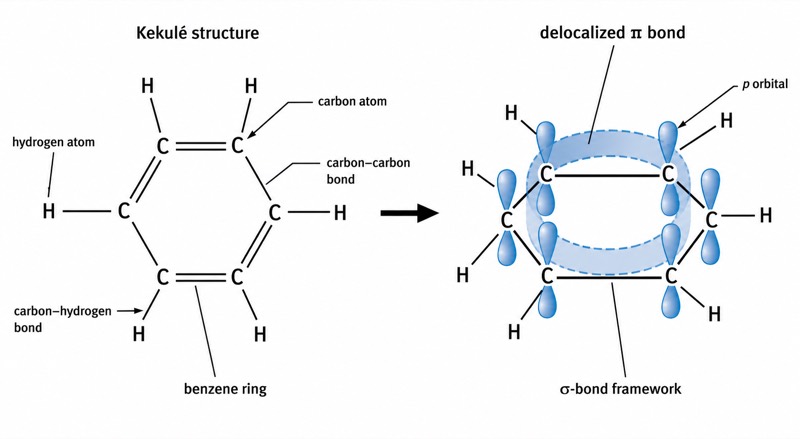
Labels included in this diagram
- Kekulé structure
- delocalized π bond
- carbon atom
- hydrogen atom
- carbon–carbon bond
- carbon–hydrogen bond
- benzene ring
- p orbital
- σ-bond framework
✓ Accurate labels ✓ Edit text after generation ✓ PNG for papers, posters & slides
 OUTPUT · 16:9 · PNG
What this diagram shows
The diagram presents two complementary representations of the molecular structure of benzene, C6H6. The Kekulé structure shows a six-membered benzene ring with alternating carbon–carbon single and double bonds, while the delocalized model shows that all six carbon–carbon bonds are equivalent. Each carbon atom is bonded to two neighboring carbon atoms and one hydrogen atom. The carbon atoms form a planar regular hexagon, and each is sp2-hybridized. This arrangement produces a strong σ-bond framework in the molecular plane and leaves one unhybridized p orbital on every carbon atom.
The six parallel p orbitals overlap sideways around the entire benzene ring, forming a delocalized π bond above and below the plane of the carbon atoms. Therefore, the π electrons are not confined to three separate carbon–carbon double bonds, even though the Kekulé structure is useful for tracking valence and reactions. Delocalization makes every carbon–carbon bond identical, with a bond length and bond order intermediate between those of typical single and double bonds. The six carbon–hydrogen bonds belong to the planar σ-bond framework and do not participate directly in the delocalized π system.
What a correct diagram must include
- Six-membered benzene ring: Draw six carbon atoms as a planar regular hexagon rather than a puckered ring.
- Kekulé structure: Show three alternating carbon–carbon single and double bonds, while recognizing that this is a simplified bonding representation.
- Carbon and hydrogen atoms: Include one hydrogen atom bonded to each carbon atom, giving the molecular formula C6H6.
- σ-bond framework: Show that each sp2-hybridized carbon forms two carbon–carbon σ bonds and one carbon–hydrogen σ bond in the same plane.
- Parallel p orbitals: Draw one unhybridized p orbital perpendicular to the ring plane on each carbon atom, with all six orbitals parallel.
- Delocalized π bond: Represent continuous electron density above and below the ring, or use a circle inside the hexagon to indicate π-electron delocalization.
- Equivalent carbon–carbon bonds: Make clear that all six carbon–carbon bonds have the same length and are intermediate between ordinary single and double bonds.
Common mistakes
- Drawing benzene as three fixed carbon–carbon double bonds without explaining that the actual π electrons are delocalized around the ring.
- Placing the p orbitals in the plane of the benzene ring instead of perpendicular to the planar σ-bond framework.
- Giving a carbon atom two hydrogen atoms or omitting a hydrogen atom, which violates the formula C6H6 and carbon valency.
- Drawing alternating short and long carbon–carbon bonds in the actual molecule, although experimental evidence shows that all six bonds are equivalent.
- Confusing the circle inside the ring with an extra atom or σ bond rather than a symbol for the delocalized six-electron π system.
Teaching tips
Use the diagram after reviewing sp2 hybridization and before introducing aromatic reactions. Ask students to count the σ bonds, identify the unhybridized p orbitals, and explain why the Kekulé structure does not predict equal carbon–carbon bond lengths. Students can compare the alternating-bond drawing with the delocalized π model and annotate the electron density above and below the ring. This supports common examination questions on molecular geometry, bond length, bond order, electron delocalization, and the greater stability of benzene compared with a hypothetical cyclohexatriene.
FAQ about this diagram
Why are all carbon–carbon bonds in benzene the same length?
The six π electrons are delocalized over all six carbon atoms rather than localized in three double bonds. Consequently, every carbon–carbon bond has the same bond order, approximately 1.5, and the same intermediate bond length.
What is the relationship between the Kekulé structure and the delocalized π-bond model?
The two Kekulé structures are contributing representations that differ only in the positions assigned to the double bonds. The real molecule is not rapidly switching between them; it has one delocalized electronic structure represented by a resonance hybrid.
How are the σ-bond framework and the π system formed?
Each sp2-hybridized carbon uses three hybrid orbitals to form two carbon–carbon σ bonds and one carbon–hydrogen σ bond. Its remaining p orbital overlaps sideways with neighboring p orbitals to create delocalized π electron density above and below the ring.