Tetrahedral Structure of a Methane Molecule Generator
Free online Tetrahedral Structure of a Methane Molecule generator: get a fully labeled figure in about 90 seconds. The AI plans the must-have label list first, then renders a clean textbook-style diagram — every label editable afterwards, ready for papers, assignments and slides.
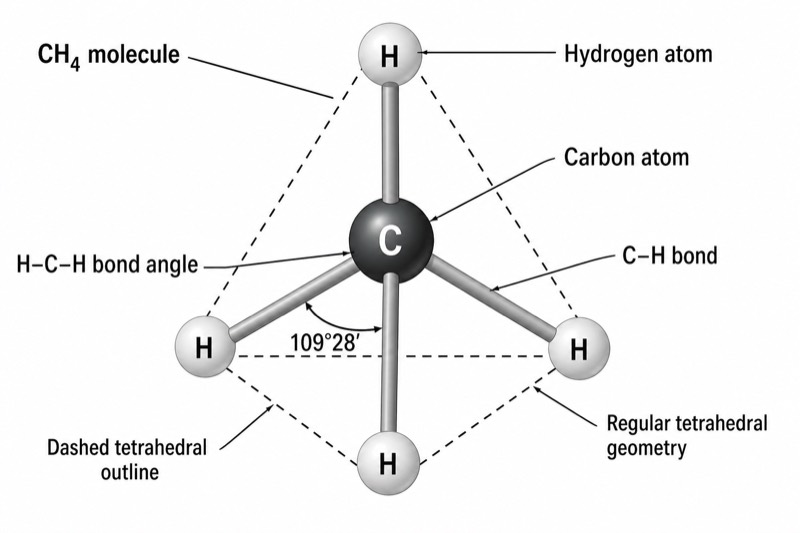
Labels included in this diagram
- CH4 molecule
- Carbon atom
- Hydrogen atom
- C–H bond
- H–C–H bond angle
- 109°28′
- Regular tetrahedral geometry
- Dashed tetrahedral outline
✓ Accurate labels ✓ Edit text after generation ✓ PNG for papers, posters & slides
 OUTPUT · 16:9 · PNG
What this diagram shows
This diagram shows the three-dimensional structure of a CH4 molecule. One carbon atom lies at the center, while four hydrogen atoms occupy the four vertices of a regular tetrahedron. Each hydrogen atom is connected to carbon by a single C–H bond. Because the four bonding directions are equivalent and spread as far apart as possible, methane has regular tetrahedral geometry. The H–C–H bond angle is 109°28′, the characteristic angle between lines drawn from the center of a regular tetrahedron to any two vertices.
The central carbon atom forms four equivalent covalent bonds by sharing one electron pair with each hydrogen atom. The ball-and-stick model represents atoms as spheres and C–H bonds as sticks, while the dashed tetrahedral outline reveals the underlying spatial arrangement. A flat drawing should use perspective so that the four hydrogen atoms do not appear to lie in one plane. The atom positions, equal C–H bonds, and identical H–C–H bond angles together explain why methane is a symmetrical, nonpolar molecule even though each C–H bond has a small bond polarity.
What a correct diagram must include
- CH4 molecule label — identify the complete model as one methane molecule containing one carbon atom and four hydrogen atoms.
- Central carbon atom — place carbon at the geometric center because it forms four equivalent single covalent bonds.
- Four hydrogen atoms — position them at the four vertices of a regular tetrahedron rather than in a square or a flat cross.
- Four C–H bonds — draw one bond from the central carbon to each hydrogen, with equal lengths in an idealized model.
- H–C–H bond angle — mark an angle between any two C–H bonds with carbon as the vertex.
- 109°28′ angle label — use the standard tetrahedral angle, approximately 109.5°, rather than 90°, 120°, or 180°.
- Regular tetrahedral geometry — state the molecular geometry clearly to distinguish methane from planar molecular structures.
- Dashed tetrahedral outline — connect the four hydrogen positions with dashed guide lines to show the imagined tetrahedral framework, not additional chemical bonds.
Common mistakes
- Drawing all four hydrogen atoms in the same plane, which incorrectly makes methane appear square planar or cross-shaped.
- Placing carbon at a tetrahedral vertex instead of at the center, even though the hydrogen atoms define the four vertices.
- Labeling the H–C–H bond angle as 90° or 120° instead of 109°28′.
- Treating the dashed tetrahedral outline as H–H bonds; these lines are only geometric guides and do not represent chemical bonds.
- Drawing unequal C–H bonds or different hydrogen environments, although all four bonds and hydrogen positions are equivalent in methane.
Teaching tips
Use the diagram after introducing covalent bonding and before comparing common molecular geometries. Ask students to count the bonding electron pairs around carbon, predict how four bonding directions arrange to minimize repulsion, and explain why a flat cross is misleading. Students can identify the central atom, trace the four C–H bonds, and locate an H–C–H angle. The figure supports examination questions on molecular shape, bond angle, three-dimensional representation, bond equivalence, and the relationship between molecular symmetry and polarity.
FAQ about this diagram
Why does methane have tetrahedral rather than square planar geometry?
Four bonding electron pairs surround the carbon atom and repel one another. A tetrahedral arrangement keeps these electron pairs farther apart than a square planar arrangement, giving methane its most stable geometry.
What does the H–C–H bond angle of 109°28′ represent?
It is the angle between any two C–H bond directions, measured at the central carbon atom. In ideal methane, all six possible H–C–H angles are equal because the molecule has regular tetrahedral symmetry.
Are the dashed lines around the tetrahedron chemical bonds?
No. The dashed tetrahedral outline is a geometric aid connecting the positions of the four hydrogen atoms. Methane contains only four C–H single covalent bonds and no H–H bonds.