Bohr Model of the Atom Generator
Free online Bohr Model of the Atom generator: get a fully labeled figure in about 90 seconds. The AI plans the must-have label list first, then renders a clean textbook-style diagram — every label editable afterwards, ready for papers, assignments and slides.
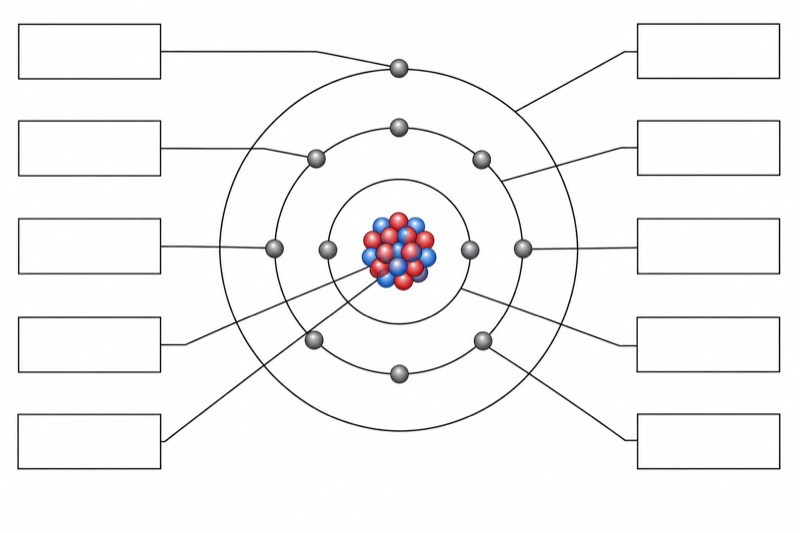
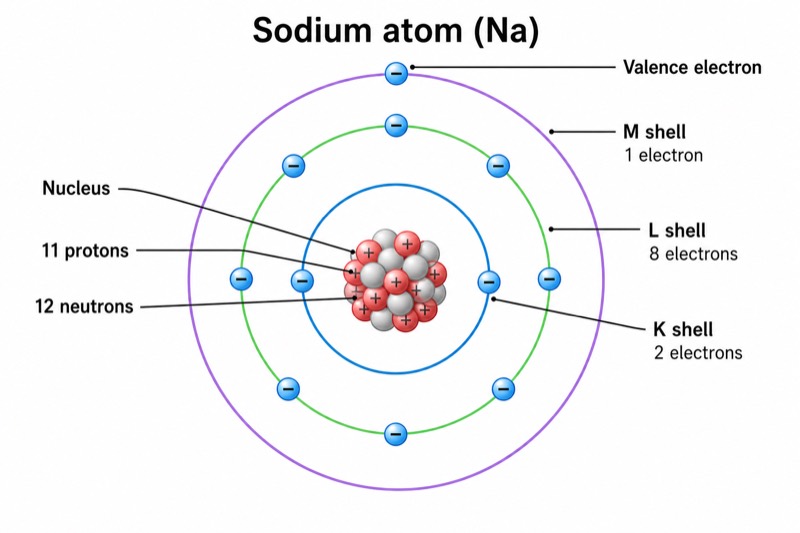
Labels included in this diagram
- Sodium atom (Na)
- Nucleus
- 11 protons
- 12 neutrons
- K shell
- 2 electrons
- L shell
- 8 electrons
- M shell
- 1 electron
- Valence electron
✓ Accurate labels ✓ Edit text after generation ✓ PNG for papers, posters & slides
 OUTPUT · 16:9 · PNG
What this diagram shows
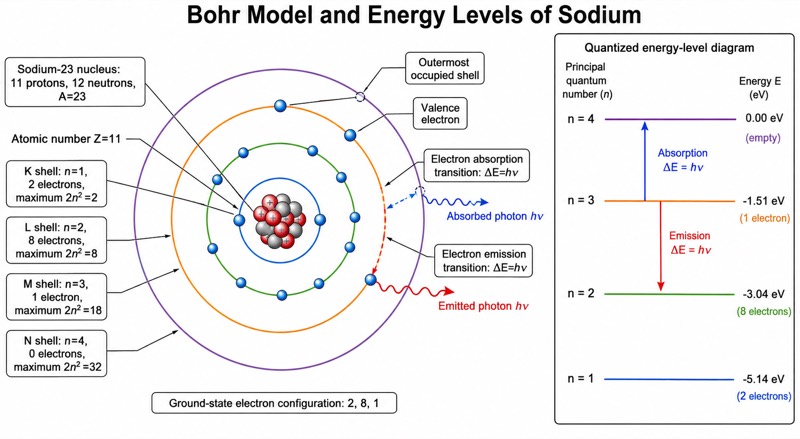
A Bohr model of a sodium atom shows a central nucleus surrounded by three concentric electron shells. For the common sodium-23 isotope, the nucleus contains 11 protons and 12 neutrons. Eleven electrons are arranged as 2 in the K shell, 8 in the L shell, and 1 in the M shell. This 2–8–1 electron configuration represents a neutral sodium atom because its number of electrons equals its number of protons. The single electron in the outermost shell is called the valence electron and largely determines sodium’s chemical behavior.
The nucleus contains nearly all the atom’s mass, while electrons occupy energy levels around it. The K shell is the first and lowest energy level, so it is filled before the L and M shells. Sodium’s electrons are therefore distributed in the order K: 2, L: 8, M: 1. The outermost M-shell electron is less strongly attracted to the nucleus than the inner electrons because it is farther away and shielded by them. Sodium can lose this valence electron to form Na⁺, leaving a stable 2–8 arrangement. The circular lines represent energy levels, not literal electron paths.
What a correct diagram must include
- Central nucleus: Draw it at the center and clearly separate it from the surrounding electron shells.
- Proton number: Label 11 protons, because sodium’s atomic number is 11 and this identifies the element.
- Neutron number: Label 12 neutrons for sodium-23; note that neutron number can differ among isotopes.
- Three concentric shells: Draw the K, L, and M shells as centered circles representing increasing energy levels.
- Correct electron arrangement: Place 2 electrons on K, 8 on L, and 1 on M, for a total of 11 electrons.
- Outermost electron: Highlight the single M-shell electron as sodium’s valence electron.
- Neutral charge relationship: Show that 11 negatively charged electrons balance the 11 positively charged protons.
- Clear shell labels: Mark the shells K, L, and M from the innermost to the outermost level without reversing their order.
Common mistakes
- Placing 11 electrons on every shell instead of distributing a total of 11 electrons as 2–8–1.
- Drawing the L or M shell before filling the lower-energy K shell, which misrepresents the shell-filling order.
- Labeling sodium as having 12 protons; sodium always has 11 protons, while the neutron number depends on the isotope.
- Showing the outer electron on the L shell instead of the M shell, which gives the wrong number of occupied energy levels.
- Treating the circular lines as exact physical orbits; in modern atomic theory, electrons are described by orbitals and probability distributions.
Teaching tips
Use the diagram after introducing atomic number, mass number, and electron shells. Ask students to calculate the numbers of protons, neutrons, and electrons before completing the model. Follow with questions such as, “Why is the electron arrangement 2–8–1?” and “Which electron is most likely to be lost?” Connect the diagram to common assessment points: identifying an element from its proton number, calculating neutrons, writing shell configurations, recognizing valence electrons, and explaining why sodium forms Na⁺ during ionic bonding.
FAQ about this diagram
Why does a neutral sodium atom have the electron arrangement 2–8–1?
Sodium has atomic number 11, so a neutral atom contains 11 electrons. The first shell holds 2, the second holds 8, and the remaining electron occupies the third shell.
Why is the outermost electron important?
The outermost electron is sodium’s only valence electron and is relatively easy to remove. Losing it produces a Na⁺ ion with the more stable shell arrangement 2–8.
Does every sodium nucleus contain 12 neutrons?
No. Every sodium atom contains 11 protons, but isotopes can have different numbers of neutrons. Sodium-23, the common stable isotope, contains 12 neutrons because 23 − 11 = 12.