Unlabeled Bohr Model Diagram (Blank Worksheet)
Unlabeled Bohr Model Diagram (Blank Worksheet) — an alternative version of the Bohr Model of the Atom, generated by AI and fully editable. Download the PNG for quizzes, homework or slides.
✓ Accurate labels ✓ Edit text after generation ✓ PNG for papers, posters & slides
 OUTPUT · 16:9 · PNG
What this diagram shows
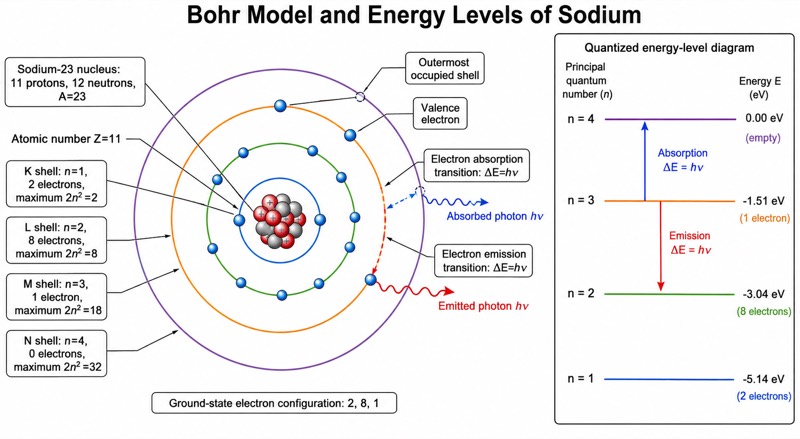
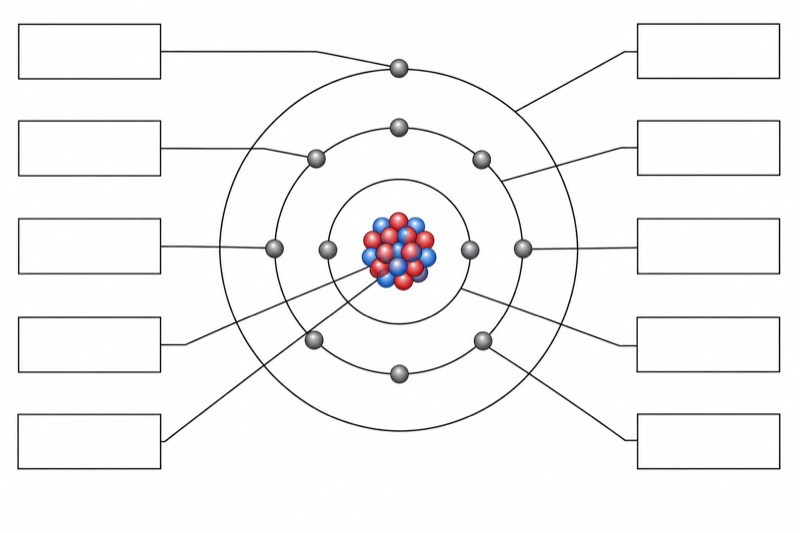
This unlabeled Bohr model diagram (blank worksheet) represents a sodium atom using a central nucleus and three concentric electron shells. The underlying structure corresponds to 11 protons, 12 neutrons, and an electron arrangement of 2, 8, 1 across the K, L, and M shells. Unlike the standard main diagram, however, it contains no words, letters, or numbers. Thin leader lines connect important features to equal-sized empty boxes outside the atom. This difference is intentional: instead of supplying information for students to read, the blank version requires them to identify and record each structure independently.
Students should first recognize the nucleus, then examine the three shells and count the electron symbols on each one. They can use the blank boxes to supply terms such as nucleus, proton, neutron, electron shell, and outermost electron, together with the appropriate particle or electron counts requested by the teacher. Because the standard labeled figure reveals these answers immediately, it is better for explanation and reference. This blank worksheet is better for retrieval practice, assessment, and checking whether students can reconstruct sodium’s Bohr model without relying on printed labels.
Teaching tips
- In-class quiz: Print the diagram without a word bank and ask students to label the nucleus, identify the three electron shells, enter the proton and neutron counts, and record the 2–8–1 electron distribution.
- Homework assignment: Pair the blank version with questions asking students to explain why sodium has one outer-shell electron and how that arrangement relates to the formation of a Na⁺ ion.
- Presentation slide: Display the unlabeled worksheet before showing the standard labeled main diagram. Invite students to complete the callouts orally or on paper, then reveal the reference version for immediate correction.
- Review outline or printed handout: Place the blank diagram beside a short checklist of required concepts. Students can complete it from memory, compare answers with notes, and mark any confusion about shells, nuclear particles, or valence electrons.
- Paper, report, or laboratory appendix: Use the clean unlabeled schematic when readers or students must annotate atomic structure themselves. A caption can identify sodium while leaving the diagram free of text for assessment, comparison, or customized labeling.
FAQ about this diagram
Why use a blank Bohr model instead of the standard labeled diagram?
The standard diagram is designed to teach or confirm the names and values, whereas the blank version tests whether students can retrieve them independently. Removing all labels also makes misconceptions visible, such as placing electrons in the nucleus or assigning sodium the wrong shell distribution.
What answers should students add to this sodium worksheet?
A complete response should identify a nucleus containing 11 protons and typically 12 neutrons, three occupied shells, and 11 electrons arranged 2, 8, and 1. Students should also recognize the single electron on the outermost shell as sodium’s valence electron.