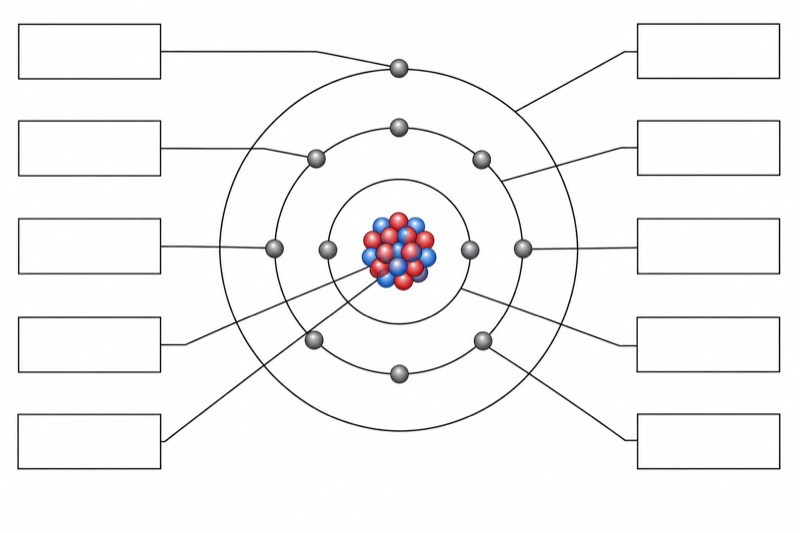
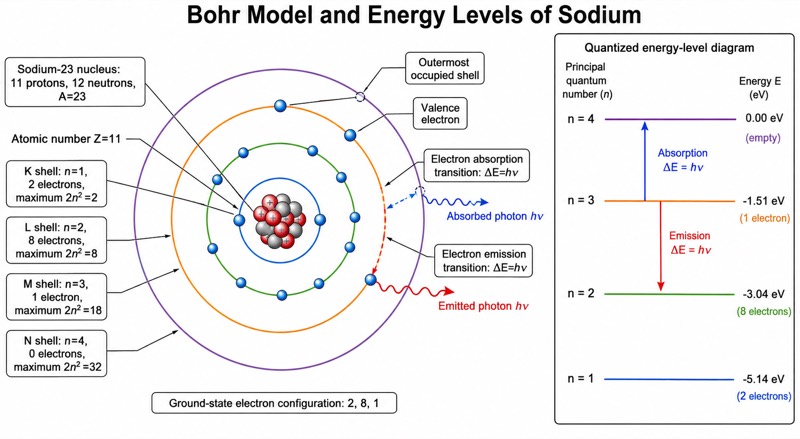
Simple Bohr Model Diagram for Middle School
Simple Bohr Model Diagram for Middle School — an alternative version of the Bohr Model of the Atom, generated by AI and fully editable. Download the PNG for quizzes, homework or slides.
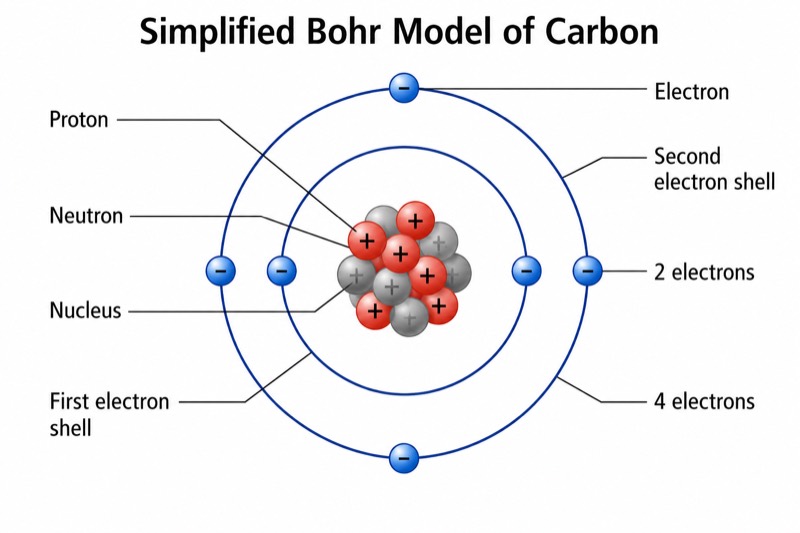
Labels included in this diagram
- Nucleus
- Proton
- Neutron
- Electron
- First electron shell
- Second electron shell
- 2 electrons
- 4 electrons
✓ Accurate labels ✓ Edit text after generation ✓ PNG for papers, posters & slides
 OUTPUT · 16:9 · PNG
What this diagram shows
This simple Bohr model diagram for middle school uses carbon as a clear example. The nucleus contains labeled protons and neutrons, while two concentric shells hold 2 and 4 electrons. Unlike a standard main diagram, this version removes energy values, orbital notation, electron motion, atomic scale, and other advanced details. Large labels, bright colors, balanced spacing, and generous white space keep attention on the three essential structures: nucleus, shells, and electrons. This reduced version is useful because younger learners can identify the basic parts before studying exceptions or more accurate atomic models.
Read the diagram from the center outward. First locate the nucleus and count six protons, which identify the atom as carbon; the neutrons represent nuclear mass but do not determine the element. Next, count two electrons on the first shell and four on the second, giving six electrons in a neutral atom. Compared with the standard main diagram, this classroom version emphasizes counting and shell arrangement rather than scientific precision. Use it to introduce atomic structure, model carbon electron distribution, or ask students to label, color, count, and explain each part in simple sentences.
Teaching tips
- In-class quiz: Remove the labels and ask students to identify the nucleus, protons, neutrons, electrons, and two electron shells, then verify the 2–4 electron arrangement.
- Homework: Have students copy the simplified carbon model, count each particle, and write one sentence explaining why six protons make the atom carbon.
- Presentation slide: Display the diagram while introducing atomic structure, revealing the nucleus first and then the two shells so students process one basic feature at a time.
- Review outline or printed handout: Place the diagram beside a short vocabulary list and let students annotate particle charges, locations, and the total number of electrons.
- School report illustration: Use it when a paper needs a clean conceptual picture of carbon, while noting that the simplified Bohr model is a teaching representation rather than a modern quantum description.
FAQ about this diagram
Why does this version show only two electron shells?
Carbon has six electrons: two fill the first shell and four occupy the second shell in the simplified Bohr arrangement. Limiting the picture to these shells makes electron counting easier and avoids details that belong in a standard or more advanced diagram.
Is this simplified diagram scientifically accurate?
It is accurate for teaching basic particle counts and introductory shell arrangement, but electrons do not actually travel on fixed circular paths. This version is used instead of the standard main diagram when clarity, large labels, and rapid recognition are more important than a complete quantum-mechanical explanation.