Detailed Bohr Model Diagram (University Level)
Detailed Bohr Model Diagram (University Level) — an alternative version of the Bohr Model of the Atom, generated by AI and fully editable. Download the PNG for quizzes, homework or slides.
Labels included in this diagram
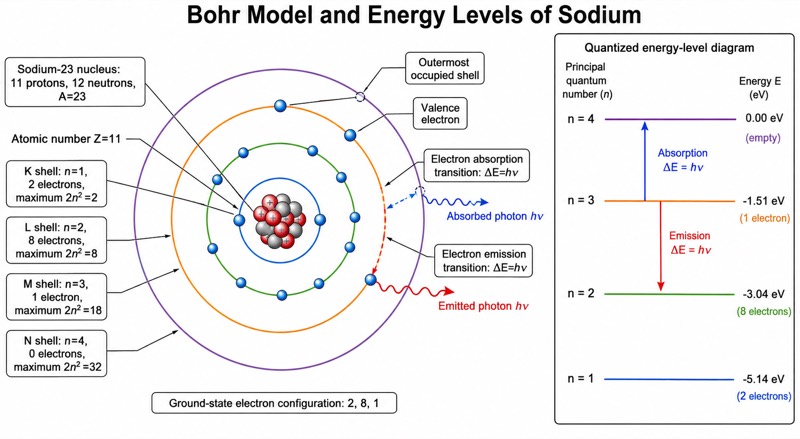
- Sodium-23 nucleus: 11 protons, 12 neutrons, A=23
- Atomic number Z=11
- K shell: n=1, 2 electrons, maximum 2n^2=2
- L shell: n=2, 8 electrons, maximum 2n^2=8
- M shell: n=3, 1 electron, maximum 2n^2=18
- N shell: n=4, 0 electrons, maximum 2n^2=32
- Ground-state electron configuration: 2, 8, 1
- Outermost occupied shell
- Valence electron
- Electron absorption transition: Delta E=hv
- Electron emission transition: Delta E=hv
- Absorbed photon hv
- Emitted photon hv
- Quantized energy-level diagram
✓ Accurate labels ✓ Edit text after generation ✓ PNG for papers, posters & slides
 OUTPUT · 16:9 · PNG
What this diagram shows
This detailed Bohr model diagram (university level) uses sodium-23 to show more than twelve labeled structures and relationships. Unlike the standard main diagram, which usually presents only the nucleus and the 2–8–1 electron arrangement, this version identifies 11 protons, 12 neutrons, atomic number 11, and mass number 23. It also distinguishes the K, L, M, and N shells as principal quantum levels n = 1–4, states each shell’s maximum capacity using 2n², and identifies the outermost occupied shell, valence electron, electron transitions, photons, and a parallel energy-level representation.
Read the concentric-shell view from the nucleus outward: sodium has 2 electrons in K, 8 in L, 1 in M, and none in N in its ground-state Bohr arrangement. Compare these occupancies with the theoretical capacities 2, 8, 18, and 32 calculated from 2n². Then follow the transition arrows: upward movement represents photon absorption, while downward movement represents photon emission with energy hν = ΔE. The adjacent energy-level diagram translates orbital spacing into discrete energies. This expanded version is preferable when learners must connect a familiar Bohr picture with quantum numbers, spectroscopy, and valence behavior rather than merely count electrons.
Teaching tips
- In-class quiz: remove selected labels and ask students to restore the proton number, neutron number, mass number, shell names, principal quantum numbers, occupancies, and maximum capacities. Use the standard main diagram for basic recall and this detailed version for reasoning about why sodium is written 2–8–1 rather than 2–8–18.
- Homework: have students calculate each shell’s 2n² capacity, compare capacity with actual occupancy, identify the M-shell electron as the valence electron, and predict formation of Na⁺ by loss of that electron. The expanded diagram is useful because all quantities can be checked within one coordinated figure.
- Lecture slides: first display the standard main figure to introduce concentric shells, then reveal this university-level version to connect K/L/M/N notation with n = 1/2/3/4, photon absorption and emission, ΔE = hν, and the parallel energy-level scheme.
- Review outline or printed handout: use the labeled figure as a compact reference for nuclear composition, electron configuration, valence, shell capacity, and quantized transitions. Print a second unlabeled copy so students can practice reconstructing the relationships without crossing or ambiguous leader lines.
- Academic report or paper illustration: use the detailed variant when a historical or pedagogical discussion requires a clearly labeled Bohr representation of sodium. The caption should state that the circular paths are model conventions, not modern quantum-mechanical electron trajectories, and should identify sodium-23 as the isotope shown.
FAQ about this diagram
Why does the diagram include an empty N shell if sodium has only 11 electrons?
The N shell is included to extend the sequence through n = 4 and to distinguish possible shell capacity from ground-state occupancy. For sodium, the shell populations are 2, 8, 1, and 0, whereas the corresponding 2n² capacities are 2, 8, 18, and 32.
Is this detailed Bohr diagram a fully accurate quantum-mechanical model of sodium?
No. It is a structured teaching model that correctly emphasizes nuclear composition, discrete energies, valence electrons, and photon-mediated transitions, but electrons do not travel in fixed circular paths in modern quantum mechanics. For advanced work, pair this version with orbital notation, the configuration 1s² 2s² 2p⁶ 3s¹, and probability-based atomic orbitals.