Simple Lewis Structure Diagram for Middle School
Simple Lewis Structure Diagram for Middle School — an alternative version of the Lewis Electron-Dot Structure, generated by AI and fully editable. Download the PNG for quizzes, homework or slides.
Labels included in this diagram
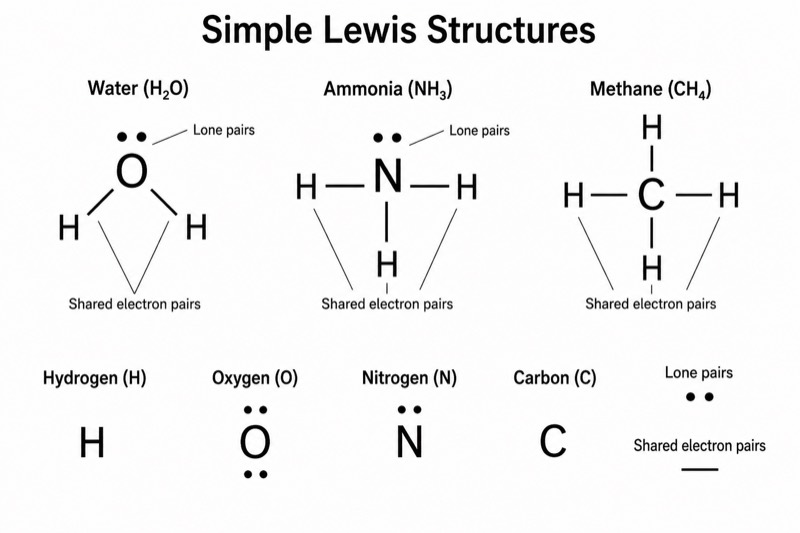
- Water (H2O)
- Ammonia (NH3)
- Methane (CH4)
- Hydrogen (H)
- Oxygen (O)
- Nitrogen (N)
- Carbon (C)
- Lone pairs
- Shared electron pairs
✓ Accurate labels ✓ Edit text after generation ✓ PNG for papers, posters & slides
 OUTPUT · 16:9 · PNG
What this diagram shows
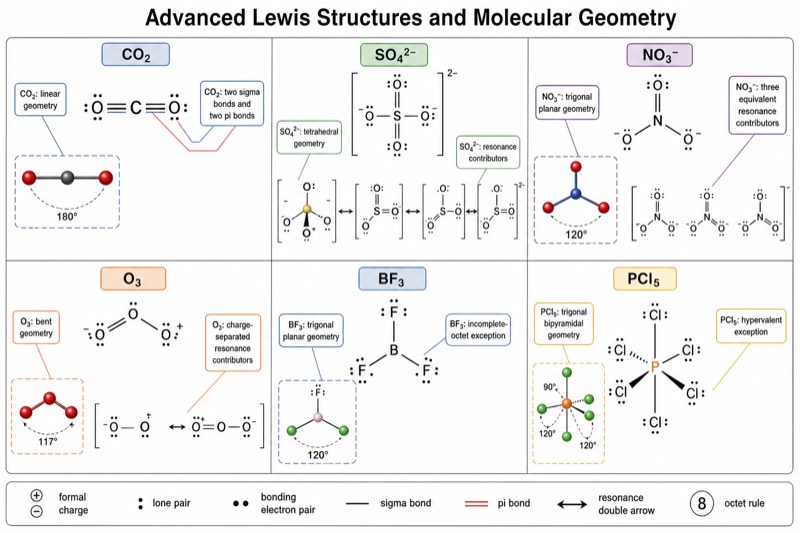
This simplified diagram shows only three basic Lewis structures: H2O, NH3, and CH4. Large element symbols identify each atom, short lines represent shared electron pairs, and dots show lone pairs. Unlike the standard main diagram, this version leaves out multiple bonds, ions, formal charges, resonance, and octet-rule exceptions. Its limited content is intentional: students can focus on the essential difference between bonding pairs and lone pairs without being distracted by advanced notation. The balanced layout and generous white space make it especially suitable for upper-elementary and middle-school chemistry lessons.
Read each short line as one shared pair of electrons forming a single covalent bond. In H2O, oxygen has two O-H bonds and two lone pairs; in NH3, nitrogen has three N-H bonds and one lone pair; in CH4, carbon has four C-H bonds and no lone pairs. Teachers can use this simple Lewis structure diagram for middle school to compare how central atoms arrange their valence electrons. Because it is less detailed than the standard main diagram, it works best for first exposure, quick recognition, and basic electron-counting practice rather than advanced structure analysis.
Teaching tips
- In-class quiz: Display the three structures without molecule names and ask students to identify H2O, NH3, and CH4, then count bonds and lone pairs.
- Homework practice: Have students copy each structure, label every shared electron pair and lone pair, and explain why hydrogen forms only one bond.
- Presentation slide: Use the simplified page before introducing the standard main diagram, so students first master single bonds and lone pairs without charges or resonance.
- Review outline or printed handout: Place the diagram beside a short table listing the central atom, number of bonds, and number of lone pairs for rapid comparison.
- Student paper illustration: Use it when a report needs a clear introductory example of Lewis notation; choose the standard diagram instead if the discussion includes formal charge, multiple bonds, or exceptions to the octet rule.
FAQ about this diagram
Why does this version include only H2O, NH3, and CH4?
These molecules demonstrate the most basic patterns around common central atoms: two bonds and two lone pairs, three bonds and one lone pair, and four bonds with no lone pairs. The smaller set reduces visual load, unlike the standard main diagram, which may include more structures and advanced cases.
Can this simplified diagram replace a complete Lewis structure reference?
No. It is designed for introductory recognition, electron-pair counting, and single-bond practice, while a standard reference is needed for ions, formal charges, double or triple bonds, resonance, and octet exceptions. Use this version first because its simplicity makes the basic notation easier to learn.