Detailed Lewis Structure Diagram (University Level)
Detailed Lewis Structure Diagram (University Level) — an alternative version of the Lewis Electron-Dot Structure, generated by AI and fully editable. Download the PNG for quizzes, homework or slides.
Labels included in this diagram
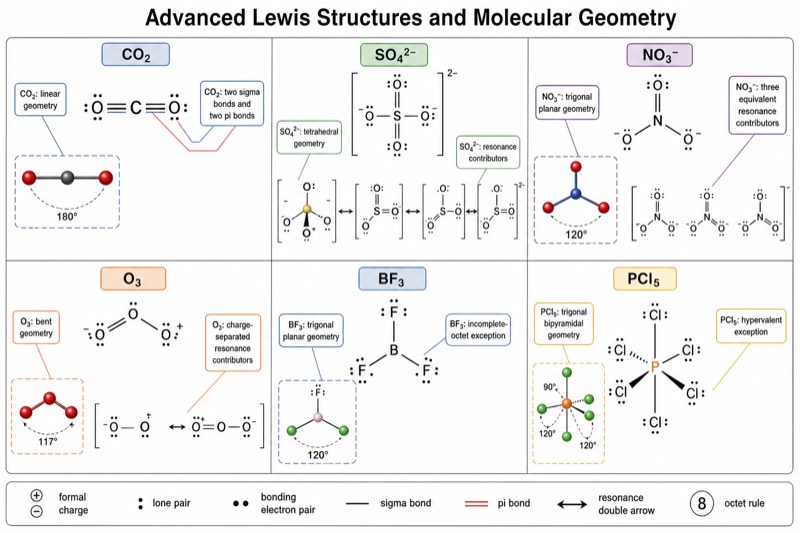
- CO2: linear geometry
- CO2: two sigma bonds and two pi bonds
- SO4^2-: tetrahedral geometry
- SO4^2-: resonance contributors
- NO3^-: trigonal planar geometry
- NO3^-: three equivalent resonance contributors
- O3: bent geometry
- O3: charge-separated resonance contributors
- BF3: trigonal planar geometry
- BF3: incomplete-octet exception
- PCl5: trigonal bipyramidal geometry
- PCl5: hypervalent exception
- formal charge
- lone pair
- bonding electron pair
- sigma bond
- pi bond
- resonance double arrow
- octet rule
✓ Accurate labels ✓ Edit text after generation ✓ PNG for papers, posters & slides
 OUTPUT · 16:9 · PNG
What this diagram shows
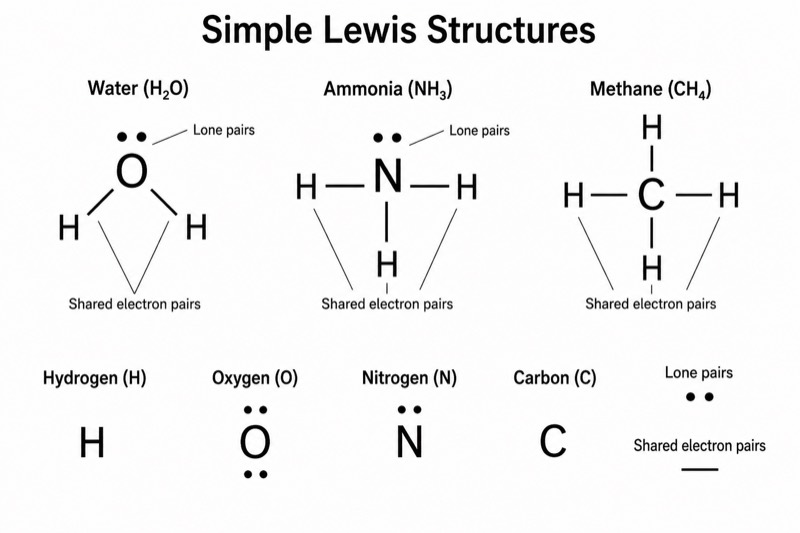
This detailed Lewis structure diagram (university level) extends the standard overview of H2O, CO2, and NH3 into a set of more than twelve complete structures and resonance contributors. CO2, SO4^2−, NO3^−, O3, BF3, and PCl5 are examined with formal charges, lone pairs, bonding pairs, σ and π bonds, resonance arrows, and VSEPR geometries. Unlike the standard main diagram, which teaches symbol placement and the octet rule, this version emphasizes electron accounting, equivalent resonance forms, delocalization, incomplete octets, and hypervalent main-group compounds.
Read each example by first counting valence electrons, then checking bonds, lone pairs, and the sum of formal charges. Compare resonance contributors connected by double-headed arrows; these are alternative electron distributions, not rapidly changing molecular shapes. Next, relate electron domains to VSEPR predictions: linear CO2, trigonal planar NO3^− and BF3, bent O3, tetrahedral SO4^2−, and trigonal bipyramidal PCl5. Use this version when the standard main diagram is too introductory, especially when students must justify charge placement, distinguish σ from π bonding, or explain departures from the octet rule.
Teaching tips
- In-class quiz — hide the formal-charge labels or selected lone pairs and ask students to complete the structures, verify the total charge, and identify octet-rule exceptions.
- Homework — require students to reproduce every resonance contributor for NO3^−, O3, and SO4^2−, calculate formal charges, and explain why the resonance hybrid is not a single contributor.
- Lecture slides — place the standard H2O–CO2–NH3 diagram first, then use this expanded version to introduce delocalized π bonding, formal-charge minimization, BF3 electron deficiency, and PCl5 hypervalency.
- Review outline or printed handout — use the twelve-plus structures as a comparison table for electron-domain count, molecular geometry, bond type, formal charge, resonance, and compliance with the octet rule.
- Paper, laboratory report, or thesis figure — use the rigorous labels and noncrossing leader lines as a reference when discussing molecular connectivity or electron distribution, while noting that Lewis structures do not replace measured geometry or quantum-chemical bonding analysis.
FAQ about this diagram
Why use this university-level version instead of the standard Lewis structure diagram?
The standard diagram is best for learning bonding pairs, lone pairs, element symbols, and the octet rule in simple molecules. This version is needed when formal charge, resonance contributors, σ and π bonding, VSEPR geometry, electron-deficient BF3, and hypervalent PCl5 must be analyzed together.
Do the resonance arrows show that atoms or bonds move back and forth?
No. A double-headed resonance arrow connects contributors that retain the same atomic framework but differ in electron placement; the actual species is a resonance hybrid. For NO3^− and O3, delocalization produces bond orders and bond lengths intermediate between idealized single and double bonds.