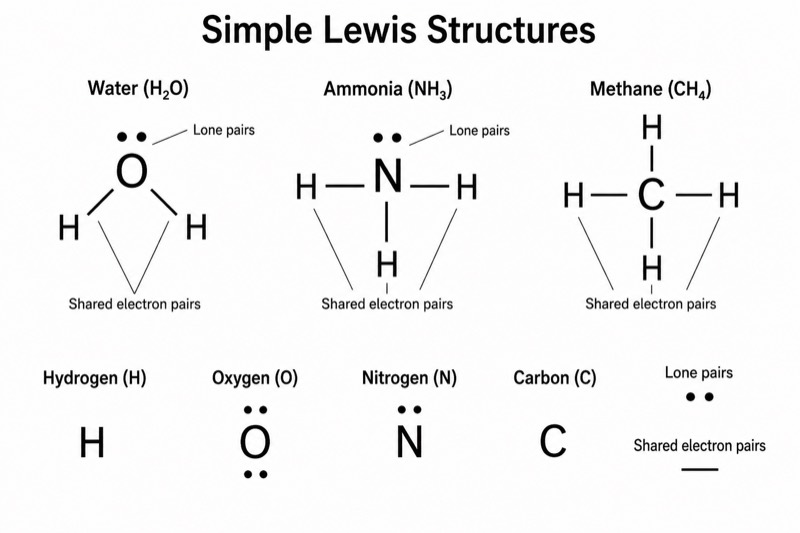
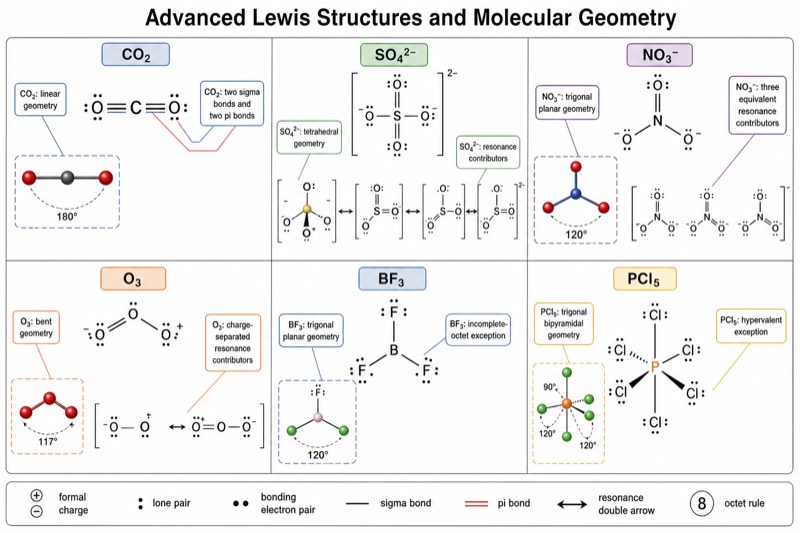
Unlabeled Lewis Structure Diagram (Blank Worksheet)
Unlabeled Lewis Structure Diagram (Blank Worksheet) — an alternative version of the Lewis Electron-Dot Structure, generated by AI and fully editable. Download the PNG for quizzes, homework or slides.
✓ Accurate labels ✓ Edit text after generation ✓ PNG for papers, posters & slides
 OUTPUT · 16:9 · PNG
What this diagram shows
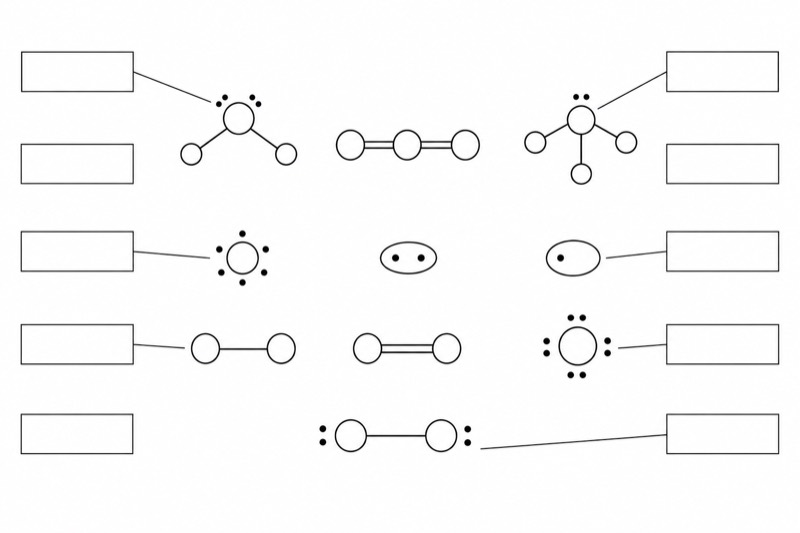
This unlabeled Lewis structure diagram presents blank, scaffolded representations of water, carbon dioxide, and ammonia. Unlike the standard main diagram, it contains no printed words, element symbols, letters, numbers, or completed annotations. Thin leader lines connect structural features to evenly arranged empty rectangular boxes outside each molecule. Students must supply the missing element symbols and identify bonding pairs, lone pairs, and octet-rule features. This difference is intentional: the standard version explains the concepts directly, whereas this blank worksheet version requires students to retrieve and apply them independently.
Use the page by asking students to complete each molecular structure and then fill the blank callout boxes by hand. They should determine the central atom, place the surrounding atoms, count valence electrons, add bonds, and distribute remaining electrons as lone pairs. Students can then check whether carbon, nitrogen, and oxygen achieve octets and whether hydrogen achieves a duet. Searching for an “unlabeled Lewis structure diagram (blank worksheet)” usually reflects this assessment purpose: it provides visual guidance without revealing answers, making misconceptions about electron counting, bonding pairs, or lone-pair placement easier to diagnose.
Teaching tips
- In-class quiz: print one copy per student and require learners to complete the three structures without notes, label bonding and lone pairs in the empty boxes, and justify octet or duet completion.
- Homework practice: assign water first, ammonia second, and carbon dioxide last so students progress from single bonds and lone pairs to a structure containing double bonds.
- Presentation activity: project the blank page, invite students to add one electron pair or label at a time, and pause after each step to discuss total valence-electron counts.
- Review outline or printed handout: place the blank worksheet beside a short checklist covering valence electrons, central-atom choice, bond formation, lone-pair distribution, and octet verification.
- Report or paper figure: use the clean, text-free diagram as an assessment example, then explain in the caption that the empty callouts are intended for learner-generated annotations rather than supplied labels.
FAQ about this diagram
How does this blank worksheet differ from a standard labeled Lewis structure diagram?
A standard diagram identifies atoms, bonding pairs, lone pairs, and octet-rule relationships for the reader. This version removes all printed answers and replaces labels with empty callout boxes, so it tests recall, electron counting, and structural reasoning rather than recognition.
What should students enter in the blank boxes?
Depending on the leader line, students should add an element symbol or identify a bonding pair, lone pair, or octet-rule feature. Their completed structures should show two O–H bonds and two oxygen lone pairs in water, two C=O double bonds in carbon dioxide, and three N–H bonds plus one nitrogen lone pair in ammonia.