Syntax Tree Diagram Generator
Free online Syntax Tree Diagram generator: get a fully labeled figure in about 90 seconds. The AI plans the must-have label list first, then renders a clean textbook-style diagram — every label editable afterwards, ready for papers, assignments and slides.
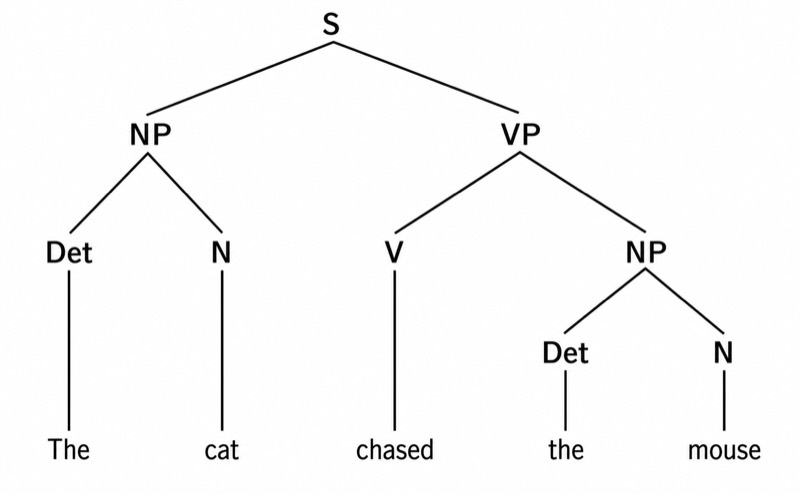
Labels included in this diagram
- S
- NP
- VP
- Det
- N
- V
- The
- cat
- chased
- the
- mouse
✓ Accurate labels ✓ Edit text after generation ✓ PNG for papers, posters & slides
 OUTPUT · 16:9 · PNG
What this diagram shows
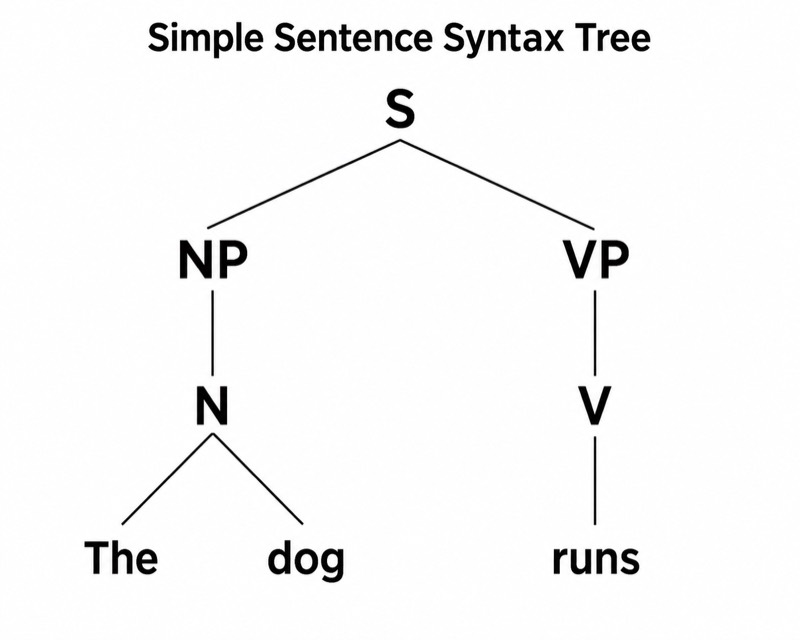
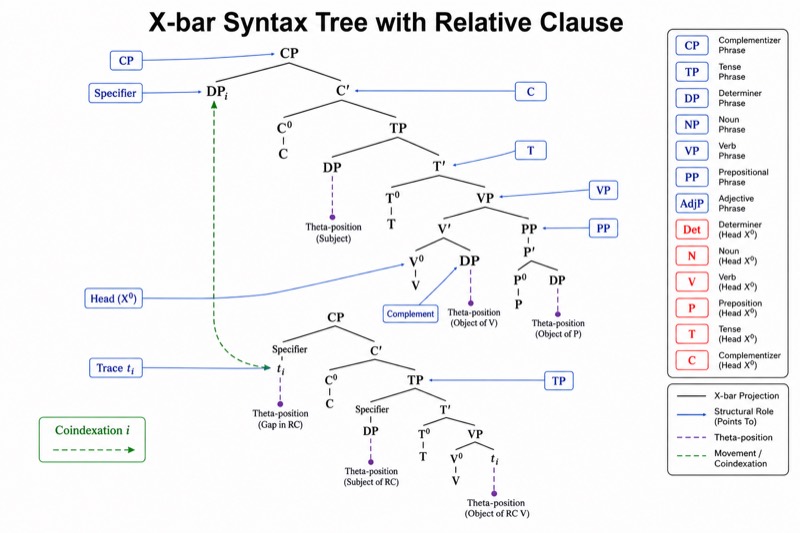
A syntax tree diagram represents the hierarchical constituent structure of an English sentence in generative grammar. Rather than showing words in a simple left-to-right sequence, it shows how smaller units combine to form larger phrases. In a basic sentence such as “The student reads books,” the highest node is S, or Sentence. S divides into an NP, “The student,” and a VP, “reads books.” The NP contains a Det and an N, while the VP contains a V and an object NP. The inverted branching structure makes grammatical constituency visible: words are terminal nodes, phrases are intermediate constituents, and S is the maximal projection represented in this simplified analysis.
The diagram is built from the top down or the bottom up according to the same constituent relations. First, identify the sentence node S. Then divide S into its immediate constituents, NP and VP. Next, expand each phrase according to its internal structure: the subject NP may contain Det + N, while the VP may contain V plus another NP. Each branch must connect a parent constituent to its direct daughters, and every word must appear exactly once at the bottom. The tree therefore encodes both category labels and structural dominance. It also distinguishes linear order from hierarchical relations, showing why constituents can behave as units in grammatical operations.
What a correct diagram must include
- Root node S: Place S at the top because it represents the complete sentence in this simplified phrase-structure analysis.
- Subject NP: Draw the subject as an NP directly dominated by S, since it functions as the sentence-level nominal constituent.
- Predicate VP: Draw the VP as the second immediate constituent of S because it contains the verb and its predicate material.
- Phrase-internal labels: Use Det, N, and V consistently so that each word is assigned its appropriate lexical category.
- Binary branching: Connect each parent to its immediate constituents rather than drawing unrelated words from one common node.
- Terminal words: Put the actual sentence words at the bottom of the tree, with each word linked to exactly one category node.
- Constituent relations: Ensure that a phrase such as NP forms a complete subtree, because constituents must be structurally grouped rather than merely adjacent.
Common mistakes
- Treating the sentence as a flat list: Students often place S directly above all words, which fails to represent the NP–VP constituent division.
- Mislabeling lexical categories: A determiner such as “the” should be labeled Det, while a noun such as “student” should be labeled N; category labels must not be confused with phrase labels.
- Attaching the object incorrectly: In “The student reads books,” “books” belongs inside an object NP, which is a constituent within the VP, not a sister of S.
- Ignoring hierarchy: Linear word order alone does not show constituency; branches must indicate which nodes dominate which phrases.
- Creating incomplete or crossing branches: Every word needs a complete path to S, and branches should not cross because standard tree diagrams encode nested structure.
Teaching tips
Use the diagram after students identify parts of speech and before introducing more complex phrase markers. Ask questions such as “Which words form a constituent?”, “What are the immediate constituents of S?”, and “What does the VP dominate?” Have students build the tree from a sentence, justify every label, and compare a correct hierarchical tree with a flat analysis. The activity supports examination points involving phrase structure rules, constituent tests, category labels, dominance, and the distinction between linear order and syntactic hierarchy.
FAQ about this diagram
Why does S branch into NP and VP?
In a basic generative grammar analysis, the sentence is represented by the phrase-structure rule S → NP VP. The NP commonly expresses the subject, while the VP expresses the predicate and may contain the verb, complements, and adjuncts.
What is the difference between N and NP?
N is a lexical category referring to a noun, such as “student.” NP is a phrase category whose head is a noun and which may include a determiner, modifiers, or complements, such as “the student.”
Why are syntax trees drawn upside down?
The root is conventionally placed at the top, and branches descend toward the terminal words. This inverted layout makes dominance relations clear: a higher node structurally contains or dominates the nodes beneath it.