Simple Syntax Tree for Middle School
Simple Syntax Tree for Middle School — an alternative version of the Syntax Tree Diagram, generated by AI and fully editable. Download the PNG for quizzes, homework or slides.
Labels included in this diagram
- S
- NP
- VP
- N
- V
- The
- dog
- runs
✓ Accurate labels ✓ Edit text after generation ✓ PNG for papers, posters & slides
 OUTPUT · 16:9 · PNG
What this diagram shows
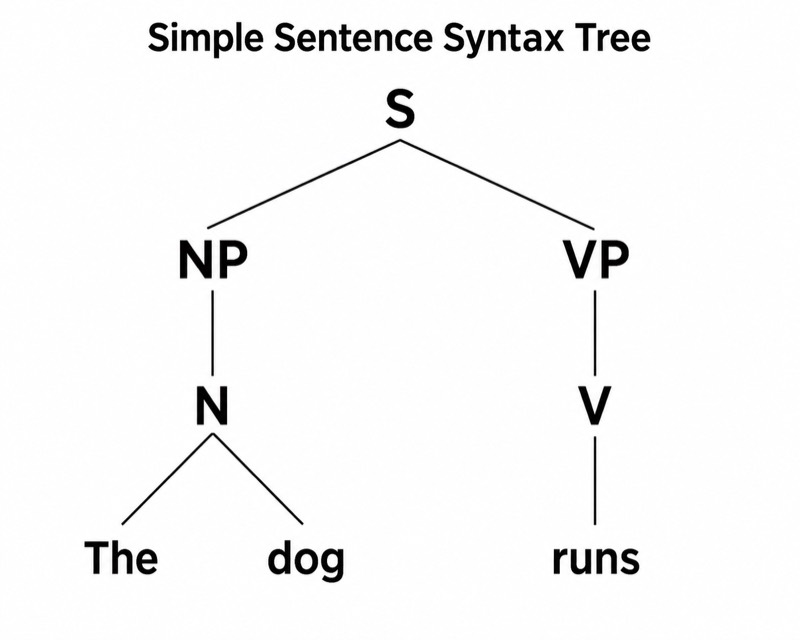
This simple syntax tree for middle school shows the sentence “The dog runs” as a clear, inverted tree. The sentence node S divides into NP for “The dog” and VP for “runs,” while N identifies the noun head “dog” and V identifies the verb “runs.” Unlike a standard syntax tree, this version omits labels such as determiner, tense, and other intermediate categories. The reduced structure helps upper-primary and middle-school learners see the central subject–predicate division before studying more detailed grammatical analysis.
Read the diagram from the top downward. Begin with S, meaning sentence, and follow its two branches to NP, the noun phrase functioning as the subject, and VP, the verb phrase functioning as the predicate. Then locate N and V to identify the main noun and verb. “The” remains inside the noun phrase but receives no separate determiner node. This deliberate simplification differs from the standard diagram: it is useful for introducing tree logic, checking basic recognition, and preventing unfamiliar terminology from distracting beginners.
Teaching tips
- In-class quiz: remove the labels S, NP, VP, N, and V from selected nodes and ask students to restore them, then explain why the sentence first divides into a subject noun phrase and a predicate verb phrase.
- Homework: provide similarly short sentences such as “Birds sing” or “The cat sleeps” and ask learners to copy the same reduced pattern. State that determiners and other details should remain unanalyzed at this stage.
- Presentation slide: display the large, symmetrical tree while introducing constituency. Reveal S first, then NP and VP, and finally N and V so students follow the hierarchy one step at a time.
- Review outline or printed handout: place the diagram beside a five-item glossary for S, NP, VP, N, and V. Use the generous white space for students to add brief notes or mark the subject and predicate.
- Paper illustration: use the simplified tree only when discussing beginner-level grammar teaching or reduced classroom notation. Add a caption explaining that standard syntactic analysis would normally include more categories, especially a determiner label for “The.”
FAQ about this diagram
Why does this tree use only S, NP, VP, N, and V?
These five labels show the most important hierarchy without introducing advanced categories. The standard main diagram is more precise, but this reduced version is better for learners who are just beginning to distinguish phrases from individual words.
Why is “The” not labeled as a determiner?
A full syntax tree would normally label “The” as a determiner and show its relationship to the noun within NP. This middle-school version intentionally omits that extra node so attention stays on the basic S-to-NP-and-VP branching pattern.