Detailed Syntax Tree (University Level)
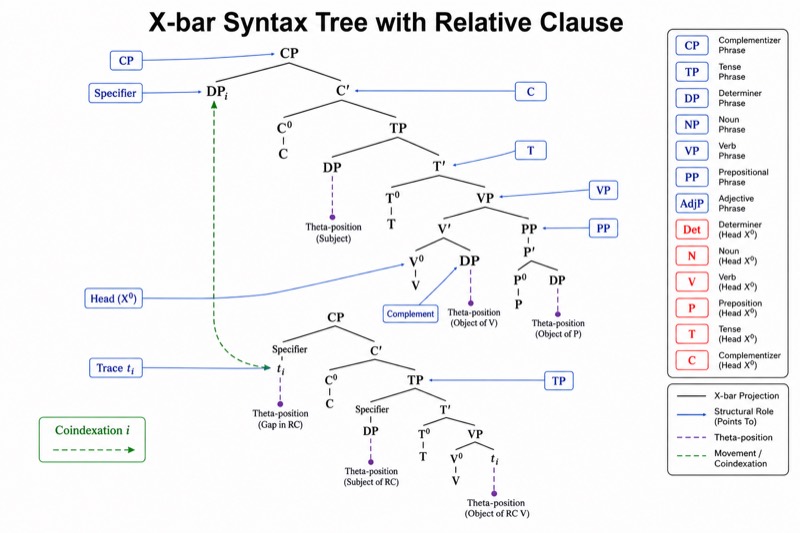
Detailed Syntax Tree (University Level) — an alternative version of the Syntax Tree Diagram, generated by AI and fully editable. Download the PNG for quizzes, homework or slides.
Labels included in this diagram
- CP
- TP
- DP
- NP
- VP
- PP
- AdjP
- Det / N / V / P / C / T
- Specifier
- Head (X^0)
- Complement
- Theta-position
- Trace t_i
- Coindexation i
✓ Accurate labels ✓ Edit text after generation ✓ PNG for papers, posters & slides
 OUTPUT · 16:9 · PNG
What this diagram shows
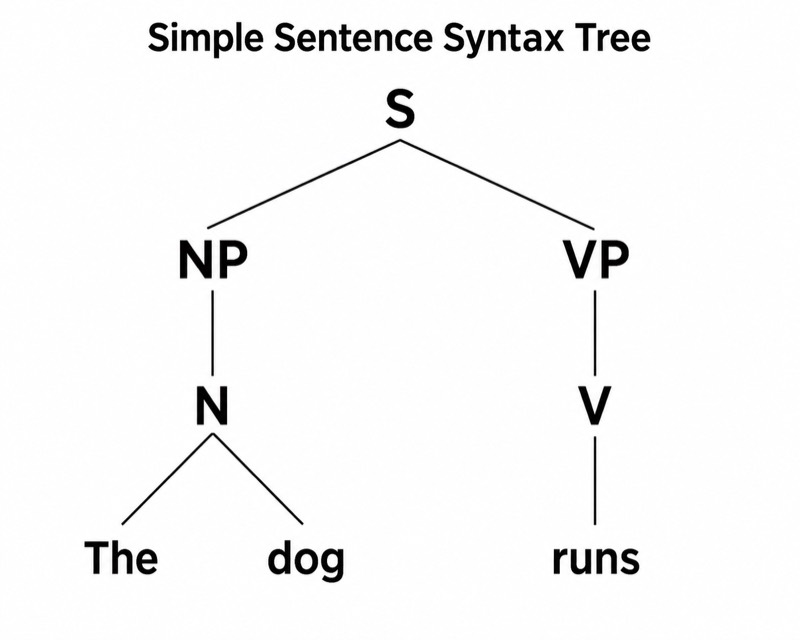
This Detailed Syntax Tree (University Level) represents a sentence containing a relative clause and a prepositional phrase, such as “The careful researcher who the committee praised analyzed the data in the laboratory.” Unlike the standard main diagram, which introduces S, NP, VP, Det, N, and V through a simplified branching structure, this version expands the analysis into CP, TP, DP, NP, VP, PP, and AdjP projections. It also identifies C, T, P, and lexical heads, distinguishes heads from complements and specifiers, and marks thematic positions, movement traces, and coindexed constituents in an X-bar-style hierarchy.
Read the tree from the highest CP or TP downward, first locating each phrase’s head and then identifying its specifier, complement, and adjunct. Follow the coindex between the relative operator and t to reconstruct the extracted argument’s thematic position. Compare the embedded relative clause with the matrix clause, and test whether the PP attaches to VP or NP. This version should be used when the standard main diagram is too compressed to explain recursion, clause boundaries, movement, or attachment. With more than twelve labeled structures and noncrossing guide lines, it supports formal parsing rather than only introductory constituent recognition.
Teaching tips
- In-class quizzes: remove selected labels such as CP, TP, DP, C, T, or PP and ask students to restore them, identify the head of each projection, and justify the position of the relative-clause trace.
- Homework exercises: pair this detailed tree with the standard main diagram and require students to explain how an introductory S–NP–VP analysis is recast through X-bar projections, functional categories, and explicit head–complement relations.
- Lecture slides: reveal the structure in stages—matrix TP, VP, DP, relative CP, PP, and movement chain—so students can see why the university-level version is needed for embedding, recursion, and syntactic dependency analysis.
- Review outlines and printed handouts: annotate theta roles, argument positions, adjuncts, complements, and coindexing in separate passes; the noncrossing layout makes the tree suitable for handwritten notes and exam preparation.
- Research papers or advanced seminar materials: use the figure as a model for a detailed syntax tree at university level when discussing relative-clause extraction, PP attachment, constituency diagnostics, or competing phrase-structure analyses.
FAQ about this diagram
Why use this version instead of the standard syntax-tree diagram?
The standard diagram is appropriate for learning basic constituency through S, NP, VP, Det, N, and V. This version is necessary when an analysis must show functional projections, embedded CP structure, head–complement relations, thematic positions, and movement dependencies that the simplified tree leaves implicit.
What do the trace t and the matching subscript represent?
A trace such as tᵢ marks the interpreted position from which a constituent has moved, while the matching subscript identifies the movement chain. In a relative clause, the extracted element and tᵢ are coindexed so that the displaced phrase can still receive its thematic role in the original argument position.