Sentence Structure Diagram Generator
Free online Sentence Structure Diagram generator: get a fully labeled figure in about 90 seconds. The AI plans the must-have label list first, then renders a clean textbook-style diagram — every label editable afterwards, ready for papers, assignments and slides.
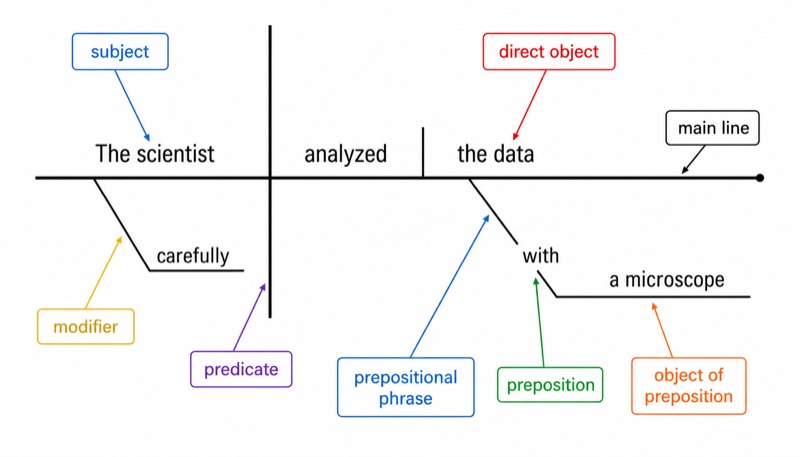
Labels included in this diagram
- subject
- predicate
- direct object
- modifier
- prepositional phrase
- preposition
- object of preposition
- main line
✓ Accurate labels ✓ Edit text after generation ✓ PNG for papers, posters & slides
 OUTPUT · 16:9 · PNG
What this diagram shows
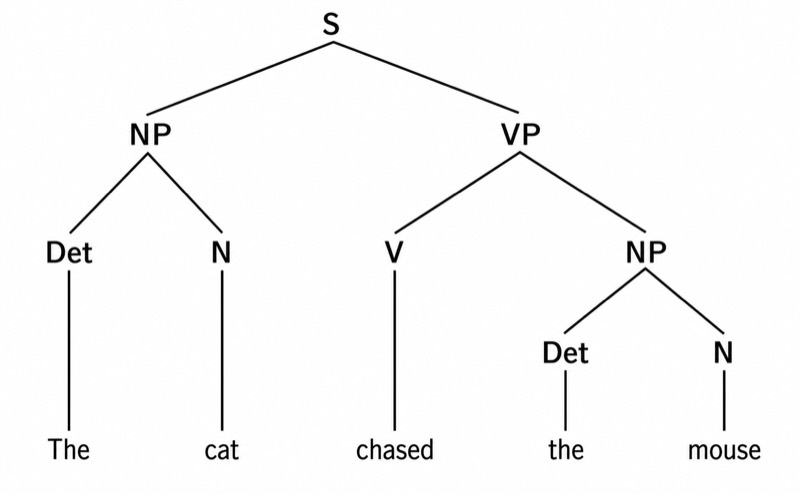
A Reed-Kellogg sentence diagram displays the grammatical structure of an English sentence through lines and spatial relationships. The horizontal baseline carries the independent clause: the subject appears on the left, while the predicate begins on the right after a vertical dividing line. A transitive verb may be followed by a direct object, separated from the verb by another vertical line. Modifiers, including adjectives and adverbs, are placed on slanting lines below the words they modify. This arrangement makes the sentence hierarchy visible and helps students distinguish essential clause elements from dependent or modifying structures.
The diagram should be built from the clause core outward. First identify the complete subject and complete predicate, then place the simple subject and main verb on the baseline. Add a direct object after the transitive verb when it answers “what?” or “whom?” Next, attach single-word modifiers beneath their heads with slanting lines. A prepositional phrase begins with the preposition on a slanting line; its object is written on a horizontal line extending from it. The entire phrase is attached beneath the noun, verb, adjective, or adverb it modifies, showing both grammatical function and dependency.
What a correct diagram must include
- Main baseline — Draw a horizontal line for the independent clause so that the sentence core is visually distinct from subordinate material.
- Subject-predicate division — Use a vertical line through the baseline between the simple subject and the predicate to mark the basic clause boundary.
- Simple subject — Place the head noun or pronoun on the left side of the baseline, excluding its articles, adjectives, and other modifiers.
- Main predicate — Place the finite main verb or verb phrase on the right side, keeping auxiliaries together with the lexical verb.
- Direct object — Write it after an action verb and separate it with a vertical line that stops at the baseline, showing that the object completes the verb’s meaning.
- Modifiers — Put adjectives and adverbs on slanting lines beneath the specific words they modify rather than beneath the whole clause.
- Prepositional phrase — Place the preposition on a slanting line and its object on a connected horizontal line, then attach the phrase to its grammatical head.
- Relationship labels — When the diagram is used for instruction, label examples of subject, predicate, direct object, modifier, and prepositional phrase without replacing the structural lines.
Common mistakes
- Placing the complete subject on the baseline instead of placing only the simple subject there and moving its modifiers to slanting lines.
- Treating every noun after a verb as a direct object; linking verbs take subject complements, and intransitive verbs do not take direct objects.
- Attaching a modifier to the nearest word rather than to the word it logically and grammatically modifies, creating an incorrect dependency.
- Writing a whole prepositional phrase on one line instead of separating the preposition from its object and showing what the phrase modifies.
- Diagramming auxiliary verbs as modifiers; auxiliaries belong with the main verb as part of the complete verb phrase.
Teaching tips
Use the diagram after students can identify parts of speech but before or during work on clause patterns, agreement, complements, and modifier placement. Begin with a short sentence and ask: “Who or what is the sentence about?”, “What is asserted about it?”, and “What completes or modifies each head?” Students can compare diagrams of ambiguous sentences to see how attachment changes meaning. The method supports examination questions on subject-verb agreement, transitive and intransitive verbs, direct objects, phrase functions, and misplaced or dangling modifiers.
FAQ about this diagram
What belongs on the main horizontal line?
The baseline contains the clause core: the simple subject, the finite verb or verb phrase, and any required object or complement. Articles, descriptive adjectives, adverbs, and prepositional phrases normally appear below it.
How is a direct object distinguished from a subject complement?
A direct object follows a transitive action verb and receives the action. A subject complement follows a linking verb and identifies or describes the subject, so Reed-Kellogg diagrams use different separator shapes for these functions.
Where should a prepositional phrase be attached?
Attach it beneath the word it modifies. If it describes a noun, it functions adjectivally; if it modifies a verb, adjective, or adverb, it functions adverbially.