Conceptual Framework: Technology Acceptance Model Generator
Free online Conceptual Framework: Technology Acceptance Model generator: get a fully labeled figure in about 90 seconds. The AI plans the must-have label list first, then renders a clean textbook-style diagram — every label editable afterwards, ready for papers, assignments and slides.
Labels included in this diagram
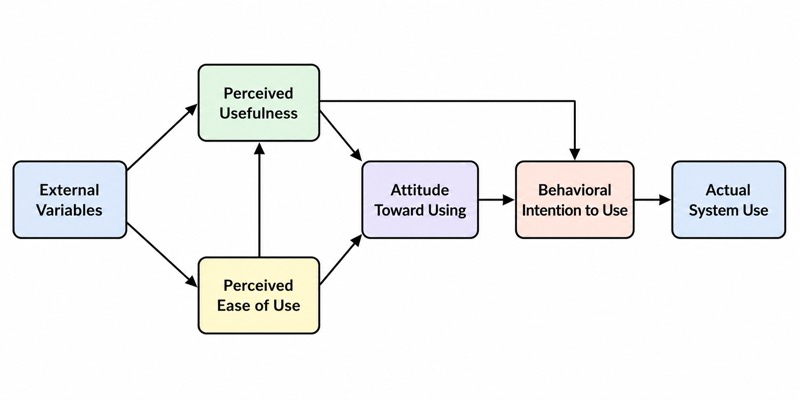
- External Variables
- Perceived Usefulness
- Perceived Ease of Use
- Attitude Toward Using
- Behavioral Intention to Use
- Actual System Use
✓ Accurate labels ✓ Edit text after generation ✓ PNG for papers, posters & slides
 OUTPUT · 16:9 · PNG
What this diagram shows
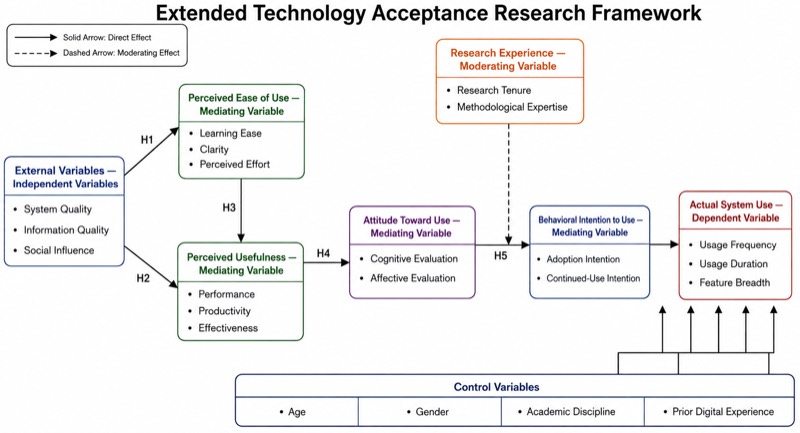
The Technology Acceptance Model explains how users come to accept and use an information system. Its central cognitive constructs are Perceived Usefulness, the belief that using the system will improve task performance, and Perceived Ease of Use, the belief that using it will require little effort. External Variables represent antecedent conditions such as system characteristics, user experience, training, social context, and task attributes. These beliefs shape Attitude Toward Using and Behavioral Intention to Use, which precede Actual System Use. The diagram therefore converts an abstract adoption theory into a testable conceptual framework composed of latent constructs, directional hypotheses, and an observable behavioral outcome.
The causal sequence generally begins with External Variables influencing both Perceived Usefulness and Perceived Ease of Use. Perceived Ease of Use also affects Perceived Usefulness because a system that requires less effort may provide greater performance benefits. Both beliefs can shape Attitude Toward Using, which represents the user's favorable or unfavorable evaluation of adoption. Attitude then influences Behavioral Intention to Use, the immediate motivational antecedent of Actual System Use. In many TAM specifications, Perceived Usefulness also has a direct path to Behavioral Intention because users may intend to adopt an effective system despite a neutral attitude. Arrows should be interpreted as theoretically hypothesized directional effects that require empirical testing, not automatically proven causation.
What a correct diagram must include
- External Variables — place this construct at the left as the source of contextual, individual, organizational, or technological antecedents.
- Perceived Ease of Use — define it as expected freedom from effort and draw an arrow from External Variables to this belief.
- Perceived Usefulness — define it as expected performance improvement and connect it to both External Variables and Perceived Ease of Use.
- Attitude Toward Using — position it after the two belief constructs to show the user's overall evaluative response to system use.
- Behavioral Intention to Use — place it between Attitude Toward Using and Actual System Use because intention is the proximal motivational predictor of behavior.
- Actual System Use — display it as the terminal outcome and, where possible, operationalize it through frequency, duration, continuity, or feature utilization.
- Directional arrows and hypotheses — use one-way arrows consistently, including Perceived Ease of Use → Perceived Usefulness and Behavioral Intention to Use → Actual System Use.
Common mistakes
- Drawing Perceived Usefulness and Perceived Ease of Use as outcomes of Attitude Toward Using, which reverses the standard TAM sequence.
- Omitting the path from Perceived Ease of Use to Perceived Usefulness, thereby losing a central theoretical mechanism of TAM.
- Treating Behavioral Intention to Use and Actual System Use as identical constructs rather than separating motivation from observed behavior.
- Connecting External Variables directly to every downstream construct without theoretical justification, which makes the framework unfalsifiable and conceptually cluttered.
- Describing every arrow as established causation even when the research design is cross-sectional and supports only hypothesized or statistically associated paths.
Teaching tips
Use the diagram after introducing technology-adoption theories and before teaching structural equation modeling or hypothesis development. Ask students to define each construct, justify every arrow, and distinguish beliefs, attitudes, intentions, and behavior. A useful exercise is to assign a technology context and require students to classify candidate External Variables, formulate directional hypotheses, and propose measurement indicators. Assessment questions can test the Perceived Ease of Use → Perceived Usefulness mechanism, the distinction between Behavioral Intention and Actual System Use, and whether a proposed direct path is theoretically supported. The framework also supports discussion of mediation, construct validity, and limits of causal inference.
FAQ about this diagram
Why does Perceived Ease of Use influence Perceived Usefulness?
Lower effort can allow users to complete tasks more efficiently and devote more attention to task performance. Ease of use may therefore increase the perceived instrumental value of the system, although the strength of this path should be tested empirically.
Is Attitude Toward Using always required in a TAM framework?
Attitude appears in the original TAM sequence, but later parsimonious versions often omit it and model direct effects of Perceived Usefulness and Perceived Ease of Use on Behavioral Intention. Researchers should state which TAM specification they adopt and justify any omitted construct.
How are Behavioral Intention to Use and Actual System Use different?
Behavioral Intention is a self-reported readiness or plan to use the system, whereas Actual System Use is realized behavior measured through usage records or reported activity. Intention may not become use when access barriers, organizational rules, limited resources, or changing circumstances intervene.