Simple Conceptual Framework Diagram for Middle School
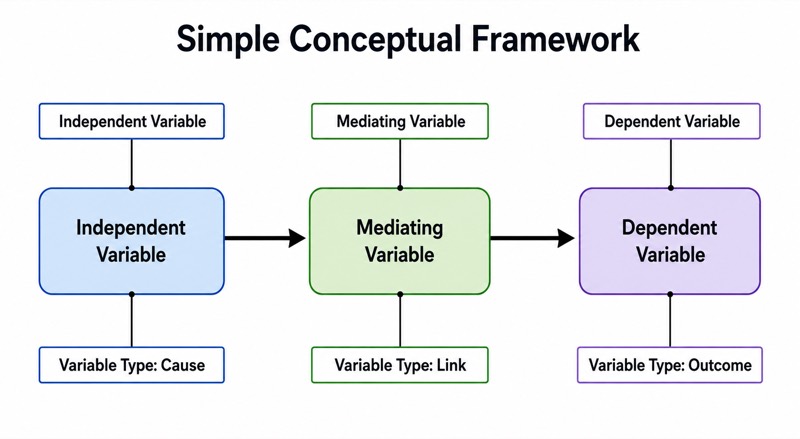
Simple Conceptual Framework Diagram for Middle School — an alternative version of the Conceptual Framework: Technology Acceptance Model, generated by AI and fully editable. Download the PNG for quizzes, homework or slides.
Labels included in this diagram
- Independent Variable
- Variable Type: Cause
- Mediating Variable
- Variable Type: Link
- Dependent Variable
- Variable Type: Outcome
✓ Accurate labels ✓ Edit text after generation ✓ PNG for papers, posters & slides
 OUTPUT · 16:9 · PNG
What this diagram shows
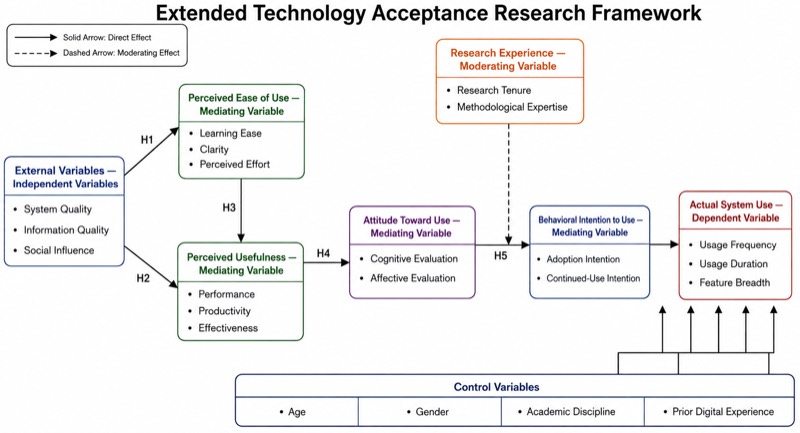
This simple conceptual framework diagram for middle school contains only three labeled boxes: an independent variable, a mediating variable, and a dependent variable. Arrows connect them from left to right to show a basic proposed relationship. Unlike the standard Technology Acceptance Model diagram, this version removes additional constructs, branching paths, hypotheses, and detailed causal links. The reduced structure helps upper-primary and middle-school learners focus on the central idea that one variable may influence another through an intermediate factor.
Read the diagram from left to right. First, identify the independent variable as the possible cause or starting condition. Next, examine the mediating variable, which explains how or why an effect may occur. Finally, identify the dependent variable as the outcome being studied. Students can replace the generic labels with a topic, such as study time, learning confidence, and test performance. Use this simplified version before introducing the standard main diagram, because its symmetry, limited vocabulary, and ample white space reduce cognitive load.
Teaching tips
- In-class quiz: provide the three-box diagram with one or more labels removed, then ask students to identify the independent, mediating, and dependent variables.
- Homework: have students choose a familiar question, such as how sleep affects school performance through concentration, and place each factor in the correct box.
- Presentation slides: use the simplified diagram to introduce variable relationships before showing the standard model with multiple constructs and paths.
- Review outline or printed handout: let students annotate each arrow with a short statement explaining the predicted relationship, while keeping the page easy to scan and print.
- Introductory paper illustration: use the three-box framework when a school research report examines one direct sequence and does not require the full complexity of the standard Technology Acceptance Model.
FAQ about this diagram
Why does this version omit the additional variables in the standard Technology Acceptance Model?
The standard model may include several beliefs, attitudes, intentions, and behavioral outcomes. This version keeps only three variable roles so younger learners can first understand the logic of a conceptual framework without being distracted by model-specific detail.
Must every middle-school research question include a mediating variable?
No. A mediator is useful when students can explain how or why the independent variable may affect the outcome. If the task examines only a direct relationship, the middle box can be removed, but that produces a simpler two-variable framework rather than this three-part variant.