Water Cycle Diagram for Kids
Water Cycle Diagram for Kids — an alternative version of the Water Cycle Diagram, generated by AI and fully editable. Download the PNG for quizzes, homework or slides.
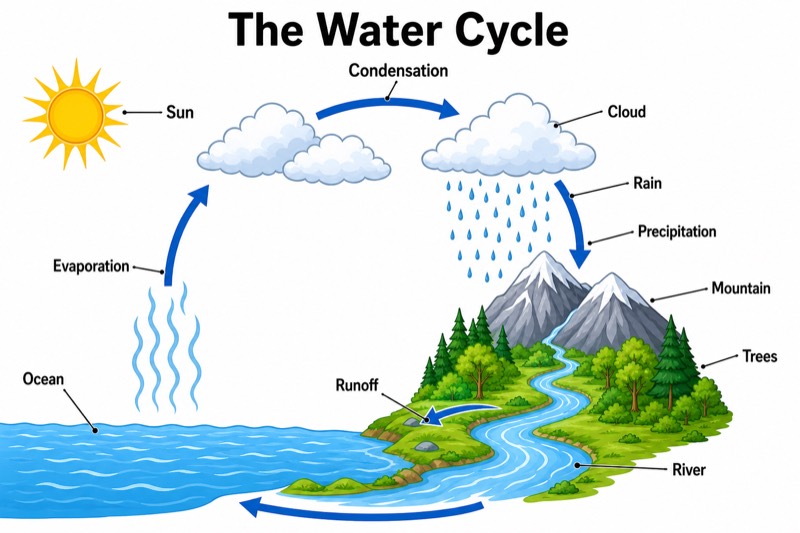
Labels included in this diagram
- Sun
- Ocean
- Cloud
- Rain
- Mountain
- River
- Trees
- Evaporation
- Condensation
- Precipitation
- Runoff
✓ Accurate labels ✓ Edit text after generation ✓ PNG for papers, posters & slides
 OUTPUT · 16:9 · PNG
What this diagram shows
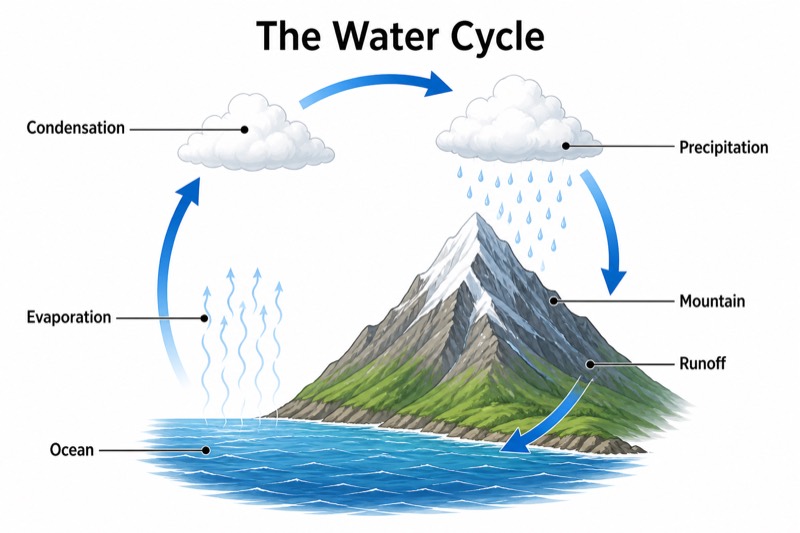
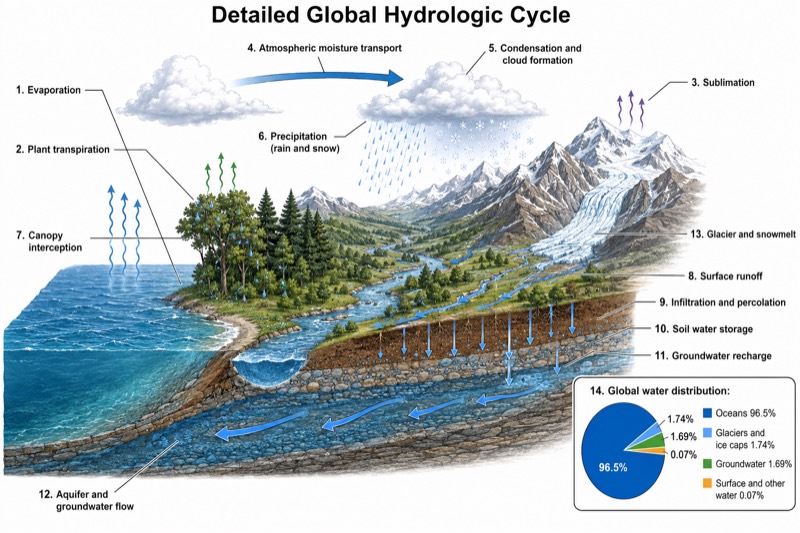
This Water Cycle Diagram for Kids shows the Sun, ocean, clouds, raindrops, hills, a river, and trees in a bright storybook style. Unlike a standard water cycle diagram, which may include groundwater, transpiration, infiltration, and scientific detail, this version focuses on four essential steps: evaporation, condensation, precipitation, and runoff. Large circular arrows make the direction of water movement unmistakable: evaporation rises, precipitation falls, and runoff flows downhill toward the ocean. The simplified artwork and extra-large labels reduce reading demands, helping younger children understand the cycle before learning its more complex pathways.
Read the diagram by starting at the ocean and following the thick arrows. Sunlight warms surface water, so evaporation moves upward. Water vapor cools and forms clouds through condensation; precipitation then carries water downward as rain. Finally, runoff travels through slopes and rivers back to the ocean, completing the cycle. This version differs from the standard main diagram because each stage uses only one short term and a supporting icon. Use it when the learning goal is sequence and direction rather than detailed atmospheric processes. Children can point, trace, say, or number the four steps.
Teaching tips
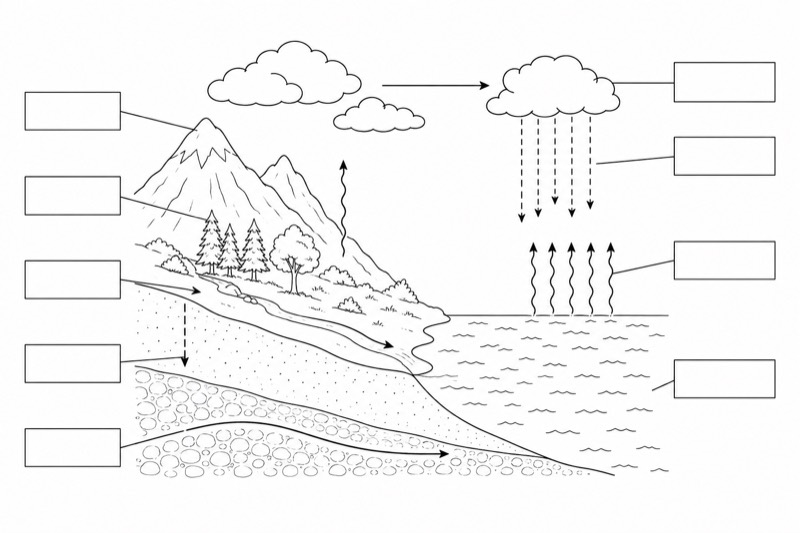
- Classroom quiz: remove or cover the four labels, then ask pupils to place evaporation, condensation, precipitation, and runoff beside the correct arrows. Check that they understand upward, downward, and return-to-ocean movement.
- Homework: ask children to color the ocean, clouds, rain, and river, then write one simple sentence for each stage. The reduced detail makes the task manageable without replacing the standard diagram used later.
- Presentation slide: display the diagram while introducing the cycle aloud. Reveal one stage at a time and have the class use hand motions to show evaporation rising, precipitation falling, and runoff flowing downhill.
- Review sheet or printed handout: place the kid-friendly diagram beside a four-step word bank. Pupils can trace the bold arrows and retell the sequence, while the standard main diagram can be added afterward for groundwater, infiltration, or transpiration.
- Report or paper illustration: use this simplified version only when explaining elementary-level instruction, visual scaffolding, or early science learning. For a technical discussion of the full hydrologic system, use the standard diagram instead.
FAQ about this diagram
Why does this version show only four parts of the water cycle?
The four-part structure highlights the core sequence that young learners need first: evaporation, condensation, precipitation, and runoff. A standard diagram adds processes such as infiltration, groundwater flow, collection, and transpiration after pupils understand the main cycle.
How can I check whether children are reading the arrows correctly?
Ask them to trace water from the ocean upward to the clouds, downward as rain, and downhill through the river back to the ocean. If they can explain those directions in order, they understand the scientific logic rather than merely memorizing the labels.