Unlabeled Water Cycle Diagram (Blank Worksheet)
Unlabeled Water Cycle Diagram (Blank Worksheet) — an alternative version of the Water Cycle Diagram, generated by AI and fully editable. Download the PNG for quizzes, homework or slides.
✓ Accurate labels ✓ Edit text after generation ✓ PNG for papers, posters & slides
 OUTPUT · 16:9 · PNG
What this diagram shows
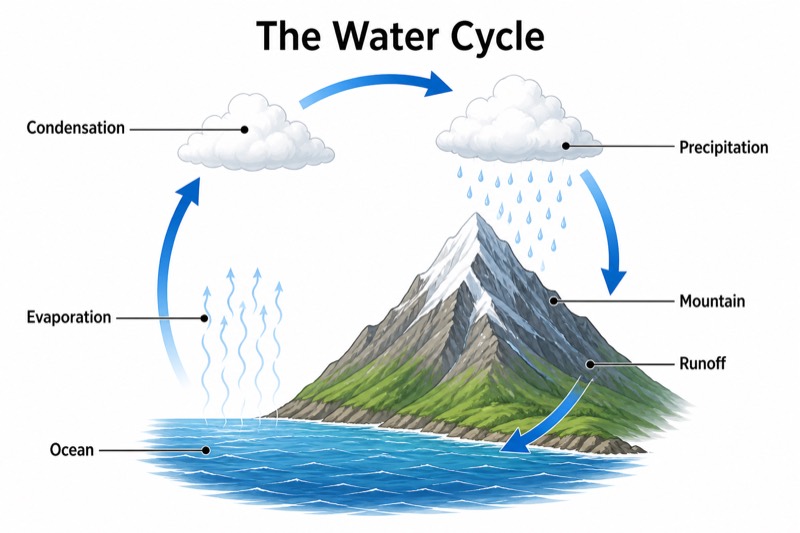
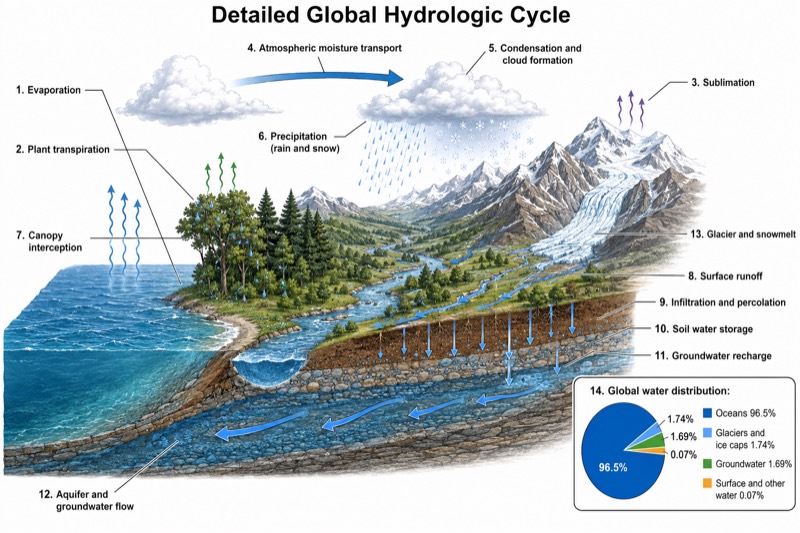
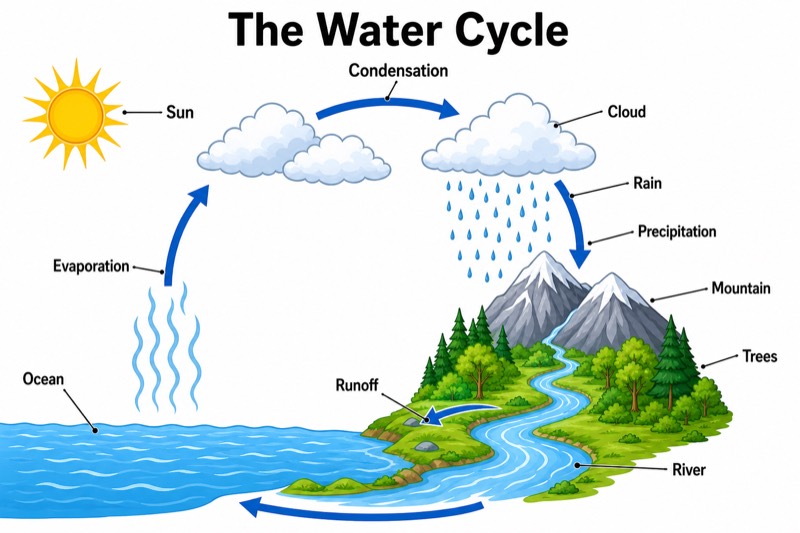
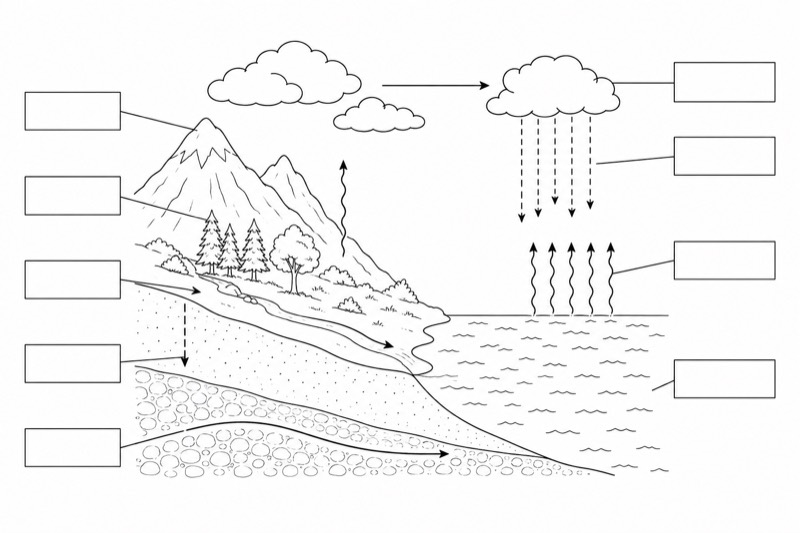
This unlabeled water cycle diagram (blank worksheet) shows the movement of water through a mountain, vegetation, land, groundwater, and ocean system. It includes visual structures for evaporation, plant transpiration, water-vapor transport, precipitation, surface runoff, infiltration, and groundwater flow. Unlike the standard main diagram, no process names, letters, or numbers appear in the illustration. Thin leader lines point from each relevant feature to identical empty rectangular boxes outside the scene. This difference turns an explanatory diagram into an active recall exercise that reveals whether students can identify processes without printed prompts.
Students should first trace water from the ocean and land surface into the atmosphere, then follow clouds, precipitation, downhill flow, soil entry, and underground return to the ocean. They can write one process name in each blank box and use the arrow direction, landscape position, and change of state as evidence. The standard labeled diagram is better for initial instruction, whereas this blank version is better for retrieval practice, assessment, and checking misconceptions. After completion, compare answers with the standard diagram and discuss common confusions, especially evaporation versus transpiration and infiltration versus groundwater flow.
Teaching tips
- In-class quiz: Print one copy per student and ask learners to label all seven processes without notes. Award separate points for correct terminology and for matching each term to the correct feature.
- Homework practice: Have students complete the blank boxes, color-code atmospheric, surface, and subsurface pathways, and write one sentence explaining how water returns from land to the ocean.
- Presentation or interactive lesson: Display the worksheet before showing the standard labeled main diagram. Invite students to propose labels one at a time, justify each answer from the arrows and landscape, and then reveal the reference version.
- Revision guide or printed handout: Place the blank worksheet beside a short word bank or on the reverse side of the labeled diagram. Students can repeatedly cover the answers and reconstruct the cycle from memory.
- Report or paper figure exercise: Use the clean, text-free illustration as an annotation base. Students can add discipline-appropriate labels, a caption, and an explanation of water storage and movement while keeping the original figure uncluttered.
FAQ about this diagram
Why use a blank worksheet instead of the standard labeled water cycle diagram?
The standard diagram supports recognition because the process names are already visible. The unlabeled version requires retrieval and spatial matching, making it more useful for quizzes, homework, review, and diagnosing misconceptions.
Which labels should students add to the empty boxes?
The expected processes are evaporation, plant transpiration, water-vapor transport, precipitation, surface runoff, infiltration, and groundwater flow. Students should use arrow direction and location to distinguish infiltration, which moves water into soil, from groundwater flow, which carries water through saturated material.