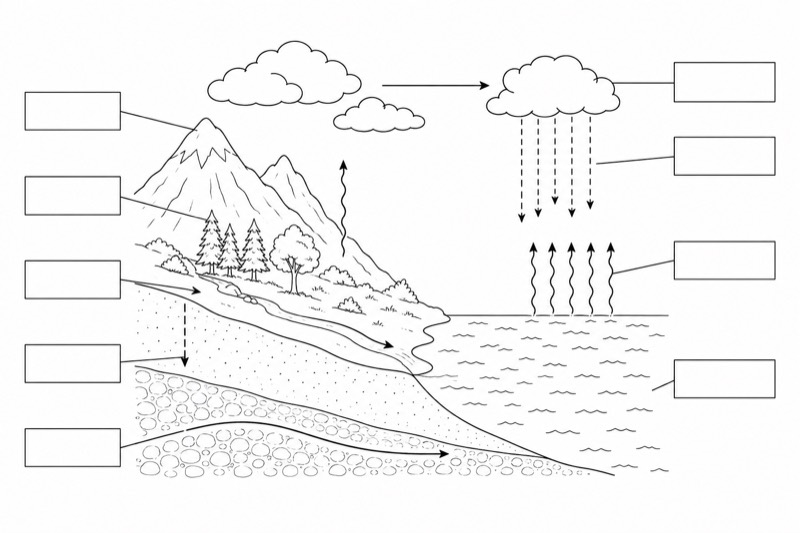
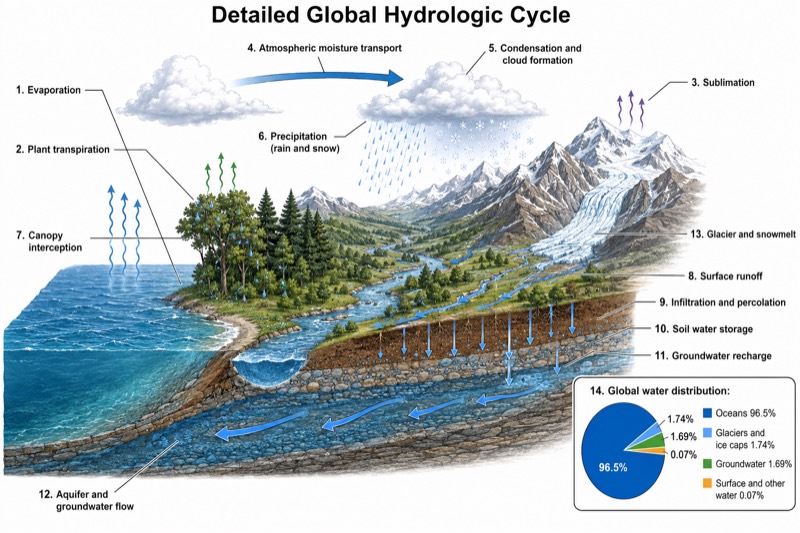
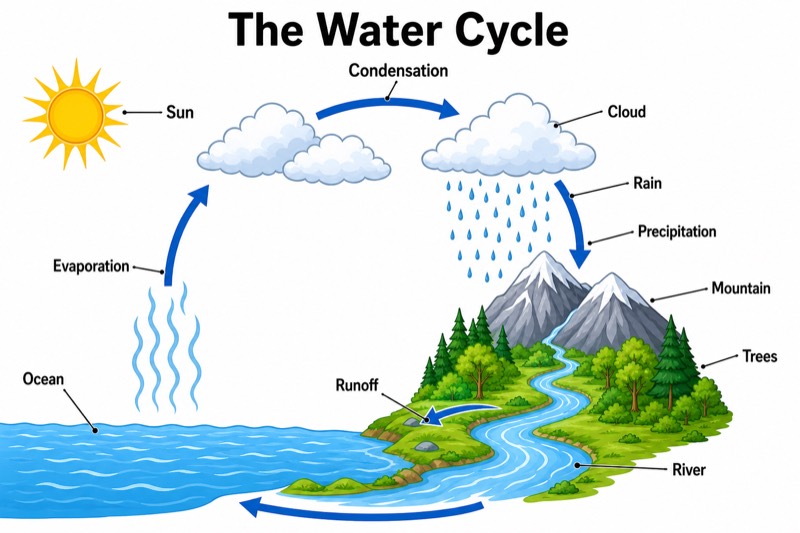
Simple Water Cycle Diagram for Middle School
Simple Water Cycle Diagram for Middle School — an alternative version of the Water Cycle Diagram, generated by AI and fully editable. Download the PNG for quizzes, homework or slides.
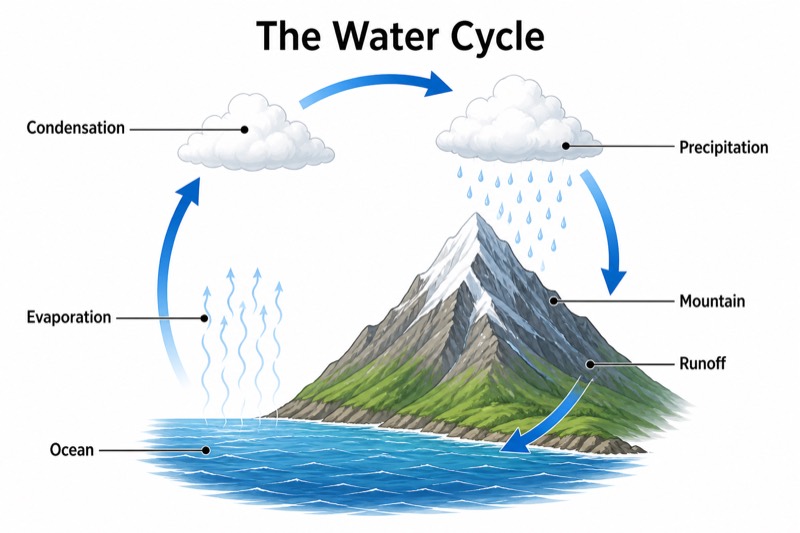
Labels included in this diagram
- Evaporation
- Condensation
- Precipitation
- Runoff
- Ocean
- Mountain
✓ Accurate labels ✓ Edit text after generation ✓ PNG for papers, posters & slides
 OUTPUT · 16:9 · PNG
What this diagram shows
This simplified diagram presents only five essential parts of the water cycle: evaporation, condensation into clouds, precipitation, runoff, and the ocean. A mountain-and-sea landscape and large circular arrows make the sequence easy to follow. Unlike the standard main diagram, this version leaves out processes such as infiltration, groundwater flow, transpiration, and water storage. Those details are useful in advanced study, but they can distract beginners from the central pattern. This simple water cycle diagram for middle school is therefore best used when students first need to understand how water moves through a repeating system.
Read the diagram by starting at the ocean and following the large arrows. Water evaporates, cools and condenses into clouds, falls as precipitation, and returns to the ocean as runoff from the mountain. The uncluttered, symmetrical layout helps students describe the cycle aloud, write the stages in order, or reconstruct the sequence from memory. Compared with the standard main diagram, this version reduces vocabulary and visual detail so that learners can focus on direction, sequence, and cause-and-effect relationships. Use it before introducing the complete cycle, or as a quick review after students have studied the more detailed version.
Teaching tips
- In-class quiz: remove or cover the five labels and ask students to identify evaporation, condensation, precipitation, runoff, and the ocean from the arrows and landscape.
- Homework: have students write one sentence for each stage, then explain how runoff completes the simplified cycle by returning water to the ocean.
- Presentation slide: display the diagram while introducing the cycle orally, revealing one labeled stage at a time before comparing it with the standard, more detailed diagram.
- Review outline or printed handout: place the diagram beside a short vocabulary list so students can trace the cycle, color-code each stage, and summarize the sequence before a test.
- Student report or paper illustration: use the simplified figure when the writing discusses only the basic circulation of water; choose the standard main diagram instead if groundwater, transpiration, or storage must be explained.
FAQ about this diagram
Why does this middle school version omit groundwater and transpiration?
Its purpose is to isolate the basic visible sequence from ocean evaporation to cloud formation, precipitation, and runoff. Groundwater and transpiration belong in the standard main diagram, but omitting them here lowers cognitive load for introductory lessons and rapid review.
Can this simplified diagram replace a standard water cycle diagram?
It can replace the standard diagram only when the learning goal is identifying the main stages and their order. For lessons about infiltration, groundwater, plant processes, storage, or multiple pathways, students should move to the standard main diagram after mastering this simpler version.