Venn Diagram Generator
Free online Venn Diagram generator: get a fully labeled figure in about 90 seconds. The AI plans the must-have label list first, then renders a clean textbook-style diagram — every label editable afterwards, ready for papers, assignments and slides.
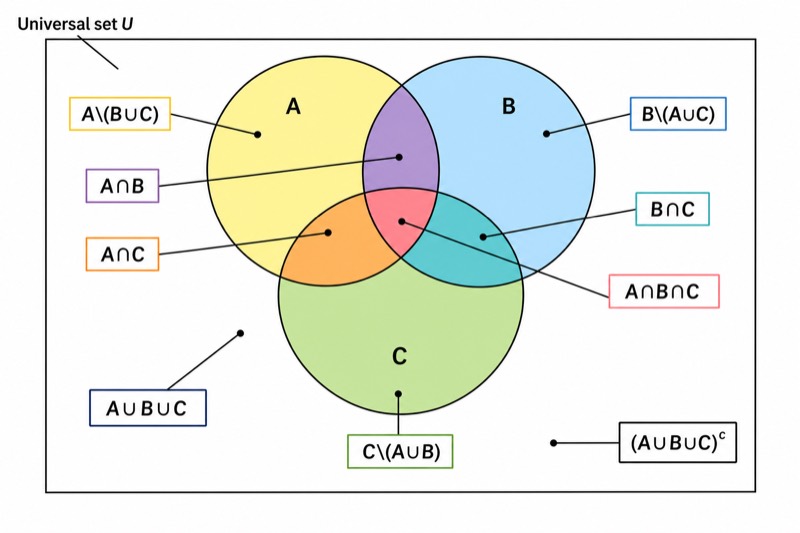
Labels included in this diagram
- Universal set U
- A
- B
- C
- A\(B∪C)
- B\(A∪C)
- C\(A∪B)
- A∩B
- A∩C
- B∩C
- A∩B∩C
- A∪B∪C
- (A∪B∪C)^c
✓ Accurate labels ✓ Edit text after generation ✓ PNG for papers, posters & slides
 OUTPUT · 16:9 · PNG
What this diagram shows
A three-set Venn diagram represents the logical relationships among sets A, B, and C inside a universal set U. Three overlapping circles divide the universal set into regions showing membership in one, two, three, or none of the sets. The central region is the triple intersection A ∩ B ∩ C. Each pairwise intersection, such as A ∩ B, includes every element belonging to both sets, including the central region unless C is explicitly excluded. The union A ∪ B ∪ C contains all regions inside at least one circle, while its complement contains everything outside the three circles but inside U.
The regions should be interpreted through membership conditions. A region belonging only to A is A ∖ (B ∪ C), while the part shared by A and B but not C is (A ∩ B) ∖ C. Similar rules apply to the other exclusive and pairwise regions. To shade a union, combine all areas satisfying at least one stated condition. To shade an intersection, keep only areas satisfying every stated condition. A complement reverses membership relative to U; for example, Aᶜ is every point in U that is not in A. Distinct colors can distinguish regions, but labels and boundaries must still communicate the exact set operation.
What a correct diagram must include
- Universal set U — Draw a rectangle around the circles because every set and every complement must be interpreted relative to a defined universe.
- Three labeled circles — Label the circles A, B, and C, and position them so that each pair overlaps and a central triple-overlap region is visible.
- Single-set-only regions — Include separate areas for elements belonging only to A, only to B, or only to C.
- Pairwise intersection regions — Show A ∩ B, A ∩ C, and B ∩ C; distinguish the pairwise-only parts from the central triple intersection when necessary.
- Triple intersection — Clearly mark A ∩ B ∩ C at the center because its elements satisfy all three membership conditions simultaneously.
- Union — Identify A ∪ B ∪ C as the entire area covered by one or more circles, not merely the overlapping regions.
- Complement region — Show the relevant complement inside U; for example, (A ∪ B ∪ C)ᶜ lies outside all three circles but inside the rectangle.
- Consistent colors and labels — Use contrasting colors or patterns for different regions, and place labels where they cannot be mistaken for circle names or boundaries.
Common mistakes
- Treating A ∩ B as only the lens outside C; mathematically, A ∩ B also includes A ∩ B ∩ C unless the expression is (A ∩ B) ∖ C.
- Shading only the overlaps for A ∪ B ∪ C instead of shading every region inside at least one of the three circles.
- Placing a complement outside the universal-set rectangle; complements contain elements in U that are excluded from the stated set.
- Drawing three circles without a common central overlap, making A ∩ B ∩ C impossible to represent.
- Using colors without precise labels, which can make pairwise intersections, exclusive regions, and the triple intersection ambiguous.
Teaching tips
Use the diagram after introducing set notation and before solving probability or counting problems. Ask students to point to regions satisfying verbal conditions such as “in A and B but not C,” then translate each condition into symbols. Reverse the task by giving expressions such as A ∩ Bᶜ or (A ∪ C)ᶜ and asking students to shade them. The diagram also supports questions on De Morgan’s laws, mutually exclusive events, inclusion–exclusion, and survey data. Emphasize that each region represents a distinct membership pattern and should be counted only once.
FAQ about this diagram
Does A ∩ B include the central region A ∩ B ∩ C?
Yes. Every element in the central region belongs to both A and B, so it is part of A ∩ B. To name only the pairwise lens outside C, write (A ∩ B) ∖ C or A ∩ B ∩ Cᶜ.
What is the difference between a union and an intersection?
A union contains elements that belong to at least one stated set, so A ∪ B ∪ C covers all three circles. An intersection contains only elements common to every stated set, so A ∩ B ∩ C is the central overlap.
How is a complement shown in a three-set Venn diagram?
A complement is shaded relative to the universal set U. For example, Aᶜ includes every region inside U but outside circle A, whereas (A ∪ B ∪ C)ᶜ includes only the region outside all three circles.