Protein Synthesis: Transcription and Translation Generator
Free online Protein Synthesis: Transcription and Translation generator: get a fully labeled figure in about 90 seconds. The AI plans the must-have label list first, then renders a clean textbook-style diagram — every label editable afterwards, ready for papers, assignments and slides.
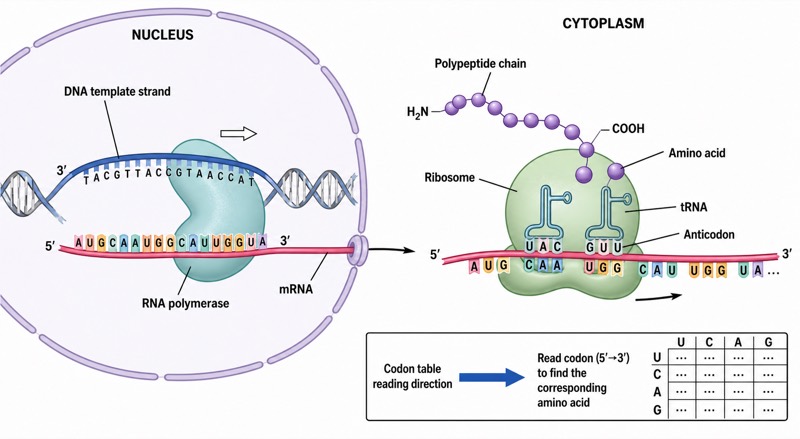
Labels included in this diagram
- DNA template strand
- RNA polymerase
- mRNA
- Ribosome
- tRNA
- Anticodon
- Amino acid
- Polypeptide chain
- Codon table reading direction
✓ Accurate labels ✓ Edit text after generation ✓ PNG for papers, posters & slides
 OUTPUT · 16:9 · PNG
What this diagram shows
This diagram explains protein synthesis through two linked stages of gene expression: transcription and translation. During transcription, RNA polymerase uses the DNA template strand to synthesize a complementary mRNA molecule. The mRNA carries genetic information from DNA to a ribosome. During translation, the ribosome reads mRNA codons in sequence, while tRNA molecules bring specific amino acids according to their anticodons. The amino acids are joined by peptide bonds to form a growing polypeptide chain, which may fold into a functional protein.
The diagram should show information flowing from DNA to mRNA and then to a polypeptide: DNA → mRNA → protein. RNA polymerase moves along the template strand and builds mRNA in the 5′ to 3′ direction. The ribosome reads the mRNA from 5′ to 3′, beginning at a start codon and ending at a stop codon. Each codon pairs with a complementary tRNA anticodon, ensuring that amino acids are added in the correct order. A codon table must be read using the mRNA codon, not the DNA template or tRNA anticodon.
What a correct diagram must include
- DNA double-stranded structure: show the coding strand and the template strand clearly, because RNA polymerase reads only the template strand.
- RNA polymerase: place it at the transcription region and show that it synthesizes RNA by complementary base pairing.
- mRNA: label its 5′ and 3′ ends and indicate that it is produced in the 5′ to 3′ direction.
- Ribosome: draw it bound to mRNA, with its reading direction from 5′ to 3′ and a visible site for codon–anticodon pairing.
- Codons and anticodons: label three-base mRNA codons and complementary tRNA anticodons, keeping their pairing antiparallel.
- tRNA and amino acids: show each tRNA carrying a specific amino acid, because tRNA connects codon information with amino-acid sequence.
- Growing polypeptide chain: show peptide bonds forming as amino acids are added in order, from the N-terminus toward the C-terminus.
- Codon table direction: indicate that the table is read with the first, second, and third bases of an mRNA codon, usually from 5′ to 3′.
Common mistakes
- Students often label the coding strand as the template strand. The template strand is read by RNA polymerase, whereas the coding strand has the same sequence as mRNA except that DNA contains T instead of U.
- The mRNA direction is frequently drawn incorrectly. RNA polymerase adds nucleotides to the 3′ end, so the new mRNA strand grows from 5′ to 3′.
- A tRNA anticodon is sometimes treated as identical to the mRNA codon. It must be complementary and antiparallel to the codon.
- Some diagrams show the ribosome reading DNA directly. In standard eukaryotic gene expression, the ribosome reads mRNA, not DNA.
- Students may use the codon table with a DNA triplet or an anticodon. The codon table should be used with the mRNA codon written in the 5′ to 3′ direction.
Teaching tips
Use the diagram after introducing DNA structure and before practising genetic-code problems. Ask students to trace the information flow, identify the template strand, mark the 5′ and 3′ ends, and predict the mRNA sequence from a DNA sequence. Then ask which tRNA anticodon and amino acid correspond to each mRNA codon. The figure supports examination points involving complementary base pairing, transcription versus translation, directionality, start and stop codons, and the relationship between nucleotide sequence and amino-acid sequence.
FAQ about this diagram
Which DNA strand is used during transcription?
RNA polymerase uses the DNA template strand as a guide and synthesizes a complementary RNA strand. The coding strand has the same base sequence as the mRNA, except that DNA uses thymine while RNA uses uracil.
Why is the mRNA codon matched with a tRNA anticodon?
A codon is a three-base sequence on mRNA that specifies an amino acid or a stop signal. The complementary anticodon on tRNA allows the correct amino acid to be delivered to the ribosome.
In what direction does translation occur?
The ribosome moves along mRNA from 5′ to 3′, reading codons in order. The polypeptide grows from its N-terminus toward its C-terminus until a stop codon is reached.