The Rock Cycle Generator
Free online The Rock Cycle generator: get a fully labeled figure in about 90 seconds. The AI plans the must-have label list first, then renders a clean textbook-style diagram — every label editable afterwards, ready for papers, assignments and slides.
Labels included in this diagram
- Magma
- Igneous rock
- Sediment
- Sedimentary rock
- Metamorphic rock
- Cooling and solidification
- Weathering, erosion, transport and deposition
- Lithification
- Metamorphism
- Remelting
✓ Accurate labels ✓ Edit text after generation ✓ PNG for papers, posters & slides
 OUTPUT · 16:9 · PNG
What this diagram shows
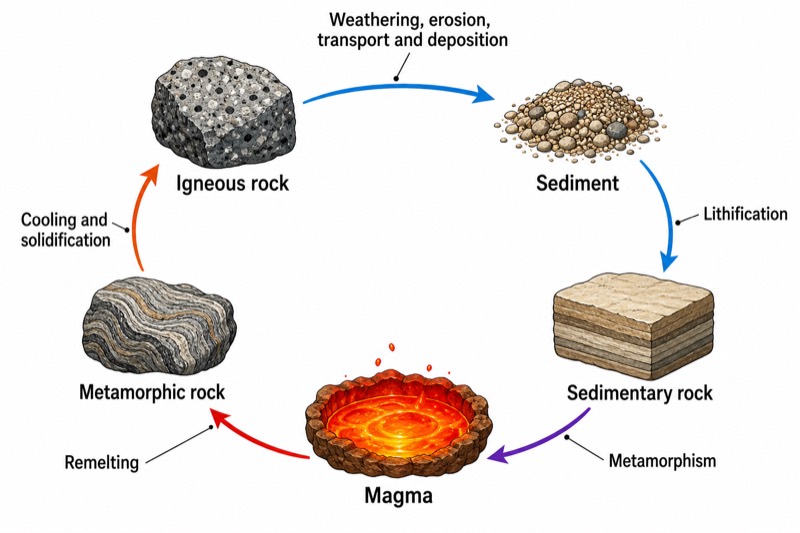
The Rock Cycle diagram shows how matter in the lithosphere is continually transformed among Magma, Igneous rock, Sediment, Sedimentary rock, and Metamorphic rock. It links each material to the geological process responsible for its formation. Cooling and solidification produce igneous rock from magma. Weathering, erosion, transport and deposition break down exposed rocks and accumulate sediment. Lithification converts sediment into sedimentary rock through compaction and cementation. Metamorphism changes existing rock under elevated temperature, pressure, and chemically active fluids without complete melting. Remelting returns rock material to magma.
The arrows represent material transformations rather than one fixed sequence. A correct main pathway is Magma → Igneous rock → Sediment → Sedimentary rock → Metamorphic rock → Magma. The arrow from Igneous rock to Sediment must be labeled Weathering, erosion, transport and deposition. Sediment becomes Sedimentary rock through Lithification, while Sedimentary rock becomes Metamorphic rock through Metamorphism. Metamorphic rock returns to Magma through Remelting. Additional valid pathways may show any exposed rock becoming sediment, or igneous and sedimentary rocks undergoing metamorphism. These branches demonstrate that the cycle is a dynamic network driven by Earth’s internal energy and surface processes.
What a correct diagram must include
- Five material reservoirs: Include Magma, Igneous rock, Sediment, Sedimentary rock, and Metamorphic rock as separate labeled nodes because each represents a distinct state or rock category.
- Cooling and solidification: Draw an arrow from Magma to Igneous rock, showing crystallization as molten material loses heat.
- Weathering, erosion, transport and deposition: Draw the essential arrow from Igneous rock to Sediment; the arrow must point toward Sediment, not back toward the rock.
- Lithification: Connect Sediment to Sedimentary rock and indicate that compaction and cementation turn loose particles into solid rock.
- Metamorphism: Draw an arrow from Sedimentary rock to Metamorphic rock, representing mineral and textural changes caused by heat and pressure without melting.
- Remelting: Connect Metamorphic rock back to Magma to show that sufficiently high temperatures can regenerate molten material.
- Arrowheads and process labels: Place every process label beside its corresponding directional arrow so that materials are not confused with transformations.
- Branching pathways: Where space permits, show that igneous rock can become metamorphic rock and that any exposed rock can produce sediment, emphasizing that the cycle is not strictly linear.
Common mistakes
- Reversing the weathering pathway by drawing Sediment → Igneous rock; weathering, erosion, transport and deposition should carry material from exposed rock, including Igneous rock, toward Sediment.
- Drawing Magma → Metamorphic rock directly; magma must first cool and solidify into igneous rock, whereas metamorphism acts on pre-existing solid rock.
- Treating melting as metamorphism; metamorphism occurs in the solid state, while complete melting produces magma.
- Labeling Lithification between Sedimentary rock and Metamorphic rock; lithification specifically converts loose Sediment into Sedimentary rock.
- Presenting the cycle as a compulsory single sequence; rocks may follow alternative pathways depending on uplift, burial, heating, erosion, and melting.
Teaching tips
Use the diagram after students have learned the three major rock groups, or as a review before questions on plate tectonics and Earth materials. First hide the process labels and ask students to infer each transformation from the starting and ending materials. Then ask, “Which process changes rock without melting?” and “Why must Igneous rock point toward Sediment during weathering?” Connect the diagram to examination tasks involving arrow completion, process identification, interpretation of heat and pressure conditions, and explanations of why the Rock Cycle is a network rather than a fixed sequence.
FAQ about this diagram
Why does Igneous rock form from Magma rather than through metamorphism?
Igneous rock forms when magma cools and solidifies, allowing mineral crystals to develop. Metamorphism changes a pre-existing solid rock without complete melting.
What is the difference between weathering, erosion, transport, and deposition?
Weathering breaks rock down in place, while erosion removes the material. Transport moves particles by water, wind, ice, or gravity, and deposition occurs when those particles settle.
Does every rock have to pass through all stages of the Rock Cycle?
No. A rock may follow several possible pathways depending on environmental and tectonic conditions. For example, igneous rock may be metamorphosed directly during deep burial or may first be weathered into sediment.