Components of Horizontal Projectile Motion Generator
Free online Components of Horizontal Projectile Motion generator: get a fully labeled figure in about 90 seconds. The AI plans the must-have label list first, then renders a clean textbook-style diagram — every label editable afterwards, ready for papers, assignments and slides.
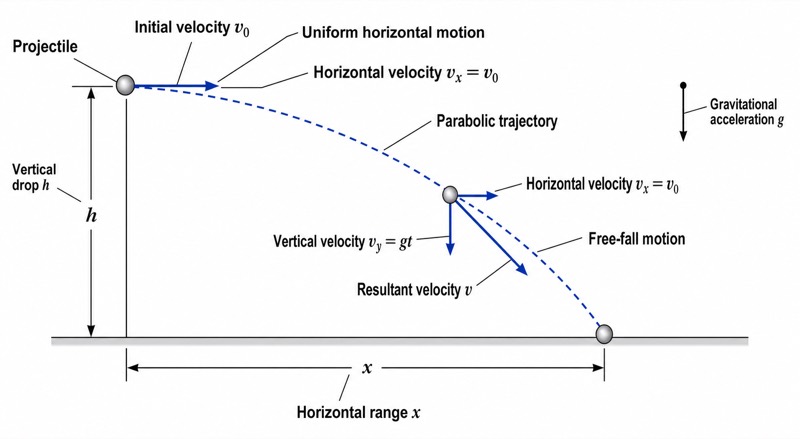
Labels included in this diagram
- Initial velocity v0
- Uniform horizontal motion
- Horizontal velocity vx=v0
- Free-fall motion
- Vertical velocity vy=gt
- Resultant velocity v
- Parabolic trajectory
- Gravitational acceleration g
- Horizontal range x
- Vertical drop h
- Projectile
✓ Accurate labels ✓ Edit text after generation ✓ PNG for papers, posters & slides
 OUTPUT · 16:9 · PNG
What this diagram shows
A horizontal projectile-motion decomposition diagram shows how an object launched horizontally moves under gravity when air resistance is neglected. At the launch point, the initial velocity v0 is entirely horizontal, while the initial vertical velocity is zero. The horizontal component is uniform linear motion because no horizontal force acts on the object. Simultaneously, the vertical component is free fall with constant gravitational acceleration g directed downward. Superposing these independent components produces a curved path. In a uniform gravitational field, this trajectory is a parabola.
The diagram should connect displacement, velocity, acceleration, and trajectory at corresponding times. Equal time intervals produce equal horizontal displacements because vx = v0 remains constant, but progressively larger vertical displacements because vy = gt increases downward. At any point, the resultant velocity is the vector sum of the horizontal component vx and vertical component vy, so it is tangent to the trajectory. The horizontal range x and drop height h satisfy x = v0t and h = 1/2 gt². Eliminating time gives h = gx²/(2v0²), the equation of the parabolic trajectory when downward is taken as positive.
What a correct diagram must include
- Coordinate system: draw perpendicular x- and y-axes, state the positive directions clearly, and keep the sign convention consistent in every equation.
- Launch point and initial velocity: mark the starting position and draw v0 horizontally, showing that the initial vertical velocity is zero.
- Parabolic trajectory: draw a smooth curve beginning tangent to v0 and bending increasingly downward under gravity.
- Horizontal motion component: show equal horizontal displacements in equal time intervals and label vx = v0 to represent uniform linear motion.
- Vertical motion component: show increasing downward displacements in equal time intervals and label vy = gt for free fall from zero vertical speed.
- Gravitational acceleration: draw g vertically downward; it has no horizontal component and remains constant near Earth's surface.
- Resultant velocity: at one or more points, add vx and vy vectorially and draw the resultant velocity tangent to the trajectory.
- Range and drop height: label the horizontal range x and vertical drop h, linking them to x = v0t and h = 1/2 gt².
Common mistakes
- Drawing the initial velocity at an upward or downward angle instead of exactly horizontal, which changes the motion into oblique projectile motion.
- Making the horizontal velocity component decrease along the path even though no horizontal acceleration acts when air resistance is neglected.
- Drawing g or the vertical velocity horizontally, or confusing downward acceleration with a constant downward velocity.
- Drawing the resultant velocity toward the center of the parabola rather than tangent to the trajectory at the object's instantaneous position.
- Spacing successive positions equally in both directions; horizontal spacing should be equal for equal times, while vertical spacing should increase.
Teaching tips
Use the diagram after reviewing vector decomposition and one-dimensional kinematics. Ask students to predict which quantities remain constant, which increase with time, and why the two component motions share the same time variable. Then let them construct velocity vectors at several points and explain why each resultant is tangent to the path. Connect the diagram to standard exam tasks: finding flight time from the drop height, calculating horizontal range using v0t, determining impact velocity, and deriving the parabolic trajectory equation. Emphasize that the independence of the components does not mean they occur at different times.
FAQ about this diagram
Why can horizontal projectile motion be treated as two independent motions?
Gravity acts only in the vertical direction, so the horizontal acceleration is zero while the vertical acceleration is g downward. The two components evolve independently but describe the same object during the same time interval.
Why is the trajectory parabolic rather than circular?
Horizontal displacement is proportional to time, x = v0t, while vertical drop is proportional to time squared, h = 1/2 gt². Eliminating time gives h = gx²/(2v0²), which is a quadratic relation and therefore a parabola.
How should the resultant velocity be drawn at different points?
Draw a constant horizontal component vx = v0 and a downward vertical component vy = gt that grows with time. Their vector sum points tangent to the trajectory and becomes progressively steeper downward.