Nitrogen Cycle Diagram Generator
Free online Nitrogen Cycle Diagram generator: get a fully labeled figure in about 90 seconds. The AI plans the must-have label list first, then renders a clean textbook-style diagram — every label editable afterwards, ready for papers, assignments and slides.
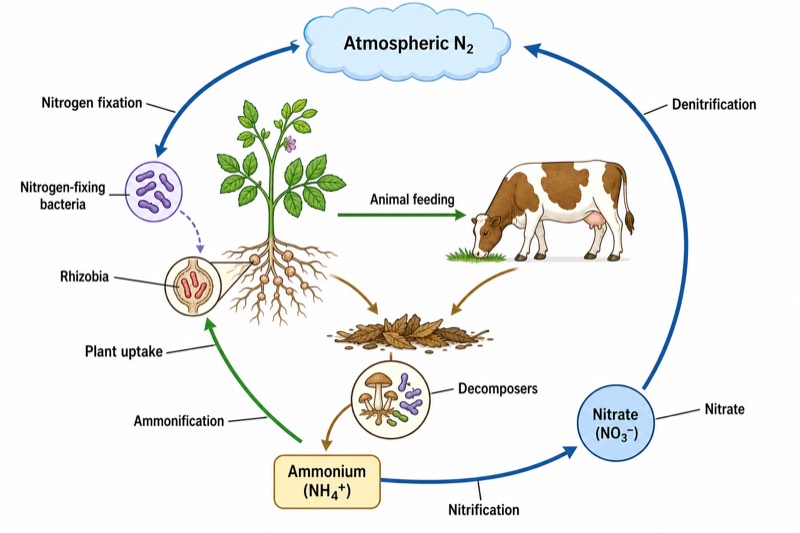
Labels included in this diagram
- Atmospheric N₂
- Nitrogen fixation
- Nitrogen-fixing bacteria
- Rhizobia
- Ammonification
- Nitrification
- Denitrification
- Nitrate
- Plant uptake
- Animal feeding
- Decomposers
✓ Accurate labels ✓ Edit text after generation ✓ PNG for papers, posters & slides
 OUTPUT · 16:9 · PNG
What this diagram shows
A nitrogen cycle diagram shows how nitrogen moves between the atmosphere, soil, plants, animals, and decomposers within an ecosystem. Atmospheric nitrogen gas cannot be used directly by most organisms. Nitrogen-fixing bacteria, including free-living bacteria and root-nodule bacteria, convert it into ammonia or ammonium compounds. Nitrifying bacteria then produce nitrites and nitrates. Plants absorb nitrates to make amino acids, proteins, and nucleic acids, while animals obtain organic nitrogen by feeding on plants or other animals.
The arrows should represent the direction of nitrogen transfer or chemical transformation. Organic nitrogen in dead organisms and waste is returned to the soil by decomposers through ammonification, producing ammonia or ammonium ions. Nitrification converts these compounds first into nitrites and then into nitrates under aerobic conditions. Nitrates may be absorbed by plant roots or converted back into atmospheric nitrogen gas by denitrifying bacteria, usually in oxygen-poor soil. Together, these linked processes recycle nitrogen while connecting biotic and abiotic components of the ecosystem.
What a correct diagram must include
- Atmospheric nitrogen gas: Place N₂ at the top or outside the ecosystem to identify the largest nitrogen reservoir.
- Nitrogen fixation: Draw an arrow from atmospheric N₂ to soil ammonia or ammonium, showing conversion by nitrogen-fixing bacteria.
- Nitrogen-fixing bacteria and root-nodule bacteria: Label both free-living soil bacteria and bacteria associated with legume root nodules.
- Ammonification and decomposers: Connect dead organisms and waste to soil ammonia or ammonium through the action of bacteria and fungi.
- Nitrification and nitrates: Show ammonia or ammonium being converted through nitrites into nitrates by nitrifying bacteria.
- Plant uptake and animal feeding: Draw nitrate uptake into plant roots, followed by nitrogen transfer from plants to animals through feeding.
- Denitrification: Draw an arrow from soil nitrates back to atmospheric N₂ and label the role of denitrifying bacteria.
- Directional arrows: Use arrowheads consistently to distinguish material flow from labels, associations, or organism locations.
Common mistakes
- Drawing plants as absorbing atmospheric N₂ directly instead of taking up mainly nitrate or ammonium ions through their roots.
- Reversing nitrification and denitrification: nitrification produces nitrates, whereas denitrification converts nitrates into nitrogen gas.
- Showing decomposers converting dead matter directly into nitrates without including ammonification and the intermediate ammonia or ammonium pool.
- Labeling root-nodule bacteria as decomposers rather than nitrogen-fixing bacteria in a mutualistic association with legumes.
- Using arrows without clear direction, making it impossible to distinguish feeding, decomposition, uptake, and chemical conversion.
Teaching tips
Use the diagram after introducing nutrient cycles or as a review before ecosystem assessment. Ask students to trace one nitrogen atom from atmospheric N₂ to a plant, an animal, decomposers, soil nitrate, and back to the atmosphere. Then remove selected labels and have students identify each process from the arrow direction. Link the diagram to examination questions on bacterial roles, plant mineral nutrition, decomposition, aerobic versus anaerobic conditions, and the effects of fertilizers or waterlogged soils on nitrate availability.
FAQ about this diagram
Why can most plants not use atmospheric nitrogen gas directly?
The triple bond in N₂ is very stable, and plants lack the enzymes needed to break it. They absorb nitrogen mainly as nitrate ions or ammonium ions after microorganisms have converted atmospheric nitrogen into usable compounds.
What is the difference between ammonification and nitrification?
Ammonification is the conversion of organic nitrogen in dead matter and waste into ammonia or ammonium compounds by decomposers. Nitrification is the aerobic bacterial oxidation of ammonium to nitrite and then nitrate.
How does denitrification differ from nitrogen fixation?
Nitrogen fixation converts atmospheric N₂ into ammonia or ammonium compounds that can enter food webs. Denitrification converts soil nitrate back into N₂, returning nitrogen to the atmosphere, especially under low-oxygen conditions.