Stages of Meiosis Generator
Free online Stages of Meiosis generator: get a fully labeled figure in about 90 seconds. The AI plans the must-have label list first, then renders a clean textbook-style diagram — every label editable afterwards, ready for papers, assignments and slides.
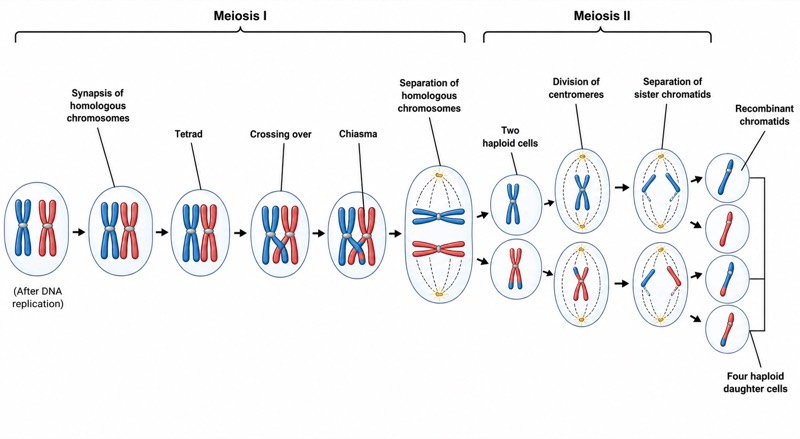
Labels included in this diagram
- Meiosis I
- Synapsis of homologous chromosomes
- Tetrad
- Crossing over
- Chiasma
- Separation of homologous chromosomes
- Two haploid cells
- Meiosis II
- Division of centromeres
- Separation of sister chromatids
- Recombinant chromatids
- Four haploid daughter cells
✓ Accurate labels ✓ Edit text after generation ✓ PNG for papers, posters & slides
 OUTPUT · 16:9 · PNG
What this diagram shows
This diagram represents meiosis, a specialized form of cell division that reduces chromosome number by half and produces four genetically different haploid cells from one diploid parent cell. Before meiosis begins, DNA is replicated once, so each chromosome consists of two sister chromatids. Meiosis I separates homologous chromosomes, while meiosis II separates sister chromatids. The diagram should show chromosome condensation, homologous chromosome pairing, tetrad formation, crossing over, alignment at the equator, separation of homologues, and final cytokinesis. Its central biological significance is the formation of haploid gametes or spores and the generation of genetic variation.
The process follows a precise sequence. In prophase I, homologous chromosomes undergo synapsis to form tetrads, and crossing over may exchange corresponding DNA segments between nonsister chromatids. In metaphase I, homologous pairs align independently at the equator; in anaphase I, homologous chromosomes move to opposite poles while sister chromatids remain joined. After meiosis I, two haploid cells form. During meiosis II, chromosomes align again, centromeres divide, and sister chromatids separate. Telophase II and cytokinesis then produce four haploid daughter cells, each containing one chromosome from every homologous pair.
What a correct diagram must include
- Show DNA replication before meiosis: each chromosome must be drawn as two sister chromatids, because replication occurs once but cell division occurs twice.
- Distinguish homologous chromosomes from sister chromatids: homologues are similar maternal and paternal chromosomes, whereas sister chromatids are identical copies joined at one centromere.
- Include synapsis and tetrad formation in prophase I: homologous chromosomes must pair closely before genetic exchange and separation.
- Mark crossing over between nonsister chromatids: exchanged segments should occur at chiasmata and remain on corresponding homologous chromosomes.
- Show homologous pairs aligned at metaphase I and separating at anaphase I: centromeres do not divide during meiosis I.
- Show centromere division and sister chromatid separation in anaphase II: this is the defining separation event of meiosis II.
- End with four haploid cells: each final cell should contain one chromosome from every homologous pair, with genetically varied combinations.
Common mistakes
- Drawing homologous chromosomes as sister chromatids: homologues may carry different alleles, while sister chromatids are replicated copies of the same chromosome.
- Showing centromeres dividing during anaphase I: homologous chromosomes separate first, but sister chromatids remain attached until anaphase II.
- Placing crossing over between sister chromatids: crossing over normally occurs between nonsister chromatids of homologous chromosomes during prophase I.
- Forgetting that DNA replication occurs only once: there is no additional S phase between meiosis I and meiosis II.
- Producing two diploid cells or four identical cells: meiosis should produce four haploid cells with genetic variation.
Teaching tips
Use the diagram first for whole-process orientation, then ask students to trace one homologous pair through both divisions. Useful questions include: What separates in meiosis I? When do centromeres divide? Why are the four products haploid and genetically different? Ask students to compare meiosis with mitosis and explain how crossing over and independent assortment contribute to variation. The diagram directly supports exam questions about chromosome number, chromatid number, DNA content, synapsis, tetrads, and the timing of chromosome separation.
FAQ about this diagram
What is the difference between a homologous chromosome pair and a pair of sister chromatids?
Homologous chromosomes are a maternal chromosome and a paternal chromosome with the same genes in the same order, although their alleles may differ. Sister chromatids are two copies of one chromosome produced during DNA replication and joined at the centromere.
Why does chromosome number become half after meiosis I?
Meiosis I separates homologous chromosomes, so each daughter cell receives only one chromosome from each homologous pair. The chromosomes still consist of two sister chromatids, but the chromosome number has already been reduced from diploid to haploid.
Why are the four cells formed by meiosis genetically different?
Crossing over exchanges DNA between nonsister chromatids during prophase I, and independent assortment gives homologous pairs different orientations at metaphase I. These processes create different combinations of alleles in the final haploid cells.