DNA Replication Diagram Generator
Free online DNA Replication Diagram generator: get a fully labeled figure in about 90 seconds. The AI plans the must-have label list first, then renders a clean textbook-style diagram — every label editable afterwards, ready for papers, assignments and slides.
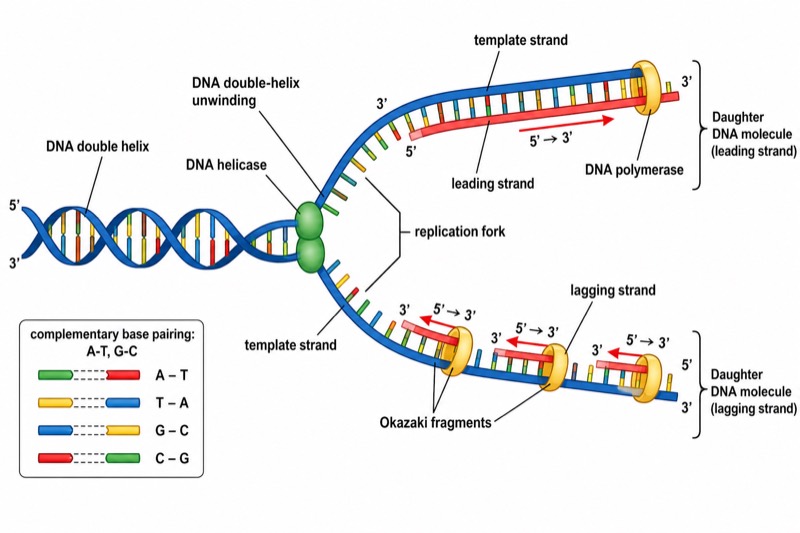
Labels included in this diagram
- DNA double helix
- DNA double-helix unwinding
- DNA helicase
- replication fork
- template strand
- leading strand
- lagging strand
- Okazaki fragments
- DNA polymerase
- complementary base pairing: A-T, G-C
✓ Accurate labels ✓ Edit text after generation ✓ PNG for papers, posters & slides
 OUTPUT · 16:9 · PNG
What this diagram shows
A DNA replication diagram shows how one parental DNA double helix produces two identical daughter DNA molecules. Helicase unwinds the double helix and separates the parental strands by breaking the hydrogen bonds between complementary bases. Each exposed parental strand then acts as a template for the synthesis of a new strand. DNA polymerase adds complementary nucleotides according to the base-pairing rules A–T and G–C. The final diagram should emphasize semiconservative replication: each daughter DNA molecule contains one parental strand and one newly synthesized strand.
The two template strands are antiparallel, while DNA polymerase can synthesize DNA only in the 5′ to 3′ direction. Therefore, the leading strand is synthesized continuously toward the replication fork. The lagging strand is synthesized discontinuously away from the fork as short Okazaki fragments, each beginning from an RNA primer. DNA polymerase extends these fragments, and DNA ligase eventually joins them into a continuous strand. Direction arrows and 5′ and 3′ labels are essential because they explain why the two new strands are produced differently even though both follow complementary base pairing.
What a correct diagram must include
- Parental double helix and replication fork — draw the DNA opening into a Y-shaped fork so the starting structure and replication region are clear.
- Helicase — place and label helicase at the replication fork, where it separates the two parental strands by disrupting hydrogen bonds.
- Template strands — label both original strands as templates and show that each directs the formation of a complementary new strand.
- 5′ and 3′ ends — mark strand polarity accurately because DNA polymerase synthesizes new DNA only in the 5′ to 3′ direction.
- Leading strand — show continuous synthesis toward the replication fork on the template running 3′ to 5′ toward the fork.
- Lagging strand and Okazaki fragments — show several short DNA segments synthesized away from the fork rather than one continuous strand.
- DNA polymerase — position it at the growing 3′ end of each new strand and use arrows to indicate the direction of nucleotide addition.
- Complementary base pairing and final products — include A–T and G–C pairing and show two daughter molecules, each containing one parental strand and one new strand.
Common mistakes
- Drawing both new strands as continuously synthesized; only the leading strand is continuous, whereas the lagging strand forms Okazaki fragments.
- Showing DNA polymerase synthesizing in the 3′ to 5′ direction; new DNA is always extended in the 5′ to 3′ direction.
- Placing helicase behind DNA polymerase or on completed DNA; helicase should be located at the replication fork where strand separation occurs.
- Pairing bases incorrectly, such as A with G or C with T; standard DNA complementary pairing is A–T and G–C.
- Drawing each daughter molecule with either two parental strands or two new strands; semiconservative replication produces one parental strand and one new strand in each molecule.
Teaching tips
Use the diagram after reviewing DNA structure and complementary base pairing, then ask students to trace each parental strand through the replication fork. Questions such as “Why are Okazaki fragments necessary?” and “Which direction does DNA polymerase move?” connect strand polarity with continuous and discontinuous synthesis. Students can color parental and new strands differently, add 5′ and 3′ labels, and predict the composition of daughter molecules. The diagram directly supports assessment of semiconservative replication, enzyme functions, complementary base pairing, and the distinction between leading and lagging strands.
FAQ about this diagram
Why is DNA replication described as semiconservative?
Each daughter DNA molecule retains one strand from the parental molecule and contains one newly synthesized strand. Complementary base pairing allows each parental strand to serve as a template.
Why does the lagging strand form Okazaki fragments?
The two template strands are antiparallel, but DNA polymerase can synthesize only in the 5′ to 3′ direction. The lagging strand must therefore be produced in short sections away from the replication fork and later joined by DNA ligase.
What are the different roles of helicase and DNA polymerase?
Helicase unwinds the double helix and separates the parental strands at the replication fork. DNA polymerase uses each exposed strand as a template and adds complementary nucleotides to the growing 3′ end.