Unlabeled Phylogenetic Tree (Blank Worksheet)
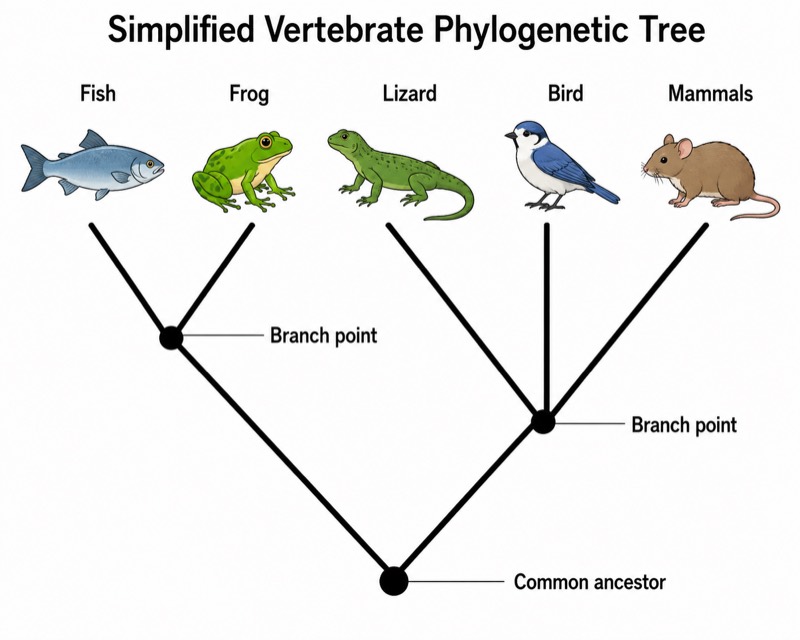
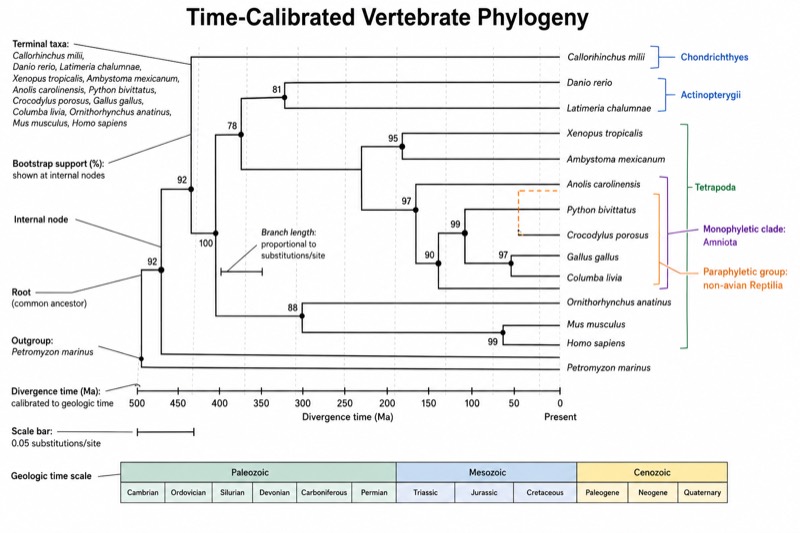
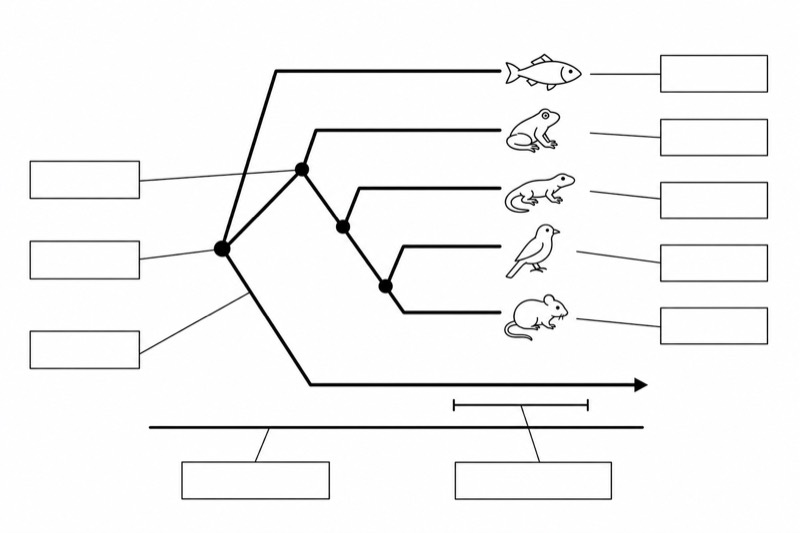
Unlabeled Phylogenetic Tree (Blank Worksheet) — an alternative version of the Phylogenetic Tree, generated by AI and fully editable. Download the PNG for quizzes, homework or slides.
✓ Accurate labels ✓ Edit text after generation ✓ PNG for papers, posters & slides
 OUTPUT · 16:9 · PNG
What this diagram shows
This unlabeled phylogenetic tree presents a simplified pattern of vertebrate evolution from a shared root to branches representing fishes, amphibians, reptiles, birds, and mammals. Unlike the standard main diagram, it contains no words, letters, numbers, taxon names, or completed annotations. Thin leader lines connect important tips, nodes, branches, the common-ancestor region, and the evolutionary time axis to evenly arranged blank boxes. This blank worksheet version is designed for active recall: students must supply the biological terms and relationships instead of merely reading labels from a completed figure.
Read the tree from the root toward the terminal branches, noting where one lineage divides into two descendant lineages. Each branching node represents a most recent common ancestor, while the branching pattern indicates relative evolutionary relatedness. Students can write group names, node descriptions, or structural terms in the empty boxes and use the unnumbered axis to discuss relative time. Branch length should be interpreted as elapsed time only when the exercise defines the tree as time-scaled. This unlabeled phylogenetic tree (blank worksheet) is preferable to the standard version when assessment, retrieval practice, or student-generated annotation is the goal.
Teaching tips
- In-class quiz: print one copy per student and ask learners to identify the five vertebrate groups, mark the root, and label selected common ancestors without consulting notes.
- Homework assignment: have students complete every blank box, then add one sentence explaining why birds share a more recent common ancestor with certain reptile lineages than with amphibians.
- Presentation activity: display the blank tree before showing the labeled main diagram, invite students to propose labels, and reveal the completed version afterward for correction and discussion.
- Revision outline or printable handout: students can annotate nodes, sister groups, terminal taxa, evolutionary direction, and branch-length meaning, then keep the completed sheet as a study guide.
- Report or paper figure planning: use the blank framework to draft taxon placement, leader-line positions, and caption terminology before preparing a fully labeled scholarly illustration; do not treat the simplified topology as primary phylogenetic evidence.
FAQ about this diagram
Why use the blank worksheet instead of the standard labeled phylogenetic tree?
The standard diagram supports explanation because names and structural terms are already visible. This version removes those cues, so it is better for checking whether students can independently recognize roots, nodes, branches, common ancestors, terminal groups, and evolutionary direction.
Do longer branches always represent more evolutionary time or greater genetic change?
No. Branch length has quantitative meaning only when the tree is explicitly scaled to time or amount of change. On a basic cladogram, students should primarily interpret the order of branching and the recency of common ancestry, not visual line length.