Simple Phylogenetic Tree for Middle School
Simple Phylogenetic Tree for Middle School — an alternative version of the Phylogenetic Tree, generated by AI and fully editable. Download the PNG for quizzes, homework or slides.
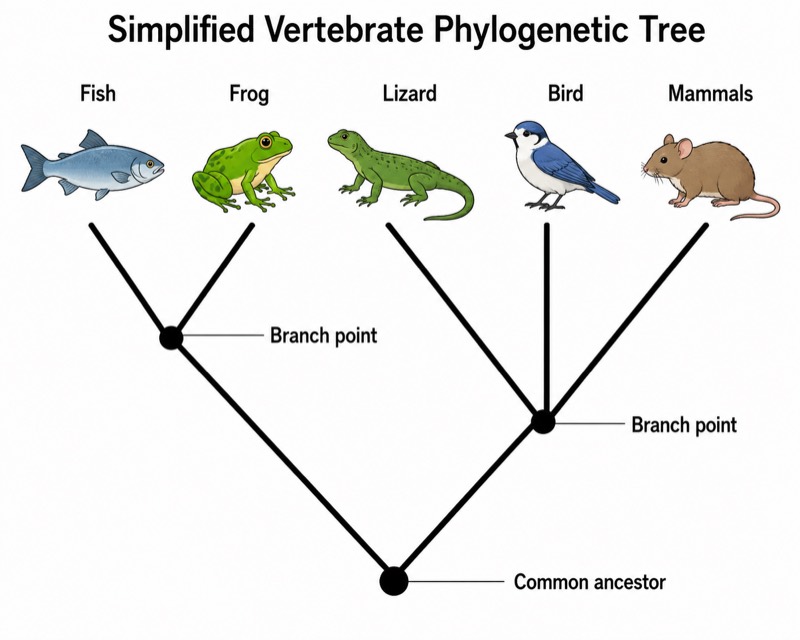
Labels included in this diagram
- Common ancestor
- Branch point
- Fish
- Frog
- Lizard
- Bird
- Mammals
✓ Accurate labels ✓ Edit text after generation ✓ PNG for papers, posters & slides
 OUTPUT · 16:9 · PNG
What this diagram shows
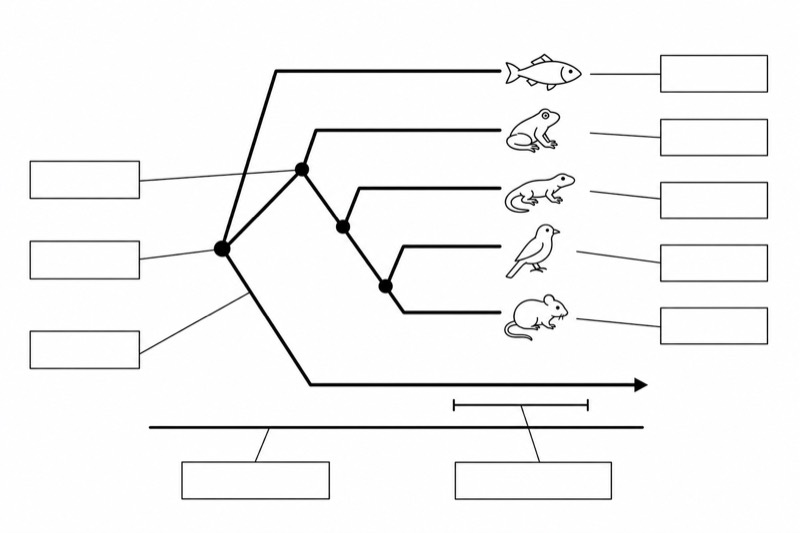
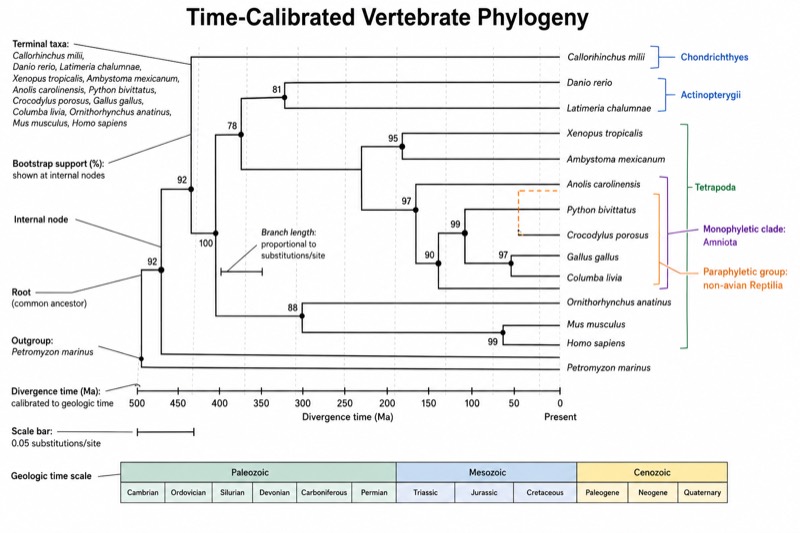
This simple phylogenetic tree for middle school shows only five terminal groups: fish, frogs, lizards, birds, and mammals. Cartoon animal silhouettes identify each group, while a root marks the common ancestor and a small number of branching nodes show where lineages separate. Unlike a standard phylogenetic tree, which may include many taxa, detailed labels, evolutionary time, or derived traits, this version keeps only the essential structures. The reduced design gives students enough space to recognize the basic branching pattern without being distracted by advanced evidence or terminology.
Read the tree from the common ancestor at the root toward the five groups at the branch tips. Each node represents a shared ancestral lineage that divided into descendant lineages; it does not mean that one living group changed directly into another. Students can trace branches backward to compare common ancestry and identify which groups share a more recent node. Use this simplified version before introducing a standard tree with clades, character changes, time scales, or scientific names. Its purpose is to establish accurate reading habits through a clear, limited example.
Teaching tips
- In-class quiz: remove or cover the node labels and ask students to mark the root, one branch, one node, and the five terminal groups.
- Homework: have students trace two groups back to their shared node and explain in one sentence what that node represents.
- Presentation slide: display the diagram while modeling how to read from the root to the tips before showing a more detailed standard phylogenetic tree.
- Review outline: place the tree beside short definitions of common ancestor, branch, node, and terminal group so students can connect each term to a visible structure.
- Printed handout or introductory report figure: use the uncluttered tree when the goal is to explain basic relatedness rather than evolutionary dates, anatomical evidence, or a complete classification.
FAQ about this diagram
Why does this version include only five animal groups?
Limiting the tree to fish, frogs, lizards, birds, and mammals makes the root-to-tip pattern easier for beginners to follow. A standard main diagram may show more taxa and evidence, but this version is designed to teach the structure of a tree before adding complexity.
Does the tree show that mammals evolved from modern fish, frogs, or lizards?
No. The branches indicate that the terminal groups share ancestors at different nodes, not that one modern group directly became another. The simple layout helps students focus on common ancestry, while a standard tree can later add more precise intermediate lineages and supporting traits.