Simple Neuron Diagram for Middle School
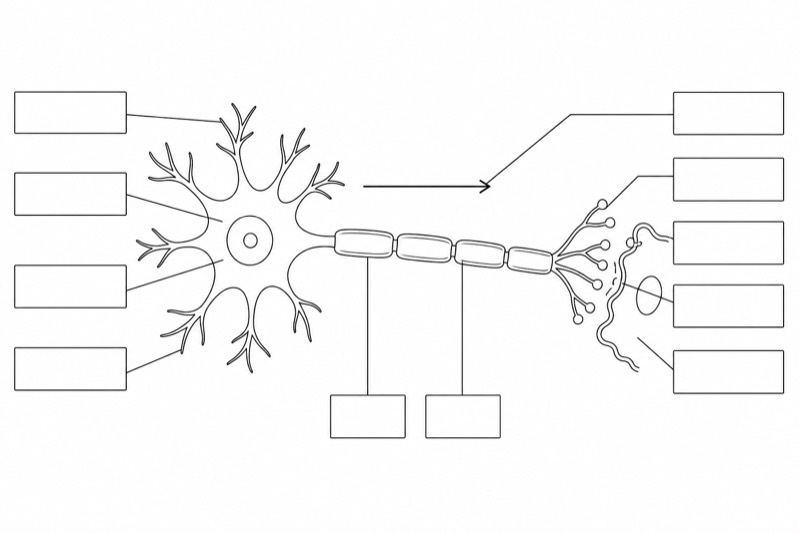
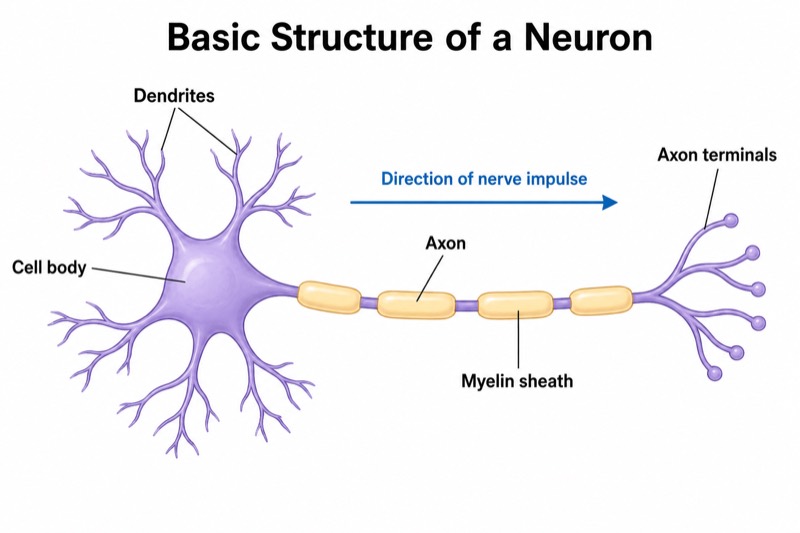
Simple Neuron Diagram for Middle School — an alternative version of the Structure of a Neuron, generated by AI and fully editable. Download the PNG for quizzes, homework or slides.
Labels included in this diagram
- Cell body
- Dendrites
- Axon
- Myelin sheath
- Axon terminals
- Direction of nerve impulse
✓ Accurate labels ✓ Edit text after generation ✓ PNG for papers, posters & slides
 OUTPUT · 16:9 · PNG
What this diagram shows
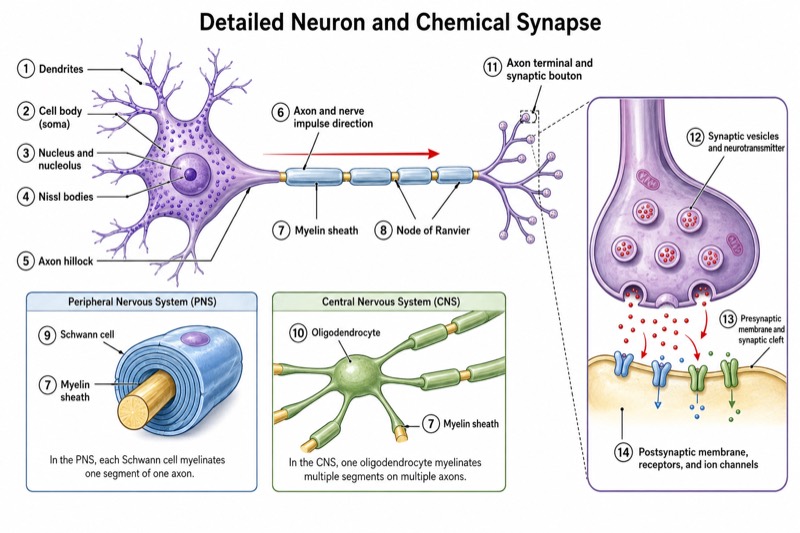
This simple neuron diagram for middle school shows only five essential structures: the cell body, dendrites, axon, myelin sheath, and axon terminals. An arrow indicates the direction of nerve impulse transmission. Unlike the standard main diagram, it leaves out the nucleus, nodes of Ranvier, Schwann cells, synapses, and other fine details. This reduced version is useful because younger learners can focus on the neuron's overall shape and basic pathway without being distracted by unfamiliar terminology or microscopic features.
Read the diagram from the dendrites toward the cell body, then follow the axon to the axon terminals. The direction arrow reinforces this simplified sequence of information flow. Students can use the image to identify each structure, match structures with basic functions, or trace the path of a nerve impulse. Compared with the standard main diagram, this version supports first exposure and rapid review rather than detailed cellular analysis. After students can label these five parts confidently, teachers can introduce a more complete neuron diagram.
Teaching tips
- In-class quiz: Remove or cover the five labels and ask students to identify the cell body, dendrites, axon, myelin sheath, and axon terminals, then draw an arrow showing impulse direction.
- Homework: Have students copy the simplified diagram, label each structure, and write one short function statement for every part without adding structures from the standard main diagram.
- Presentation slide: Use the diagram when first introducing neurons, guiding the class from dendrites to axon terminals before showing the more detailed standard version.
- Review outline or printed handout: Place the diagram beside a five-row structure-and-function table so students can connect each visible part with its basic role.
- Introductory report illustration: Include the diagram in a middle school paper when the discussion concerns basic neuron organization; use a standard scientific diagram instead if microscopic detail is required.
FAQ about this diagram
Why does this version omit structures shown in a standard neuron diagram?
The omissions are intentional. Limiting the image to five basic structures reduces cognitive load and helps younger students learn the neuron's main organization before studying nuclei, nodes, supporting cells, or synapses.
Does the arrow show exactly how a nerve impulse travels?
The arrow shows the basic teaching sequence: dendrites and cell body toward the axon and axon terminals. This is an age-appropriate simplification; more advanced lessons should distinguish electrical signaling along the neuron from chemical signaling between cells.