Simple Free Body Diagram for Middle School
Simple Free Body Diagram for Middle School — an alternative version of the Free-Body Diagram on an Inclined Plane, generated by AI and fully editable. Download the PNG for quizzes, homework or slides.
Labels included in this diagram
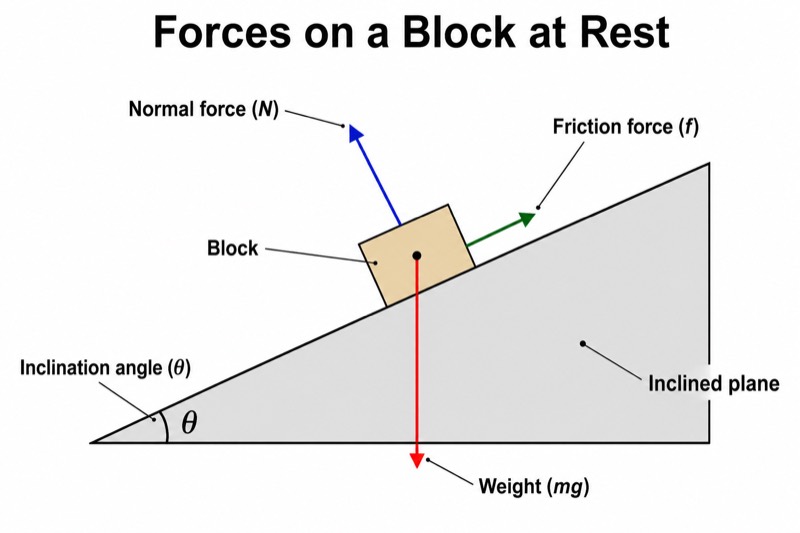
- Block
- Inclined plane
- Weight (mg)
- Normal force (N)
- Friction force (f)
- Inclination angle (θ)
✓ Accurate labels ✓ Edit text after generation ✓ PNG for papers, posters & slides
 OUTPUT · 16:9 · PNG
What this diagram shows
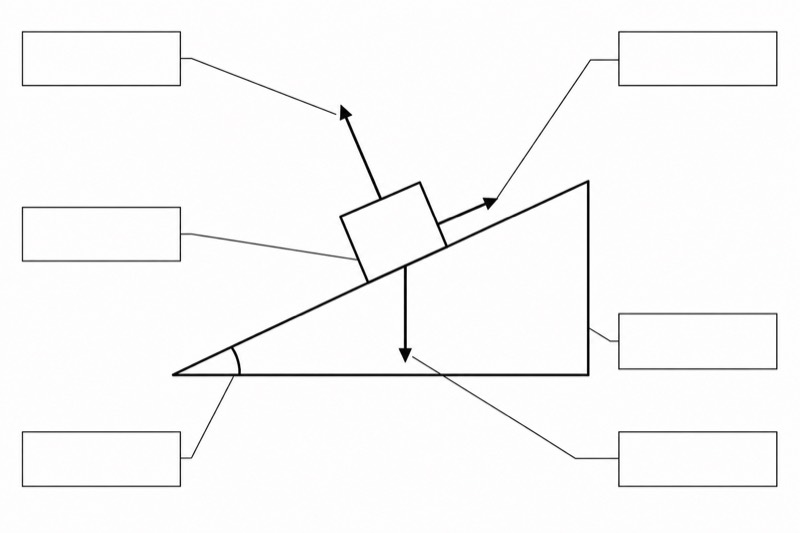
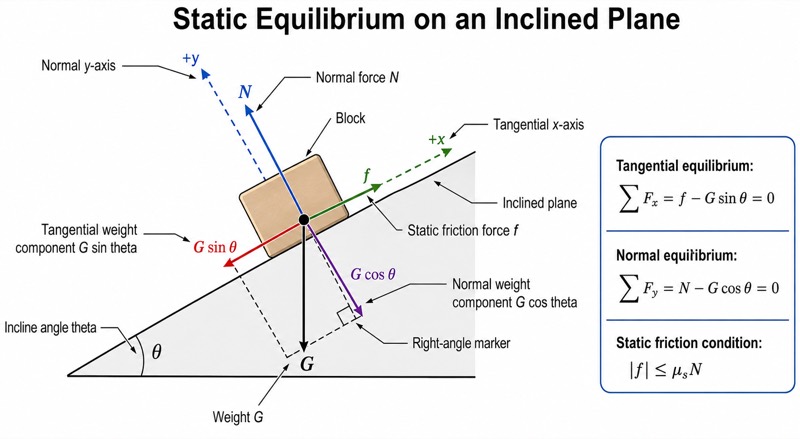
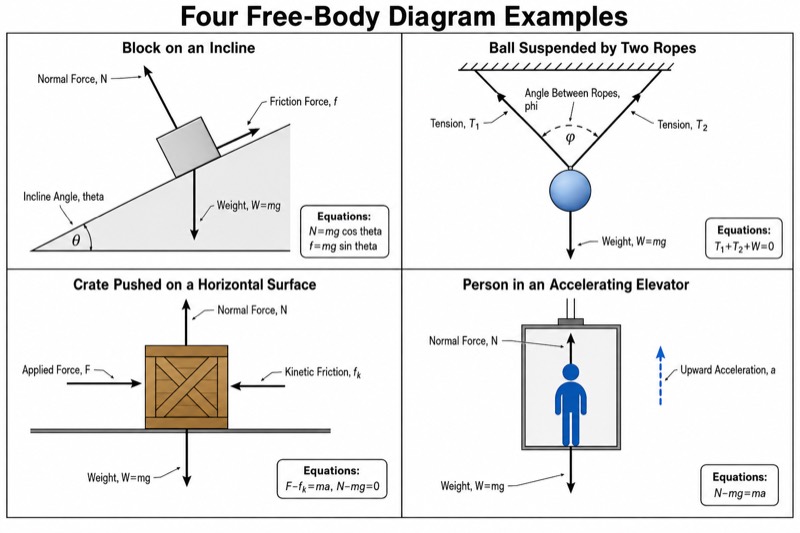
This simple free body diagram for middle school shows a square block at rest on an inclined plane. Only three forces are included: gravity acting vertically downward, the normal force acting perpendicular to the plane, and friction acting up the slope to oppose the block’s tendency to slide downward. The incline angle θ is also marked. Unlike the standard main diagram, this version omits coordinate axes, force components, equations, motion details, and extra construction lines. Thick arrows, large labels, balanced spacing, and generous white space reduce visual load, making the essential force directions easier for younger learners to identify.
Read each arrow from the block outward and compare its direction with the inclined surface. Gravity always points straight down, not along the slope. The normal force is perpendicular to the surface, while static friction is parallel to the surface and points uphill in this resting-block example. Students can use the diagram to name the forces, describe their directions, or explain why the block remains stationary. The simplified version should be used before the standard main diagram: it builds a clear conceptual foundation without introducing weight components or axes too early. Later, students can add those features when solving quantitative problems.
Teaching tips
- In-class quiz: remove the three force labels and ask students to identify gravity, the normal force, and friction from their arrow directions. Use the standard main diagram only in a later question that introduces components.
- Homework: ask students to redraw the simplified figure, state which force is perpendicular to the slope, and explain why friction points uphill. This checks basic understanding without requiring trigonometry.
- Presentation slide: display the diagram before showing a full inclined-plane analysis. Reveal one force at a time so students can distinguish vertical, perpendicular, and parallel directions.
- Review sheet or printed handout: place the large, uncluttered diagram beside a short force-direction table. Its thick arrows and limited labels remain readable when printed in grayscale or reduced in size.
- Introductory report or paper illustration: use this variant when the text discusses only the qualitative forces on a stationary block. Choose the standard main diagram instead if the discussion requires coordinate axes, weight components, equations, or calculated force magnitudes.
FAQ about this diagram
Why does this version omit the components of gravity?
The purpose is to help learners recognize actual forces before decomposing them mathematically. Weight components parallel and perpendicular to the slope are calculation tools, not additional forces, so they belong in the standard main diagram rather than this simplified version.
Why does the friction arrow point up the incline?
Without friction, the block would tend to slide down the incline because of gravity. Static friction therefore acts up the slope to oppose that tendency; if the tendency of motion changed, the direction of friction could change as well.