Free Body Diagram Examples (4 Worked Cases)
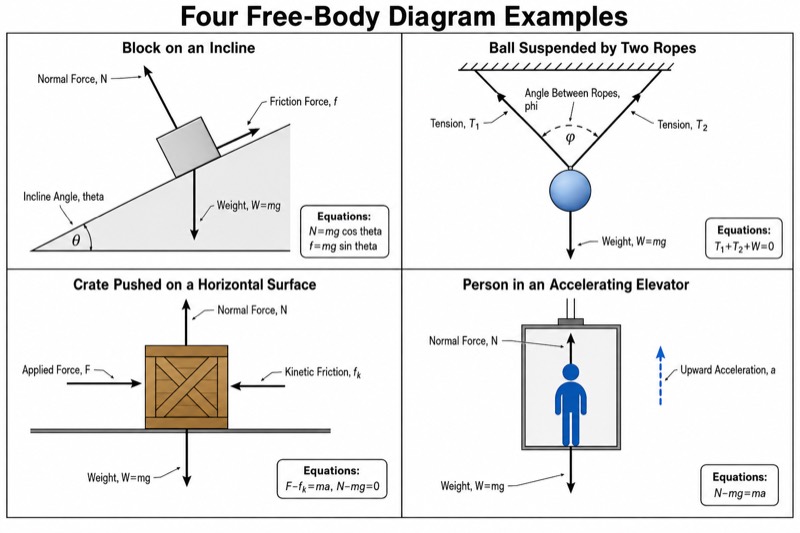
Free Body Diagram Examples (4 Worked Cases) — an alternative version of the Free-Body Diagram on an Inclined Plane, generated by AI and fully editable. Download the PNG for quizzes, homework or slides.
Labels included in this diagram
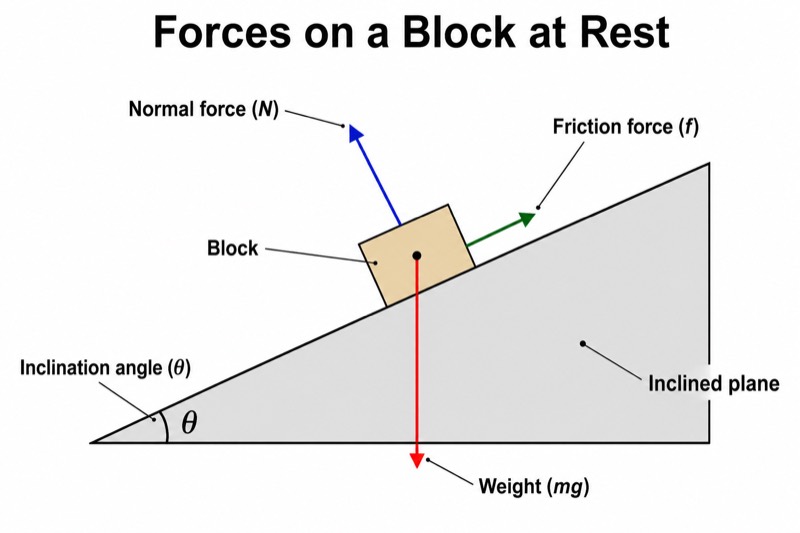
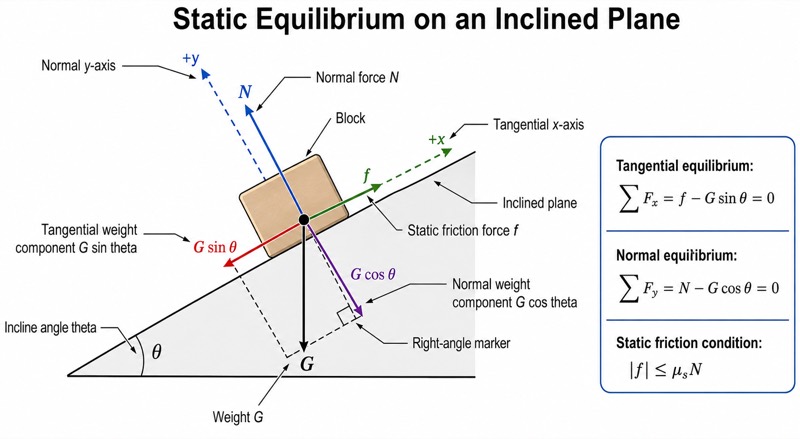
- Block on an Incline
- Ball Suspended by Two Ropes
- Crate Pushed on a Horizontal Surface
- Person in an Accelerating Elevator
- Weight, W=mg
- Normal Force, N
- Friction Force, f
- Tensions, T1 and T2
- Applied Force, F
- Kinetic Friction, fk
- Incline Angle, theta
- Angle Between Ropes, phi
- Upward Acceleration, a
- Equations: N=mg cos theta, f=mg sin theta; T1+T2+W=0; F-fk=ma, N-mg=0; N-mg=ma
✓ Accurate labels ✓ Edit text after generation ✓ PNG for papers, posters & slides
 OUTPUT · 16:9 · PNG
What this diagram shows
This Free Body Diagram Examples (4 Worked Cases) page expands the standard inclined-plane diagram into a 2×2 comparison grid. The four panels show a block on a slope, a ball suspended by two ropes, a pushed box on level ground, and a person in an upward-accelerating elevator. Unlike the standard main figure, which develops one inclined-plane problem in detail, this version compares how force selection changes across situations. Uniform arrow weights and simplified blocks or points keep attention on force direction, while an equation in each panel connects the diagram to equilibrium or Newton’s second law.
Read each panel by first isolating the object, then identifying only forces acting directly on it. For the slope, resolve weight relative to the incline and compare friction with the downslope component. For the suspended ball, use the two tension directions and their included angle; for the pushed box, compare the applied force with kinetic friction; for the elevator passenger, note that upward acceleration requires the normal force to exceed weight. Use this version when students need transferable diagram-reading practice rather than the standard figure’s focused treatment of one inclined-plane case.
Teaching tips
- In-class quiz: hide the force labels or lower-right equations and ask students to identify each force, choose axes, and write the appropriate equilibrium or Newton’s second law equation.
- Homework: assign one panel at a time and require students to resolve components, determine the sign of each force, and explain whether the object is in equilibrium or accelerating.
- Lecture slides: display the 2×2 grid after teaching the standard inclined-plane figure to show which diagramming rules remain constant when ropes, pushes, friction, or vertical acceleration are introduced.
- Review sheet or printed handout: place the four cases beside a checklist—identify the body, draw external forces, select axes, resolve components, and apply ΣF = ma—for rapid exam preparation.
- Report or paper illustration: use the compact comparison when a single figure must distinguish equilibrium cases from accelerated motion without reproducing a full derivation for every example.
FAQ about this diagram
How is this four-case version different from the standard inclined-plane diagram?
The standard main diagram concentrates on one block and usually emphasizes resolving gravity into components parallel and perpendicular to the slope. This version sacrifices some single-case detail to compare four force patterns, making it better for classification, transfer practice, and mixed-problem review.
Why does the elevator diagram show a larger normal force than weight?
For upward acceleration, Newton’s second law gives N − mg = ma, so N = m(g + a). The person may be moving upward or downward at that instant; the key condition is that the acceleration arrow points upward.