Unlabeled ER Diagram (Blank Worksheet)
Unlabeled ER Diagram (Blank Worksheet) — an alternative version of the Entity-Relationship Diagram, generated by AI and fully editable. Download the PNG for quizzes, homework or slides.
✓ Accurate labels ✓ Edit text after generation ✓ PNG for papers, posters & slides
 OUTPUT · 16:9 · PNG
What this diagram shows
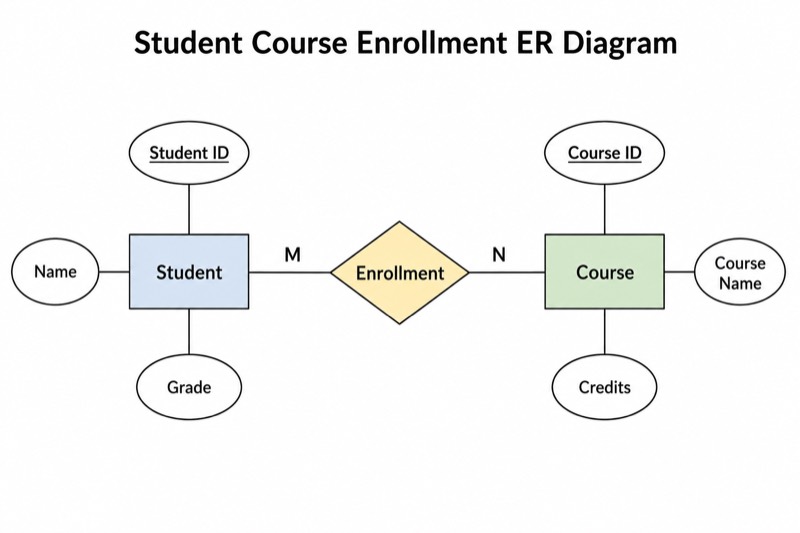
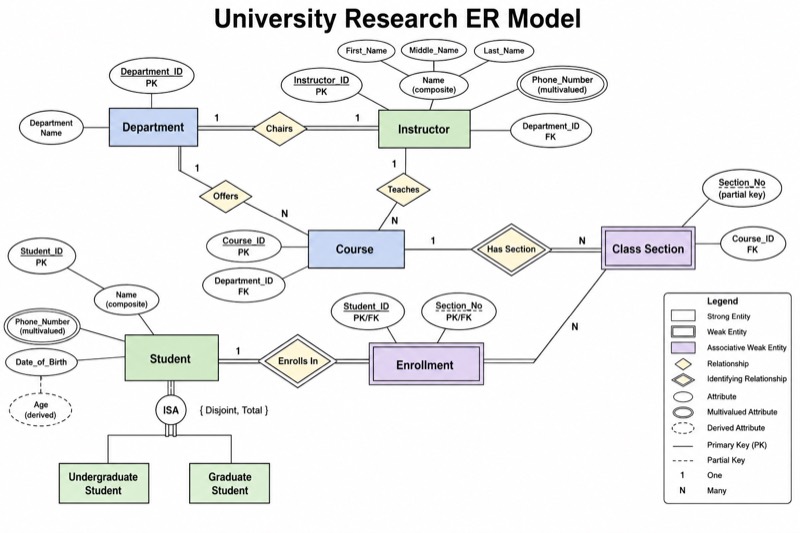
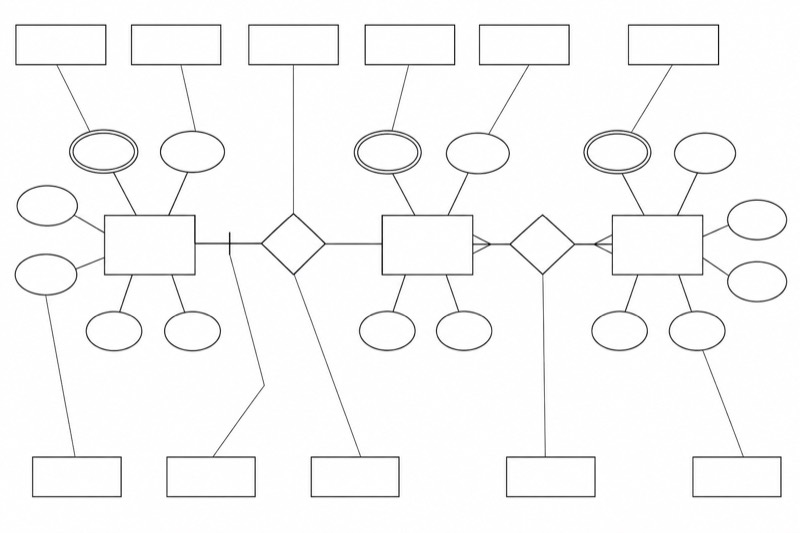
This unlabeled ER diagram (blank worksheet) presents the structure of a student–enrollment–course database without showing any words, letters, or numbers. Rectangles represent entities, ellipses represent attributes, and a diamond represents the relationship, while connecting lines preserve the intended database structure. Unlike the standard ER diagram, which directly names every component and displays primary-key and cardinality labels, this version replaces all answers with uniform blank boxes connected by thin leader lines. The missing labels make the page useful for retrieval practice, assessment, and checking whether students understand ER notation rather than merely recognizing a completed example.
Read the worksheet first by identifying each shape according to ER conventions, then follow its leader line to the corresponding blank box. Students can write entity names, attribute names, relationship names, underline the appropriate primary-key entries, and supply cardinalities such as 1:N or M:N where required. The underlying arrangement still models three entities connected through enrollment, but the standard diagram’s explanatory labels have been deliberately removed. Use this blank version after teaching with the labeled main diagram: the completed version introduces the model, while the worksheet requires learners to reconstruct its meaning independently and gives teachers clear evidence of misconceptions.
Teaching tips
- In-class quiz: display or print the worksheet and ask students to complete every blank box from memory, including entity types, attributes, primary keys, the relationship, and 1:N or M:N cardinalities.
- Homework assignment: provide the unlabeled sheet after a lesson on ER modeling, then require students to submit both their completed labels and a short explanation of why each relationship has its chosen cardinality.
- Presentation activity: place the blank diagram on a slide and invite students to fill one callout at a time, using the labeled standard diagram only afterward for class correction and discussion.
- Revision outline: add the worksheet to a study guide so learners can repeatedly reconstruct the student–enrollment–course model and compare each attempt with the standard labeled version.
- Printed handout or paper illustration: use the clean black-and-white layout as an annotation exercise, or include it in an academic appendix when readers are expected to analyze and complete the ER structure themselves.
FAQ about this diagram
Why use an unlabeled ER diagram instead of the standard labeled diagram?
The standard diagram is best for explanation because it reveals entity names, attributes, keys, relationships, and cardinalities immediately. The blank worksheet removes those cues, turning the same structure into an active-recall task that tests whether learners can interpret ER notation independently.
What should students enter in the blank callout boxes?
Students should supply the missing entity, attribute, and relationship names, identify and underline primary keys, and add the required 1:N or M:N cardinalities. Teachers may assign all boxes for a formal quiz or prefill selected answers to create a scaffolded exercise.