Simple ER Diagram for Middle School
Simple ER Diagram for Middle School — an alternative version of the Entity-Relationship Diagram, generated by AI and fully editable. Download the PNG for quizzes, homework or slides.
Labels included in this diagram
- Student
- Student ID
- Name
- Grade
- Enrollment
- Course
- Course ID
- Course Name
- Credits
- M
- N
✓ Accurate labels ✓ Edit text after generation ✓ PNG for papers, posters & slides
 OUTPUT · 16:9 · PNG
What this diagram shows
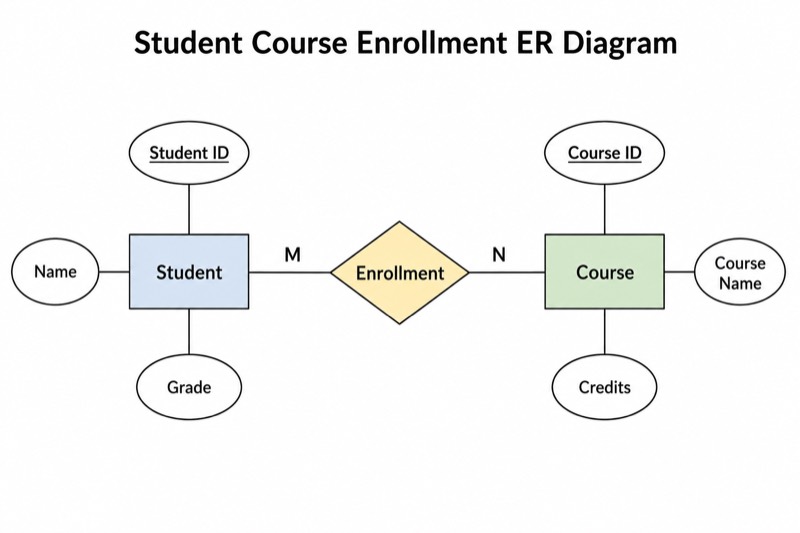
This simple ER diagram for middle school keeps only the structures needed for a first lesson: two entity rectangles, Student and Course; one Enrollment relationship diamond; and three attribute ovals for each entity. Student ID and Course ID are underlined to identify the primary keys, while M:N labels show that many students may take many courses. Unlike a standard ER diagram, this version omits weak entities, composite or multivalued attributes, participation constraints, and implementation details. The reduced content prevents unfamiliar notation from distracting learners who are still distinguishing entities, attributes, relationships, and keys.
Read the diagram from the outside toward the center. First, identify Student and Course as the two kinds of things about which data is stored. Next, read their attached ovals as descriptive attributes and note that the underlined attributes uniquely identify records. Finally, follow the lines to Enrollment and interpret M:N in both directions: one student can enroll in many courses, and one course can include many students. Use this simplified version before the standard main diagram so learners can practice the basic visual grammar, explain the model aloud, or convert its elements into simple database tables.
Teaching tips
- In-class quiz: remove several labels and ask students to restore Student, Course, Enrollment, the primary-key underlines, and the M:N cardinality.
- Homework: have learners write one sentence for each entity, list its three attributes, and explain why Student ID or Course ID is a better key than a name.
- Presentation slide: reveal the two entities first, add their attributes, and then introduce the relationship diamond and M:N labels step by step.
- Review outline or printed handout: place the diagram beside short definitions of entity, attribute, relationship, primary key, and many-to-many cardinality for quick recall.
- Introductory report or paper illustration: use the compact diagram when the text needs a basic conceptual example without the extra notation found in a standard ER model.
FAQ about this diagram
Why does this version omit details found in a standard ER diagram?
Its purpose is to teach the smallest complete set of ER concepts: entities, attributes, primary keys, a relationship, and cardinality. Advanced notation is intentionally omitted so middle school learners can master these foundations before reading a standard main diagram.
Does the M:N relationship need another entity when the design becomes a database?
Yes. In a relational database, the many-to-many Enrollment relationship is usually converted into an associative table containing Student ID and Course ID as foreign keys. That implementation step is excluded here because this version focuses on reading a conceptual ER diagram, not building the full table design.