Unlabeled Cladogram (Blank Worksheet)
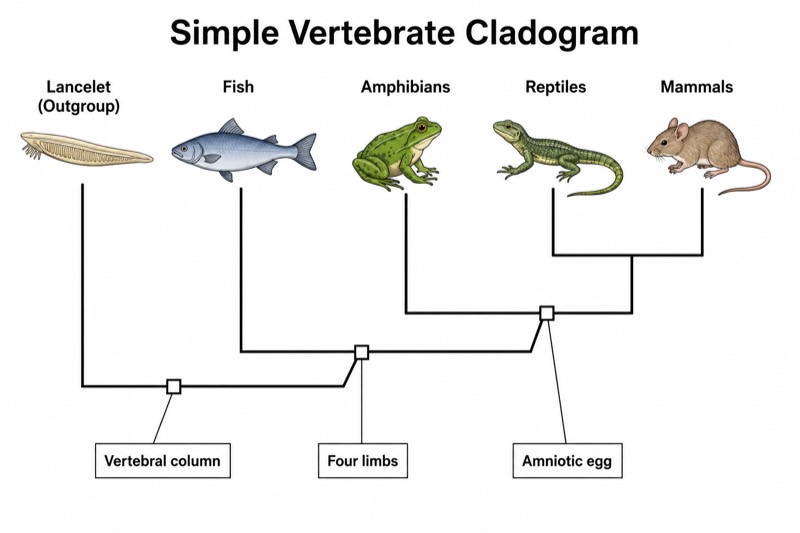
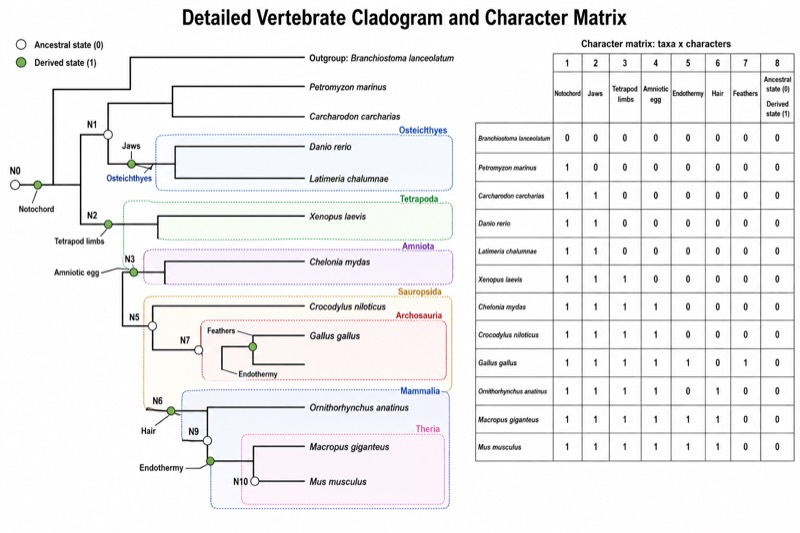
Unlabeled Cladogram (Blank Worksheet) — an alternative version of the Cladogram, generated by AI and fully editable. Download the PNG for quizzes, homework or slides.
✓ Accurate labels ✓ Edit text after generation ✓ PNG for papers, posters & slides
 OUTPUT · 16:9 · PNG
What this diagram shows
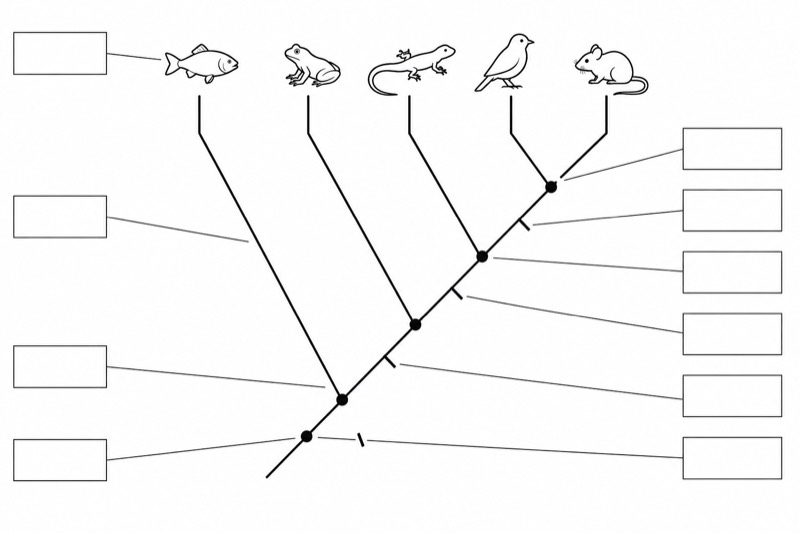
This unlabeled cladogram (blank worksheet) presents a stepwise branching diagram for practicing evolutionary relationships based on shared derived characteristics. Its structure includes an outgroup branch, common-ancestor nodes, and positions for traits such as the amniotic egg, endothermy, and hair. Unlike the standard main diagram, it contains no words, letters, numbers, or species names. Each item to be identified has a thin leader line connected to an evenly sized blank rectangular box. Removing the completed labels turns the reference diagram into an active-recall exercise suitable for handwriting, assessment, and independent reconstruction.
Read the diagram from the ancestral base toward the terminal branches. Each node represents a hypothetical common ancestor, while each trait position indicates a derived characteristic shared by the lineages branching beyond that point unless a later loss is specified. Students can fill the boxes with organism names, clade names, structural terms, or derived traits supplied by the teacher. Because this blank version does not provide the answers shown in the standard diagram, learners must infer placements from branching order and character distribution. Branch proximity indicates recency of common ancestry, not overall similarity or evolutionary advancement.
Teaching tips
- In-class quiz: provide a word bank of taxa and derived traits, then ask students to place each term in the correct blank box without consulting the labeled reference diagram.
- Homework practice: assign the worksheet after teaching shared derived characters, requiring students to complete the labels and justify two selected placements in writing.
- Presentation or digital lesson: display the blank cladogram first, invite students to propose labels one branch at a time, and reveal a separate completed version for feedback.
- Review outline or printed handout: let students annotate the boxes, circle sister taxa, mark the outgroup, and trace the most recent common ancestor of selected lineages.
- Report or paper figure exercise: use the uncluttered structure as a template for students to add taxa and character evidence from a dataset, while noting that a cladogram represents branching relationships rather than elapsed time.
FAQ about this diagram
How is this blank worksheet different from a standard labeled cladogram?
The branching structure and answer locations are retained, but all names, letters, numbers, and trait labels are removed. The standard diagram supports explanation and reference, whereas this version requires students to retrieve terms and interpret relationships independently.
Can the lengths of branches be used to compare evolutionary time or amount of change?
Not unless a scale or explicit convention is provided. In a basic cladogram, the branching order and nodes carry the main meaning; line length and the left-to-right arrangement of terminal taxa are usually not quantitative.