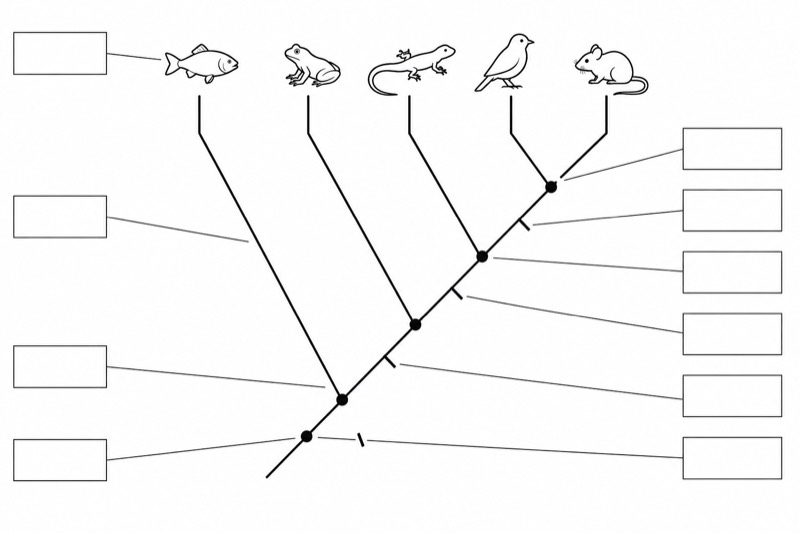
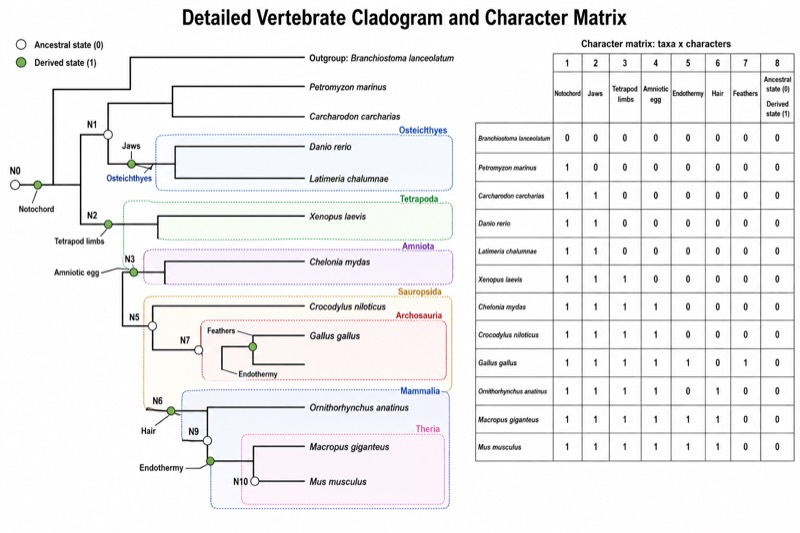
Simple Cladogram for Middle School
Simple Cladogram for Middle School — an alternative version of the Cladogram, generated by AI and fully editable. Download the PNG for quizzes, homework or slides.
Labels included in this diagram
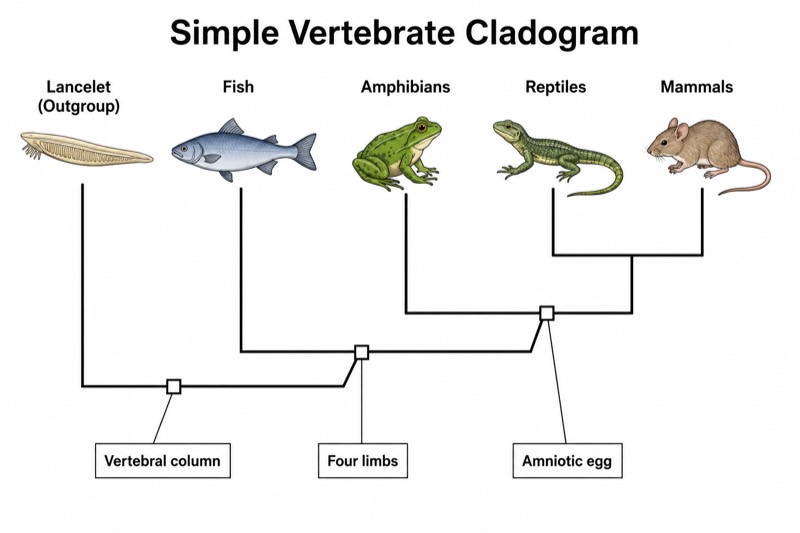
- Lancelet
- Outgroup
- Fish
- Amphibians
- Reptiles
- Mammals
- Vertebral column
- Four limbs
- Amniotic egg
✓ Accurate labels ✓ Edit text after generation ✓ PNG for papers, posters & slides
 OUTPUT · 16:9 · PNG
What this diagram shows
This Simple Cladogram for Middle School shows five groups in a staircase arrangement, including one labeled outgroup. Small squares mark branching nodes, while three shared derived traits—vertebral column, four limbs, and amniotic egg—appear along the main line. Unlike a standard cladogram, which may include many taxa, additional traits, scientific names, and more complex branching patterns, this version keeps only the structures needed to introduce evolutionary relationships. The reduced detail, large type, balanced layout, and generous white space help upper-elementary and middle school students focus on the basic logic of common ancestry.
Read the diagram from the outgroup toward the later branches. When a trait appears on the main line, every group branching after that point is interpreted as sharing the trait, unless the diagram states otherwise. Each square node represents a common ancestor, not a modern organism, and groups sharing a more recent node are more closely related. This simplified version is useful before students work with a standard cladogram because it isolates three essential skills: locating nodes, tracing shared derived traits, and comparing relationships. It should not be read as a ladder of progress or as a timeline showing when species appeared.
Teaching tips
- In-class quiz: remove one or more trait labels and ask students to place vertebral column, four limbs, and amniotic egg at the correct positions, then justify which groups inherit each trait.
- Homework: have students identify the outgroup, circle the most recent common ancestor of two selected groups, and write one sentence comparing their evolutionary relationship.
- Presentation slide: introduce the simple cladogram before displaying the standard main figure, using the reduced version to model how branches, square nodes, and shared derived traits are read.
- Review outline or printed handout: place the diagram beside short definitions of outgroup, node, common ancestor, and shared derived character, leaving white space for student annotations.
- Short report or paper illustration: use the simplified figure when the text explains only the basic principle of cladograms; choose the standard version instead when detailed taxon sampling, additional characters, or more precise phylogenetic relationships are required.
FAQ about this diagram
Why use this simplified version instead of a standard cladogram?
A standard cladogram may contain enough taxa, branch points, and character labels to overwhelm beginners. This version deliberately limits the content to five groups, one outgroup, three traits, and clearly marked nodes so students can practice the core reading process before handling a more detailed figure.
Does the staircase arrangement mean that the group on the far right is the most advanced?
No. The branch order represents patterns of common ancestry, not progress, superiority, or increasing complexity. Rotating branches around a node can change the visual order of the groups without changing their evolutionary relationships.