Detailed UML Class Diagram (University Level)
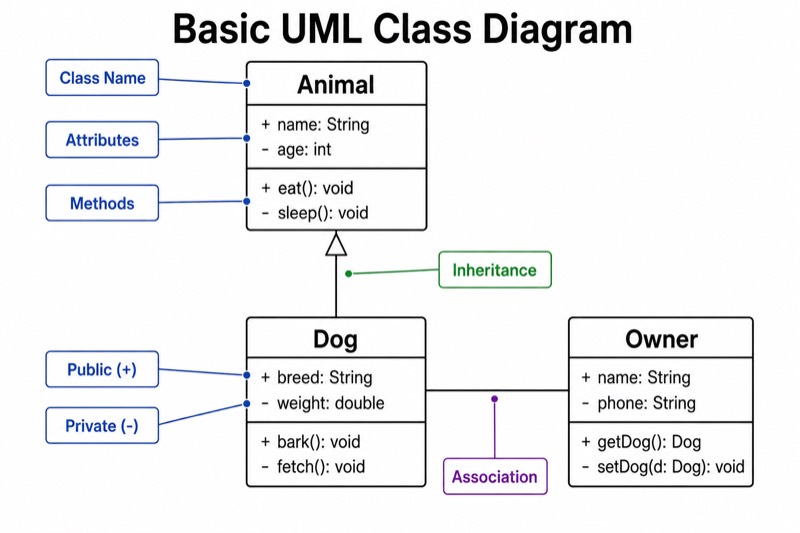
Detailed UML Class Diagram (University Level) — an alternative version of the UML Class Diagram, generated by AI and fully editable. Download the PNG for quizzes, homework or slides.
Labels included in this diagram
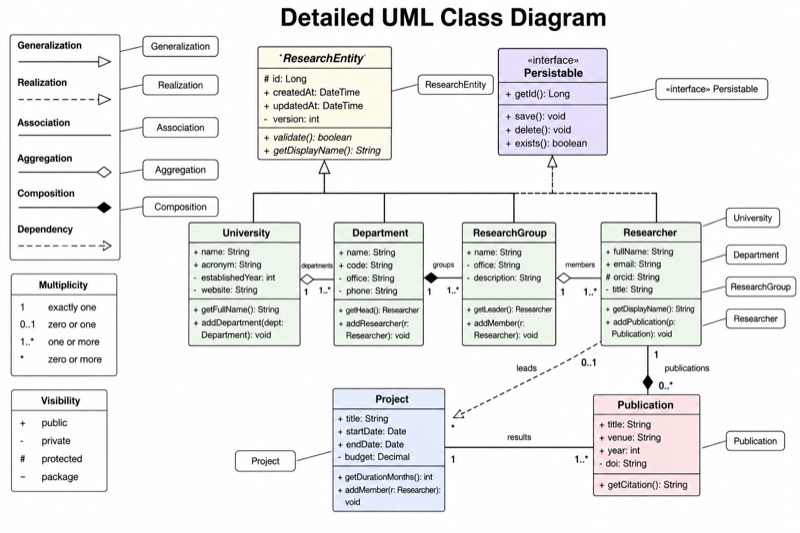
- ResearchEntity
- «interface» Persistable
- University
- Department
- ResearchGroup
- Researcher
- Project
- Publication
- Generalization
- Realization
- Association
- Aggregation
- Composition
- Dependency
✓ Accurate labels ✓ Edit text after generation ✓ PNG for papers, posters & slides
 OUTPUT · 16:9 · PNG
What this diagram shows
This Detailed UML Class Diagram (University Level) expands the standard three-class overview into a research-oriented model with at least six classifiers and more than twelve labeled structures. In addition to compartmented class boxes, attributes, and operations, it includes an italicized abstract class, an «interface» stereotype, inheritance, interface realization, association, aggregation, composition, and dependency. Multiplicities such as 1, 0..1, 1..*, and * appear beside association ends, while role names clarify participation. Underlined static members and the visibility symbols +, -, #, and ~ add notation that the standard main diagram intentionally omits.
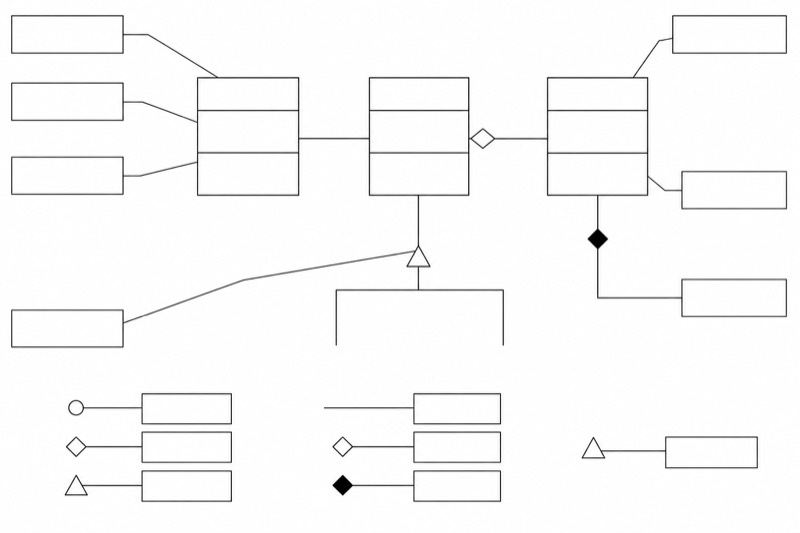
Read each classifier from top to bottom: name, attributes, then operations. Next, trace solid and dashed connectors by arrowhead or diamond type before interpreting multiplicities and role names at their ends. The hollow triangle marks generalization, a dashed line with a hollow triangle marks realization, and an open arrow on a dashed line marks dependency; hollow and filled diamonds distinguish aggregation from composition. Unlike the standard main diagram, this version supports notation analysis rather than quick recognition. Use it when learners must justify ownership, substitutability, lifecycle dependence, access control, or cardinality in a formally specified software model.
Teaching tips
- In-class quiz: hide the relationship labels and ask students to identify generalization, realization, dependency, association, aggregation, and composition from line and endpoint notation, then explain the semantic difference between each pair.
- Homework assignment: require students to reproduce the model, add one valid subclass and one interface implementation, and justify every multiplicity, role name, visibility marker, and ownership diamond in a short design rationale.
- Lecture slides: present the standard main diagram first for basic orientation, then use this detailed version to introduce abstract classifiers, interfaces, static members, package visibility, navigability, and lifecycle semantics without overcrowding the introductory slide.
- Revision outline or printed handout: use the labeled structures as a notation checklist, asking learners to annotate what 1, 0..1, 1..*, and * permit and to compare shared aggregation with strong composition.
- Thesis or research-paper figure: adapt the rigorous layout when a conceptual or software architecture model needs precise classifier responsibilities and relationships. Define project-specific stereotypes in the caption and preserve readable, noncrossing connectors for print.
FAQ about this diagram
Why use this university-level variant instead of the standard UML class diagram?
The standard main diagram is better for introducing class compartments and a few common relationships. This variant is necessary when assessment or research writing requires precise treatment of abstraction, interfaces, visibility, multiplicity, roles, static members, realization, dependency, and object lifecycle.
Does a filled diamond simply mean a stronger form of aggregation?
A filled diamond denotes composition: the whole has strong ownership, and the part normally belongs to at most one composite and shares its lifecycle. A hollow diamond denotes shared aggregation, although many formal models prefer a plain association unless meaningful whole–part semantics must be stated.