Simple Plant Cell Diagram for Middle School
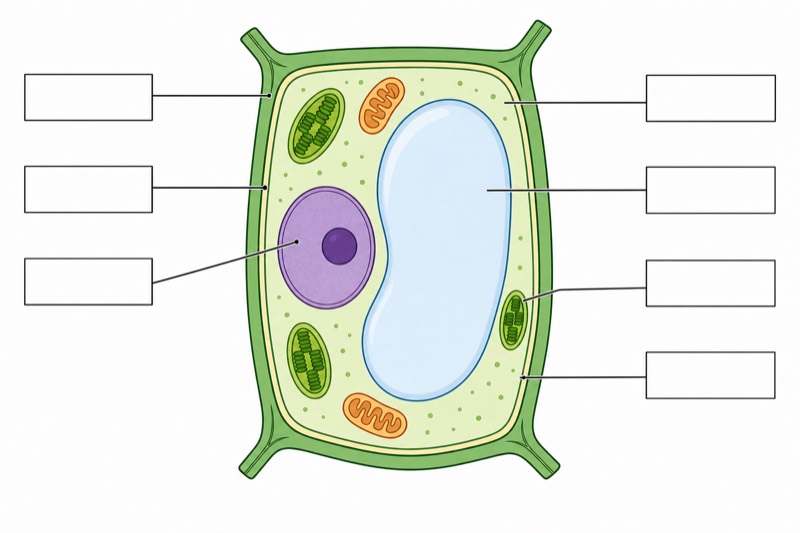
Simple Plant Cell Diagram for Middle School — an alternative version of the Plant Cell Structure Diagram, generated by AI and fully editable. Download the PNG for quizzes, homework or slides.
Labels included in this diagram
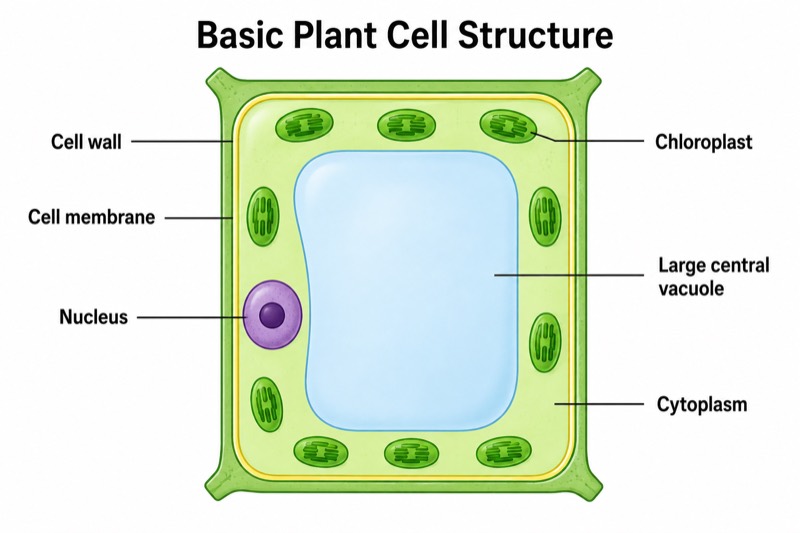
- Cell wall
- Cell membrane
- Nucleus
- Chloroplast
- Large central vacuole
- Cytoplasm
✓ Accurate labels ✓ Edit text after generation ✓ PNG for papers, posters & slides
 OUTPUT · 16:9 · PNG
What this diagram shows
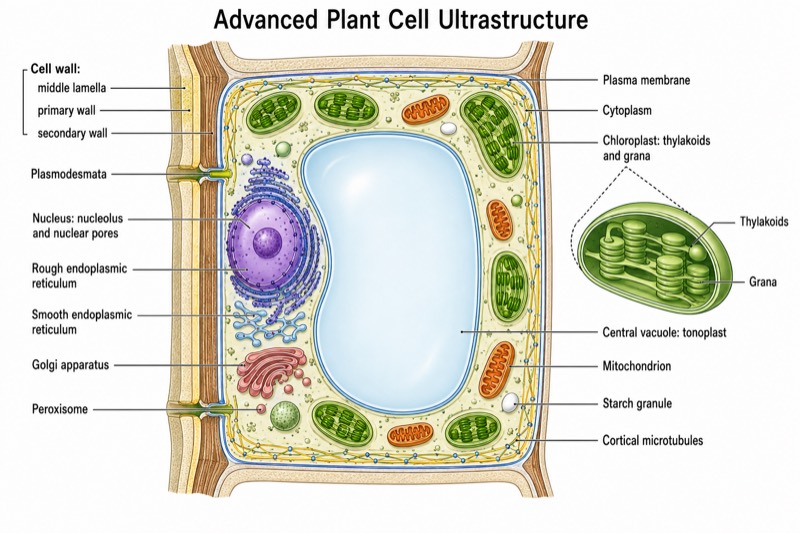
This simple plant cell diagram for middle school shows only six essential structures: the cell wall, cell membrane, nucleus, chloroplasts, large vacuole, and cytoplasm. Unlike a standard plant cell diagram, it leaves out mitochondria, ribosomes, endoplasmic reticulum, Golgi apparatus, and other advanced details. The cell has a clear rectangular outline, bright colors, large labels, balanced spacing, and plenty of blank space. This reduced version is useful because younger learners can focus on the structures that most clearly distinguish a plant cell without being distracted by organelles they have not yet studied.
Read the diagram from the outside inward. The cell wall forms the firm outer boundary, while the cell membrane lies just inside it and controls movement into and out of the cell. Cytoplasm fills the cell, the large vacuole occupies much of the interior, the nucleus contains genetic material, and chloroplasts carry out photosynthesis. Teachers can ask students to identify each structure, match it to its function, or cover the labels for recall practice. Compared with the standard main diagram, this version reduces visual and vocabulary demands, making first instruction and rapid review more effective.
Teaching tips
- In-class quizzes: remove or cover the six labels and ask students to name each structure, then add one basic function beside it.
- Homework: have students copy the simplified diagram, color-code the structures, and write a one-sentence explanation of the cell wall, chloroplasts, and large vacuole.
- Presentation slides: display the uncluttered figure during an introductory lesson and reveal one large label at a time while explaining how plant cells differ from animal cells.
- Review outlines and printed handouts: place the diagram beside a six-row structure-and-function table so students can connect spatial position with biological role before a test.
- School reports or paper illustrations: use the simplified figure when the text discusses only basic plant cell organization; choose a standard detailed diagram instead if advanced organelles are part of the discussion.
FAQ about this diagram
Why does this diagram omit organelles found in a standard plant cell diagram?
The omission is intentional: this version introduces only the six structures most important for basic plant cell recognition. A standard diagram is better for later units on cellular respiration, protein synthesis, transport, and organelle interactions.
Is the rectangular shape an exact representation of every plant cell?
No. Plant cells vary in shape, but a rectangular outline clearly emphasizes the rigid cell wall and makes the basic parts easier to locate. It is a teaching simplification rather than a claim that all plant cells have identical geometry.