Detailed Mitosis Diagram (University Level)
Detailed Mitosis Diagram (University Level) — an alternative version of the Stages of Mitosis, generated by AI and fully editable. Download the PNG for quizzes, homework or slides.
Labels included in this diagram
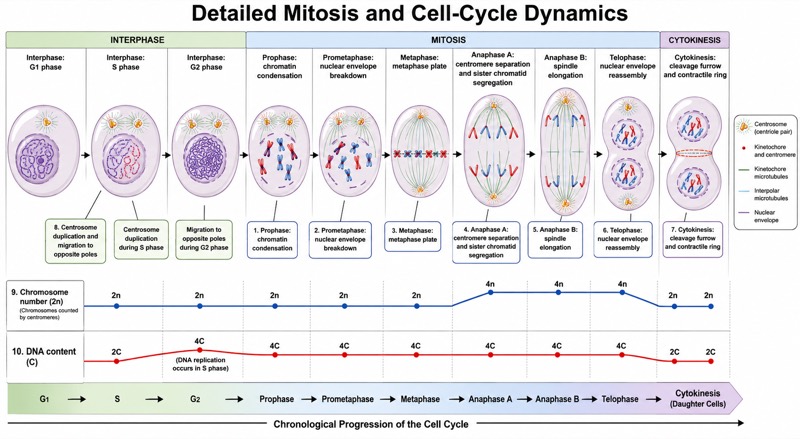
- Interphase: G1, S, and G2 phases
- Prophase: chromatin condensation
- Prometaphase: nuclear envelope breakdown
- Metaphase: metaphase plate
- Anaphase A: centromere separation and sister chromatid segregation
- Anaphase B: spindle elongation
- Telophase: nuclear envelope reassembly
- Cytokinesis: cleavage furrow and contractile ring
- Centrosome duplication and migration to opposite poles
- Kinetochore and centromere
- Kinetochore microtubules
- Interpolar microtubules
- Chromosome number (2n)
- DNA content (C)
✓ Accurate labels ✓ Edit text after generation ✓ PNG for papers, posters & slides
 OUTPUT · 16:9 · PNG
What this diagram shows
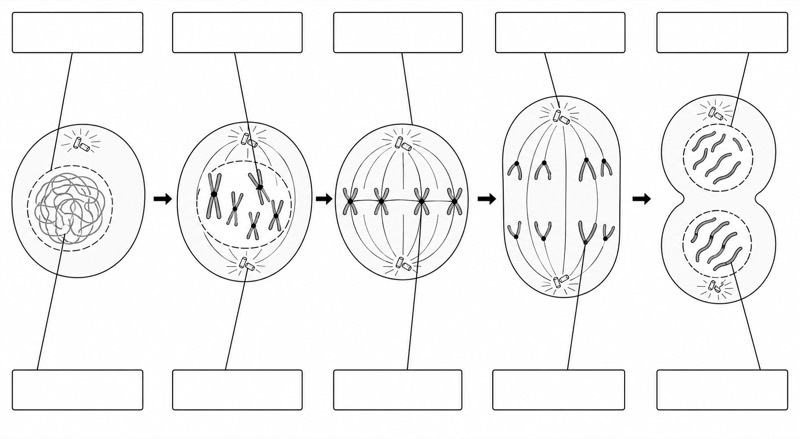
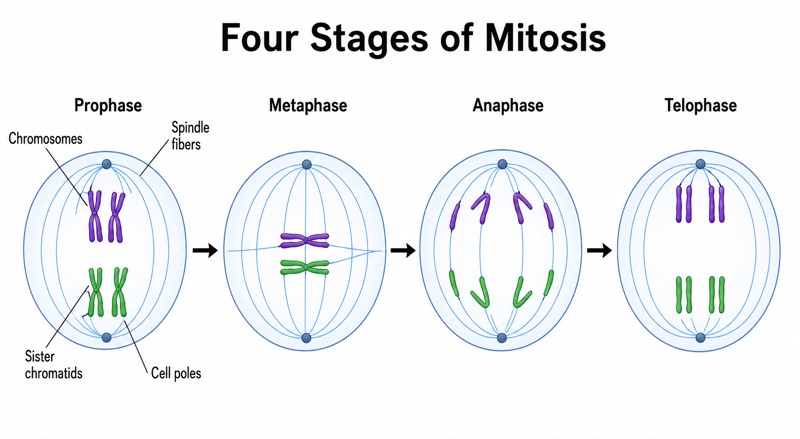
This detailed mitosis diagram (university level) expands the standard five-stage overview into G1, S, G2, prophase, prometaphase, metaphase, anaphase A, anaphase B, telophase, and cytokinesis. Unlike the standard main diagram, it identifies more than twelve structures and events, including chromatin, chromosomes, sister chromatids, centromeres, kinetochores, centrosomes, spindle poles, kinetochore microtubules, polar microtubules, the metaphase plate, nuclear envelope, cleavage furrow, and contractile ring. Use this version when students must connect visible cell morphology with molecular mechanisms rather than simply memorize stage names.
Read the sequence from G1 to cytokinesis while comparing chromosome form, spindle organization, centrosome position, kinetochore attachment, and nuclear-envelope status. Then follow the lower curves: a diploid cell is 2n, 2C in G1; DNA replication produces 2n, 4C by G2; centromere separation temporarily gives one anaphase cell 4n, 4C; each daughter cell finishes at 2n, 2C. This differs from the standard diagram by distinguishing chromosome number from DNA content, making it appropriate for interpreting experiments, solving quantitative questions, and explaining segregation errors.
Teaching tips
- In-class quiz: remove selected labels and ask students to identify prometaphase, the metaphase plate, kinetochores, kinetochore microtubules, and the contractile ring from structural evidence rather than stage order alone.
- Homework: have students annotate when centrosomes duplicate, the nuclear envelope disassembles and reforms, sister chromatids separate, and anaphase A transitions to anaphase B; require a brief mechanism for each event.
- Lecture slides: reveal the stages sequentially to contrast the simpler five-stage main figure with this research-oriented version, especially the distinction between chromosome movement toward poles and spindle-pole separation.
- Revision outline or printed handout: pair each stage with chromosome number, DNA content, spindle status, and nuclear-envelope status, then use the completed table to check common 2n/4C misconceptions.
- Paper, laboratory report, or thesis illustration: use the detailed layout as a conceptual reference when describing mitotic phenotypes, spindle defects, delayed chromosome congression, abnormal kinetochore attachment, or failed cytokinesis.
FAQ about this diagram
Why does this version separate prophase from prometaphase and anaphase A from anaphase B?
The standard main diagram combines events that are mechanistically distinct. Prometaphase begins with nuclear-envelope breakdown and spindle access to kinetochores; anaphase A shortens kinetochore microtubules to move chromosomes poleward, whereas anaphase B increases the distance between spindle poles.
Does chromosome number double during DNA replication or during anaphase?
DNA replication doubles DNA content from 2C to 4C without changing chromosome number because joined sister chromatids are counted as one chromosome. Chromosome number doubles transiently when centromeres separate at anaphase, but cytokinesis partitions the chromosomes so that each daughter cell returns to 2n, 2C.